Temperature18 – 22 °C
GoldfishConservation status: Least concern LC
Other scientific names: Carasius auratus, Carassius buergeri, Carassius burgeri, Carassius carassius, Carassius chinensis, Carassius coeruleus
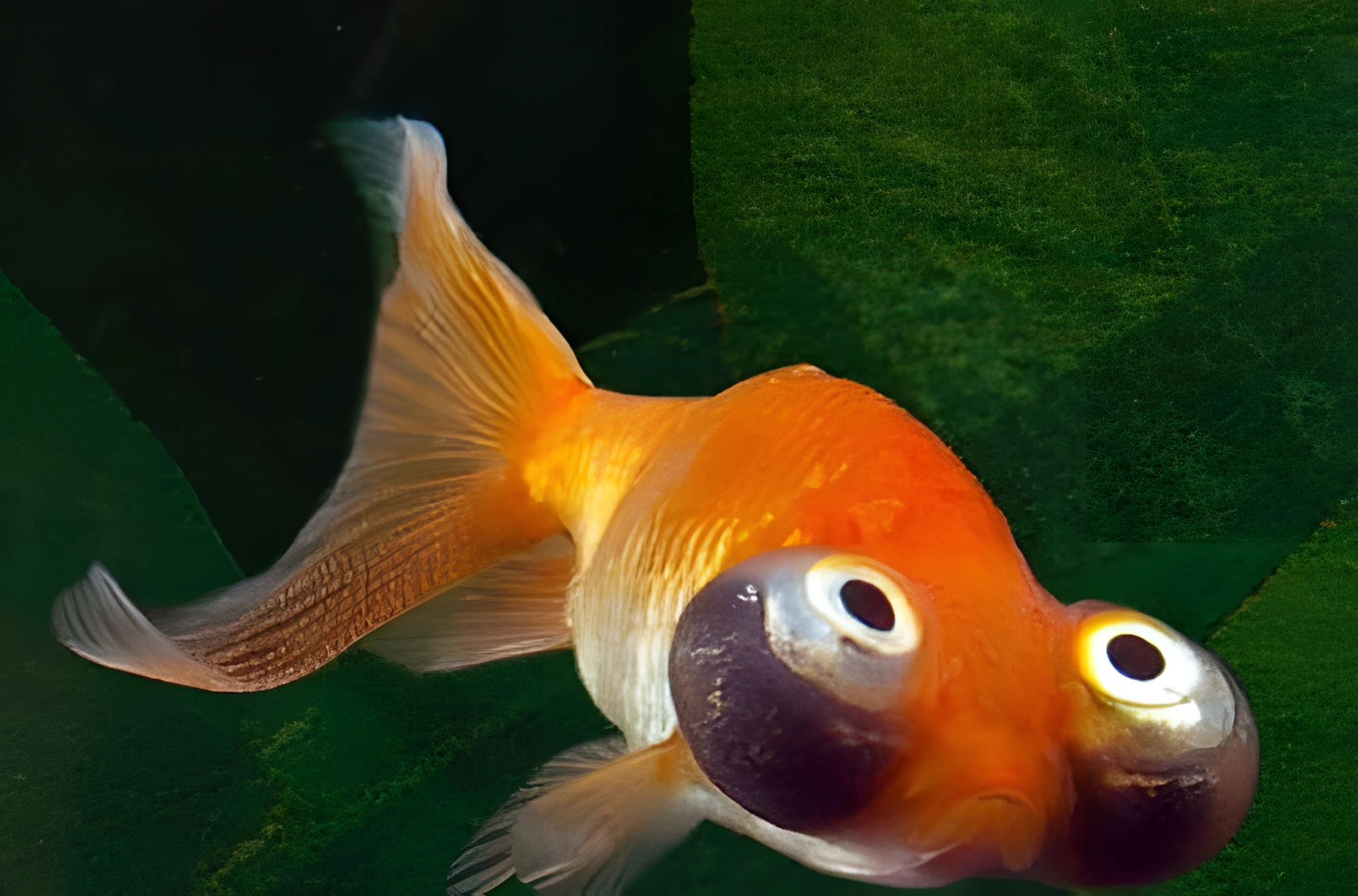
The Celestial, or Stargazer, is a unique variety of goldfish characterized by an unusual eye structure. The eyes of this fish protrude significantly from the sides of the head and are always directed upwards. The creation of this breed occurred in several stages: by the end of the 19th century in China, a goldfish with protruding eyes, known as the Telescope, was bred. In the early 20th century, selective breeding continued in Japan, where, through targeted selection, the modern upward-gazing eye position of the Celestial was achieved.
- Required aquarium volume
- 40 L
- Size in aquarium
- 10 – 13 cm
- Temperature
- 18 – 22 °C
- Temperament
- Peaceful (regular)
Parameters
Water pHSlightly acidic (6) – Slightly alkaline (8)
Water dHSoft (5) – Very hard (19)
Water salinityno salt (freshwater)
Size in aquarium10 – 13 cm
Lifespan15 years
TemperamentPeaceful (regular)
Toward small fishnot a predator
Required aquarium volume40 L
Lightingmoderate (regular)
Substrateany (no restrictions)
Water flownone or stagnant (no flow)
FeedingAny (universal)
CareMixed (solitary / pair / group)
Description
The Celestial is a selectively bred, short-bodied form of goldfish with characteristic telescopic eyes, the pupils of which are directed strictly vertically upwards. The body is egg-shaped, the dorsal fin is completely absent, and the caudal and anal fins are bifurcated. Fish reach a length of 10–15 cm. The coloration is most often orange-gold; white, red-and-white, and variegated variations are also found. Sexual dimorphism is weakly expressed, becoming noticeable only during the spawning period, when males develop a characteristic rash on their gill covers, and females' abdomens become noticeably rounded.
Habitat
This species does not occur in nature, as it is an artificially bred variety of goldfish (Carassius auratus). All modern forms originate from the silver crucian carp, which inhabits stagnant or slow-moving waters of Asia. The selective breeding of Celestials was carried out in China and Japan over many centuries, initially under conditions of limited lighting, which contributed to the fixation of the eye mutation.
Behavior and Compatibility
A peaceful, slow-moving, and rather vulnerable fish. Due to its specific eye structure and the absence of a dorsal fin, it has limited vision and low swimming speed. Intraspecific compatibility is high, however, when kept with active or aggressive fish, Celestials may experience stress and remain hungry due to competition for food. It is recommended to keep them in a species tank or with other slow-moving, short-bodied goldfish varieties.
Care and Maintenance
For a pair of individuals, an aquarium of at least 100 liters is required, with effective filtration and aeration, as the fish are sensitive to water quality. Optimal parameters: temperature 18–22°C, pH 6.0–8.0, hardness 5–19 dGH. The substrate should be soft, without sharp edges, so that the fish do not injure their eyes when searching for food. Decorations and plants should be chosen without sharp corners; hard-leaved species with a strong root system are preferable, as the fish tend to dig up the substrate.
Diet
An omnivorous species with a predominance of plant matter in its diet. It is recommended to use high-quality specialized goldfish foods, supplementing them with vegetable additives such as blanched lettuce or spinach. Due to poor eyesight, the fish find food slowly, so food should be distributed over the surface or given in small portions so that it does not settle to the bottom. Feeding is carried out 1–2 times a day.
Breeding and Reproduction
Breeding is possible in a spawning tank when the fish reach an age of about one year. A rise in water temperature and the imitation of a spring period serve as a stimulus. During spawning, the male actively pursues the female; eggs are laid on fine-leaved plants. After the process is complete, the parents must be removed to prevent them from eating the eggs. Fry require careful care, regular water changes, and high-quality starter food.
Diseases
The species is prone to gastrointestinal diseases with improper feeding and bacterial infections with poor water quality. Due to the peculiarities of their eye structure, the fish are susceptible to injuries that can lead to infectious corneal lesions. Prevention includes maintaining cleanliness in the aquarium, using quality foods, and eliminating sharp objects in the decor.
How to choose
When purchasing, choose active individuals with clean fins and no damage to the body or eyes. It is important to ensure that the fish's eyes are symmetrical and directed strictly upwards, and that its behavior is not sluggish. Avoid individuals with signs of emaciation, film on the scales, or an unnaturally bloated abdomen. It is best to acquire fish from reputable breeders, as selective forms require strict adherence to keeping conditions from an early age.
Frequently asked questions
The essentials: size, tank volume, water parameters and care
How big does Celestial get?
An adult reaches 10–13 cm in length. Plan the tank around the maximum size: the fish quickly outgrows a cramped setup.
What size aquarium does Celestial need?
The minimum recommended volume is 40 L. A smaller tank speeds up nitrate build-up and raises stress levels.
What water parameters does Celestial need?
Temperature 18–22 °C, pH 6–8, hardness 5–19 dGH. Stability matters more than exact values: sudden swings are harder on the fish than a small deviation from the ideal.
How long does Celestial live?
Around 15 years when kept properly. Lifespan depends directly on tank volume, water quality and a varied diet.
Is Celestial aggressive?
Temperament: peaceful (regular). Keep this in mind when choosing tank mates.
How many Celestial should be kept together?
Recommended setup: mixed (solitary / pair / group). Ignoring this is a common cause of stress and disease.
What does Celestial eat?
Diet type: any (universal). Feed small portions that are finished within a couple of minutes — overfeeding does more harm than underfeeding.
What is the scientific name of Celestial?
The scientific name of the species is Carassius auratus, family Cyprinids (Cyprinidae). It also appears in the literature as: Carasius auratus, Carassius buergeri, Carassius burgeri.