Temperature22 – 28 °C
Natural range
- French Guiana area
CatfishConservation status: Least concern LC
Other scientific names: Bagrus piramuta, Bagrus reticulatus, Brachyplatystoma parnahybae, Brachyplatystoma vaillante, Piramutana piramuta, Platystoma vaillantii
The large predatory fish known as the Lau-Lau Catfish, or Brachyplatystoma vaillantii, belongs to the family Pimelodidae, also known as the Pimelodids or flat-headed catfishes. It is virtually impossible to encounter it in amateur aquaristics, which is explained by the significant costs associated with its keeping.
- Required aquarium volume
- 1500 L
- Size in aquarium
- 80 – 150 cm
- Temperature
- 22 – 28 °C
- Temperament
- Semi-peaceful (including aggression during spawning / intraspecific conflicts)
Parameters
Water pHSlightly acidic (6) – Slightly alkaline (8)
Water dHVery soft (1) – Very hard (21)
Water salinityno salt (freshwater)
Size in aquarium80 – 150 cm
Lifespan15 years
TemperamentSemi-peaceful (including aggression during spawning / intraspecific conflicts)
Toward small fishnot a predator
Required aquarium volume1500 L
Lightingdimmed
Substratecoarse sand / gravel / pebbles
Water flowany
FeedingMeat / protein (live, frozen, fresh)
CareBoth solitary and in group (flexible)
Description
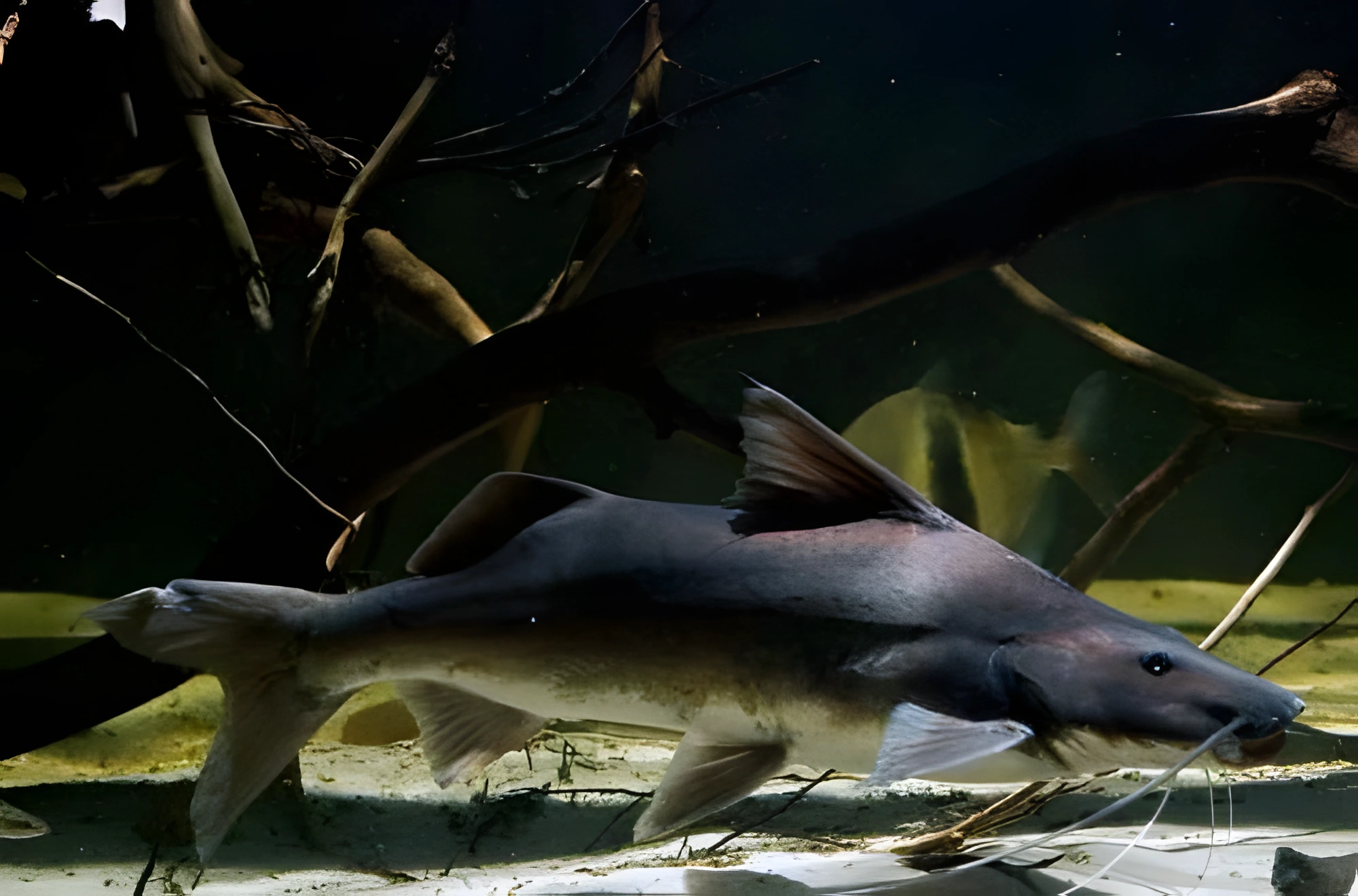
Adults of this fish can reach approximately one meter in length. The coloration of the Lau-Lau Catfish varies from dark gray on the upper part of the body to light on the lower part. Its caudal fin is deeply forked, with slender lobes of almost equal length. The fish has long barbels on its head, which help it navigate and find food in the low-light conditions of the underwater world.
Habitat
Initially, this catfish species was considered endemic to the river systems of French Guiana, from where it originates in South America. However, it was later discovered that its range is much wider: Brachyplatystoma vaillantii inhabits almost all major river basins, including giants like the Amazon and Orinoco. These fish prefer deep-water sections of the main river channels, less frequently found in tributaries, and primarily stay in the bottom layer.
Behavior and Compatibility
Despite its impressive size and carnivorous diet, this catfish exhibits a rather peaceful disposition. It coexists successfully with other fish of comparable size. However, it should be remembered that any fish small enough to fit into its mouth will undoubtedly be eaten.
Care and Maintenance
Keeping the Lau-Lau Catfish requires very large aquariums, with a volume of at least 1500 L. Maintaining high water quality in such large systems is a challenging task, especially without the use of automated processes. For example, weekly replacement of hundreds of liters of water with fresh water without a proper drain and supply system would be an extremely laborious undertaking. The installation and subsequent maintenance of such aquariums, whose total mass along with equipment and decor can reach several tons, are associated with a number of significant costs. This includes not only construction work and the laying of utility lines but also requires substantial financial investment and time. Based on all of the above, it can be confidently stated that the Lau-Lau Catfish is not classified as a fish for amateur aquaristics. It is mainly acquired by wealthy enthusiasts, or it becomes an inhabitant of large public aquariums.
Diet
In its natural environment, this catfish actively preys on other fish and does not disdain carrion. In captivity, the Lau-Lau Catfish easily adapts to a varied diet. Its food can consist of specialized commercial products, as well as food prepared independently from shrimp, mussels, squid, and white fish. Feeding is usually done once a week, but the portion should be quite substantial.
Breeding and Reproduction
In its natural habitat, the reproductive cycle of this catfish species is closely linked to prolonged migrations. Adult sexually mature individuals travel upstream to spawn. Subsequently, the fry and young fish return to the estuary. The total length of such a journey can exceed 3500 kilometers. Recreating such conditions in an artificial environment is completely impossible, therefore, the Lau-Lau Catfish does not breed in aquariums. Only wild-caught specimens are available for sale.
Diseases
Most health problems in fish often arise from unsuitable keeping conditions. Maintaining a stable and comfortable habitat is a key factor for successful keeping. If symptoms of illness appear, the first step is to check the water quality. If deviations are found, it is important to take immediate measures to eliminate them. If the symptoms do not disappear or worsen, medicinal treatment may be required. More detailed information on symptoms and treatment methods can be found in the "Diseases of Aquarium Fish" section.
How to choose
The acquisition of this catfish species requires exceptional caution, as the fish belongs to the category of large predators intended for keeping in public aquariums or specialized private systems with a volume of 1500 L or more. In retail, specimens are often presented as young individuals, which conceals their potential size of up to 150 cm. When inspecting in a store, pay attention to the following signs: the fish's activity in the bottom layer, absence of visible skin damage, integrity of fins and barbels, and absence of signs of emaciation. Avoid purchasing individuals with signs of apathy or an unnaturally bloated abdomen, as this may indicate internal parasites or metabolic disorders.
Frequently asked questions
The essentials: size, tank volume, water parameters and care
How big does Lau-Lau Catfish get?
An adult reaches 80–150 cm in length. Plan the tank around the maximum size: the fish quickly outgrows a cramped setup.
What size aquarium does Lau-Lau Catfish need?
The minimum recommended volume is 1500 L. A smaller tank speeds up nitrate build-up and raises stress levels.
What water parameters does Lau-Lau Catfish need?
Temperature 22–28 °C, pH 6–8, hardness 1–21 dGH. Stability matters more than exact values: sudden swings are harder on the fish than a small deviation from the ideal.
How long does Lau-Lau Catfish live?
Around 15 years when kept properly. Lifespan depends directly on tank volume, water quality and a varied diet.
Is Lau-Lau Catfish aggressive?
Temperament: semi-peaceful (including aggression during spawning / intraspecific conflicts). Keep this in mind when choosing tank mates.
How many Lau-Lau Catfish should be kept together?
Recommended setup: both solitary and in group (flexible). Ignoring this is a common cause of stress and disease.
What does Lau-Lau Catfish eat?
Diet type: meat / protein (live, frozen, fresh). Feed small portions that are finished within a couple of minutes — overfeeding does more harm than underfeeding.
What is the scientific name of Lau-Lau Catfish?
The scientific name of the species is Brachyplatystoma vaillantii, family Pimelodidae (Long-whiskered Catfishes). It also appears in the literature as: Bagrus piramuta, Bagrus reticulatus, Brachyplatystoma parnahybae.