Temperature22 – 26 °C
Natural range
- Costa Rica area
- Eastern Highlands area
LivebearersConservation status: Vulnerable VU
Other scientific names: Brachyrhaphis umbratilis, Gambusia umbratilis, Neoheterandria umbratilis, Poeciliopsis maculifer
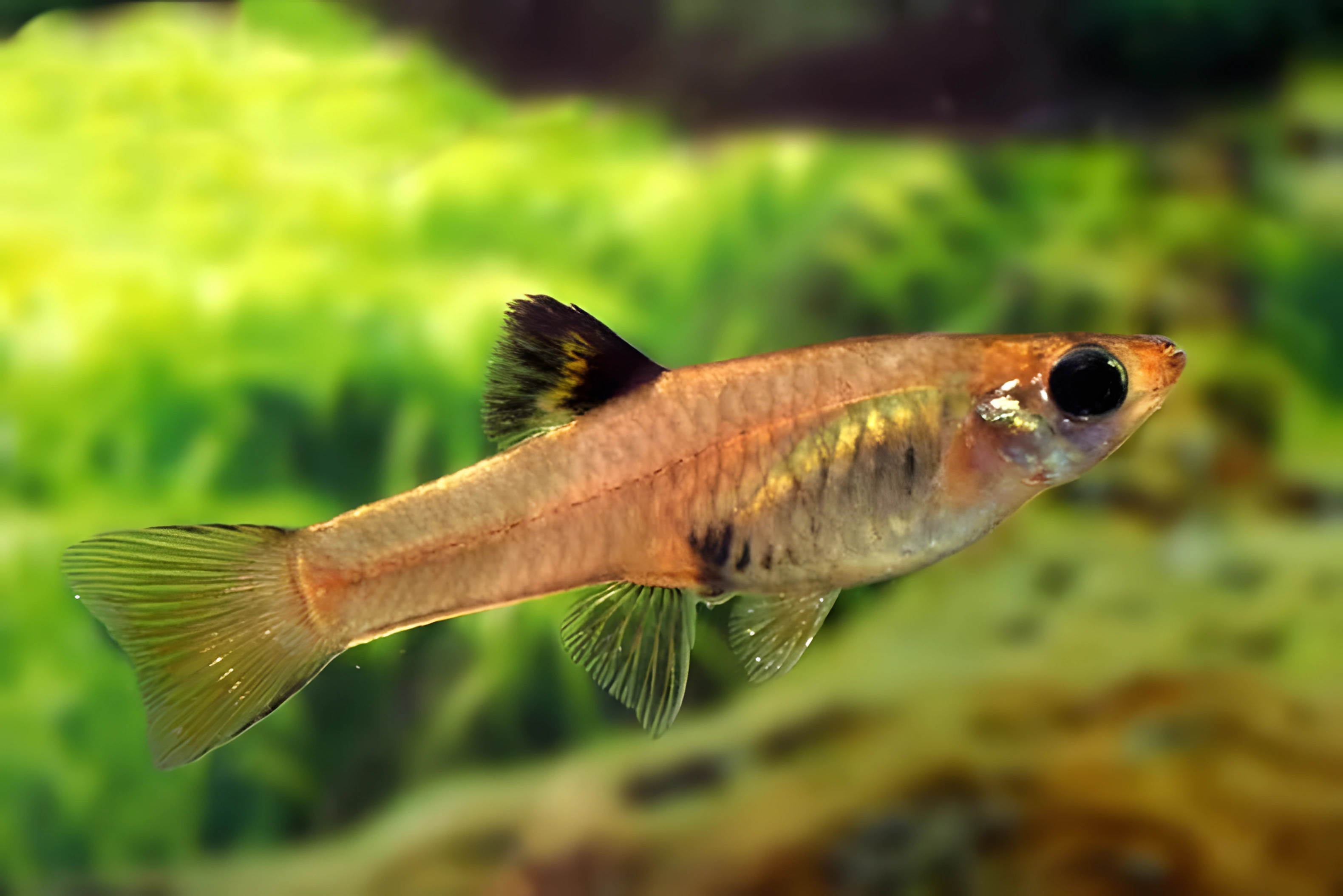
Xenophallus umbratilis, also known as the Golden Teddy, is a species belonging to the family Poeciliidae. This fish boasts an attractive and intense coloration. However, keeping it in an aquarium involves a number of difficulties, mainly related to the need for constant maintenance of high water quality, which makes it not the best choice for those just starting out in aquaristics.
- Required aquarium volume
- 80 L
- Size in aquarium
- 4 – 6 cm
- Temperature
- 22 – 26 °C
- Temperament
- Peaceful (regular)
Parameters
Water pHNeutral (7) – Neutral (7.5)
Water dHVery soft (2) – Hard (12)
Water salinityno salt (freshwater)
Size in aquarium4 – 6 cm
Lifespan3 years
TemperamentPeaceful (regular)
Toward small fishnot a predator
Required aquarium volume80 L
Lightingdimmed
Substrateany (no restrictions)
Water flownone or stagnant (no flow)
FeedingAny (universal)
CareSmall group (3–4 individuals)
Description
A distinctive feature of this fish is its bright yellow or golden coloration. Its body is semi-transparent, allowing a clear view of the spine. The dorsal fin is black, while the other fins remain colorless. Males typically reach 4 cm in length and have a more slender build compared to females, which grow up to 6 cm. Males also possess a modified anal fin known as a gonopodium.
Habitat
The natural habitat of this species is in Central America, on the eastern plateaus of Costa Rica. These fish prefer to live in calm backwaters of rivers and lakes, finding refuge near the banks among dense thickets of aquatic vegetation.
Behavior and Compatibility
This fish exhibits active and friendly behavior, but thrives best in a group. When kept in isolation, they can become timid. Good tankmates for them would be other peaceful freshwater species of similar size.
Care and Maintenance
The Golden Teddy is an active fish that is comfortable in the company of its kin. Despite its modest size, it requires a fairly spacious aquarium, with a volume of at least 80 liters. It is recommended to heavily decorate the aquarium with both rooted and floating plants; the latter will create necessary shaded areas. Avoid overly bright lighting, as fish tend to lose the intensity of their coloration under such conditions. It is a common belief that livebearing species are hardy. However, the Golden Teddy is an exception to this rule. It is very demanding regarding the hydrochemical composition of the water. The fish tolerates pH fluctuations from neutral values poorly and is particularly sensitive to the accumulation of organic waste products. The optimal temperature range for keeping them is narrow, at 22–26 degrees Celsius.
Diet
In their natural habitat, Golden Teddies feed on various small invertebrates, and also include plant matter and algae in their diet. In a home aquarium, they adapt without problems to most popular commercial foods. However, it is desirable that the offered diet includes components of plant origin. Aqvium flake food for aquarium fish Check out our new product, a bestseller on Ozon with a rating of 4.9. Flake food is suitable for most aquarium fish. The raw material is manufactured according to new European Union standards (EU 2018/848). Contains vitamins A, C, D3, E and Omega 3-6 Buy on Ozon
Breeding and Reproduction
Sexual maturity in these fish is reached at 3–4 months, after which they begin to actively reproduce. Under favorable conditions, the incubation period for the eggs is about 28 days, after which 15 to 20 fully formed fry are born. Although parental instincts in the Golden Teddy are weakly expressed, they nevertheless do not show a tendency towards cannibalism towards their offspring. In an aquarium specifically designed for this species, with dense thickets of fine-leaved plants, the young can develop quite successfully alongside adult individuals.
Diseases
The main cause of most diseases in aquarium fish often lies in unfavorable keeping conditions. For a fish as undemanding as the Golden Teddy, the appearance of any signs of illness likely indicates a significant deterioration in the habitat. Often, restoring optimal keeping conditions contributes to natural recovery. However, if symptoms persist, medicinal treatment may be required. More detailed information on disease signs and available treatment methods is presented in the section "Diseases of Aquarium Fish."
How to choose
When acquiring Xenophallus umbratilis, one should choose individuals with clean skin without plaque, spots, or fin damage. The fish should be active, mobile, and react to a person's approach, rather than hiding in the corners of the aquarium. Avoid purchasing specimens with signs of emaciation, sunken bellies, or apathetic behavior, as this species is sensitive to transport conditions and water quality. In the store, it is advisable to inquire whether the fish were kept in conditions close to those recommended and how long ago they were imported. Since the species is not frequently available for sale, it is recommended to purchase a group of 3–4 individuals for successful adaptation in a new aquarium.
Frequently asked questions
The essentials: size, tank volume, water parameters and care
How big does Golden Teddy get?
An adult reaches 4–6 cm in length. Plan the tank around the maximum size: the fish quickly outgrows a cramped setup.
What size aquarium does Golden Teddy need?
The minimum recommended volume is 80 L. A smaller tank speeds up nitrate build-up and raises stress levels.
What water parameters does Golden Teddy need?
Temperature 22–26 °C, pH 7–7.5, hardness 2–12 dGH. Stability matters more than exact values: sudden swings are harder on the fish than a small deviation from the ideal.
How long does Golden Teddy live?
Around 3 years when kept properly. Lifespan depends directly on tank volume, water quality and a varied diet.
Is Golden Teddy aggressive?
Temperament: peaceful (regular). Keep this in mind when choosing tank mates.
How many Golden Teddy should be kept together?
Recommended setup: small group (3–4 individuals). Ignoring this is a common cause of stress and disease.
What does Golden Teddy eat?
Diet type: any (universal). Feed small portions that are finished within a couple of minutes — overfeeding does more harm than underfeeding.
What is the scientific name of Golden Teddy?
The scientific name of the species is Xenophallus umbratilis, family Poeciliidae. It also appears in the literature as: Brachyrhaphis umbratilis, Gambusia umbratilis, Neoheterandria umbratilis.