Temperature19 – 24 °C
Natural range
- Upper Uruguay River Basin
- Brazil area
- Argentina area
- Uruguay area
CatfishConservation status: Least concern LC
Other scientific names: Plecostomus luteus
The Golden Pleco, scientifically known as Hypostomus luteus, belongs to the family Loricariidae, also called Armored Catfishes. The natural habitat of this catfish is the waters of the South American continent. It can be found in the upper reaches of the Uruguay River, in the southern Brazilian states.
- Required aquarium volume
- 250 L
- Size in aquarium
- 40 cm
- Temperature
- 19 – 24 °C
- Temperament
- Semi-peaceful (including aggression during spawning / intraspecific conflicts)
Parameters
Water pHSlightly acidic (6) – Neutral (7.5)
Water dHSoft (5) – Hard (15)
Water salinityno salt (freshwater)
Size in aquarium40 cm
Lifespan12 years
TemperamentSemi-peaceful (including aggression during spawning / intraspecific conflicts)
Toward small fishnot a predator
Required aquarium volume250 L
Lightingmoderate (regular)
Substraterocky (rock formations, boulders, etc.)
Water flowweak or moderate
FeedingPlant-based (algae, vegetables)
CareBoth solitary and in group (flexible)
Description
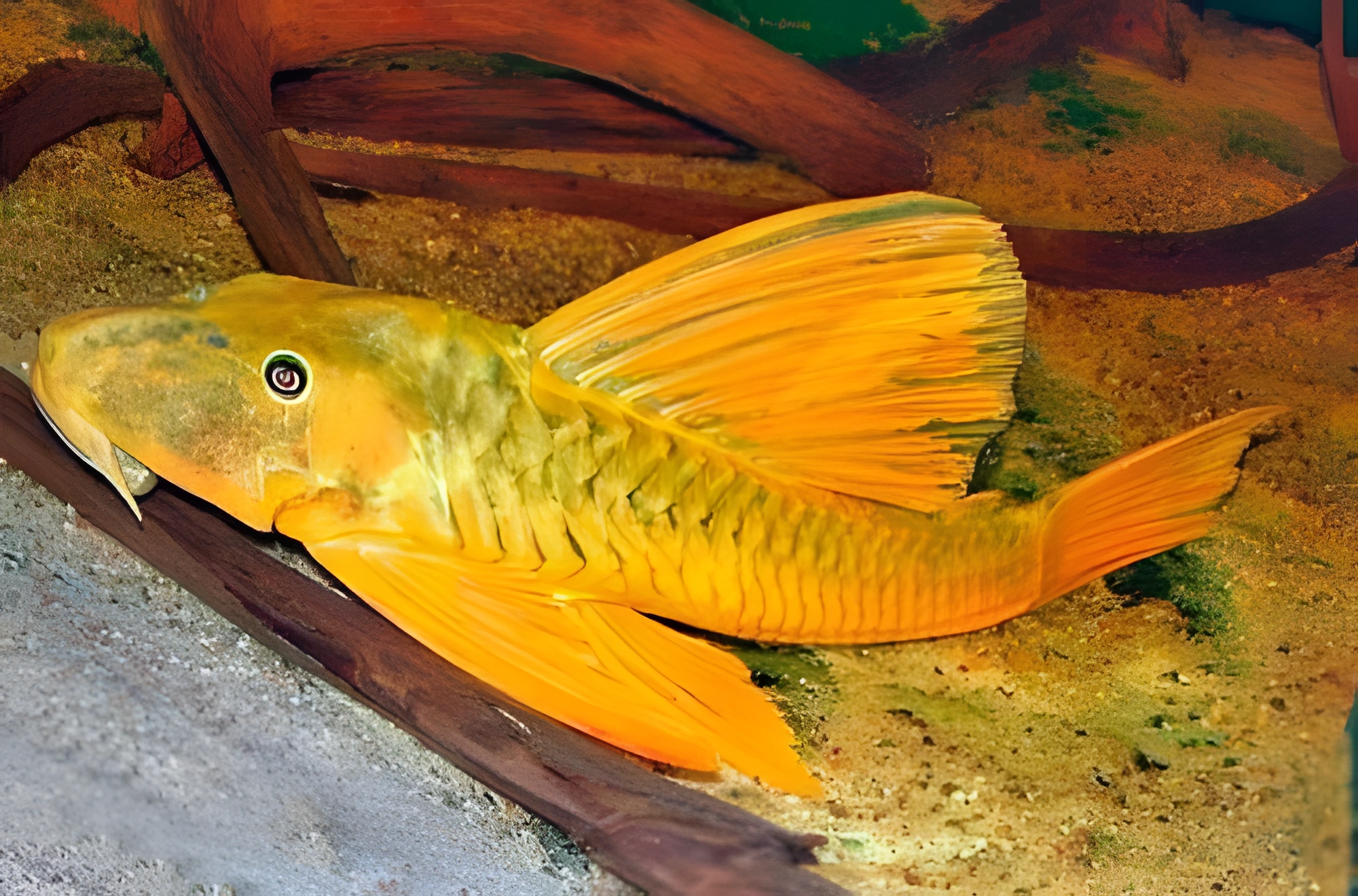
Adult fish of this species grow up to 40 cm in length. Their body is massive and covered with armor made of hard bone plates. The head is large, with eyes located on the top, and a mouth shifted to the underside. This body structure, characteristic of all Plecos, allows the catfish to simultaneously search for danger and feed, collecting food particles from the bottom. The wide fins are equipped with sharp spines, which are modified first rays. The coloration changes with age. Young individuals are black with a pattern of yellow specks and yellow fins. As they mature, the speckle pattern disappears, the black coloration gradually fades, and lighter tones begin to show through. In the final stage of development, the catfish acquires a uniform golden hue.
Habitat
The species inhabits South America, primarily in the upper basin of the Uruguay River in Brazil, Argentina, and Uruguay. It populates sections of rivers with moderate or fast currents. In its natural environment, it prefers the bottom layers of water, where it stays among submerged trees, snags, and rocky substrate.
Behavior and Compatibility
Adults are distinctly territorial, so the best solution is to keep them individually. If you plan to keep several adult fish, each will need a sufficiently large space at the bottom of the aquarium. Young fish, on the other hand, are more peaceful and can successfully live in a group. This attitude towards personal boundaries applies not only to conspecifics but also to other bottom dwellers. Excellent compatibility is observed with species that prefer the middle and upper water layers.
Care and Maintenance
For the comfortable existence of one adult Gold Pleco, an aquarium of at least 250 liters is recommended. Gravel substrate is suitable as a bottom material, on which large stones and snags can be placed. Since these fish are herbivorous, the use of live aquatic plants in the aquarium's decor is impractical. Being inhabitants of flowing waters, Gold Plecos tolerate excessive accumulation of organic waste poorly, which they themselves produce in significant quantities. Therefore, it is extremely important to replace 30–40% of the water with fresh water weekly and to equip the aquarium with a powerful filtration system. Unlike most of their relatives living in tropical and subequatorial regions, this catfish is adapted to a cooler aquatic environment. The optimal temperature for it is within 19–24°C. It is important to provide these fish with a large amount of plant-based food. This can include specialized foods for herbivorous fish in the form of pellets, tablets, or gels, as well as fresh chopped vegetables and fruits, which should be secured to the bottom. The surfaces of snags create favorable conditions for the natural growth of algae, serving as an excellent additional food source.
Diet
A rich diet with a predominance of plant-based food is vital for this species. Catfish can be fed specialized products for herbivorous fish, available in the form of pellets, tablets, or gels. Fresh pieces of vegetables and fruits, which should be securely fastened to the bottom, will also be an excellent addition. Algae growth on snags, serving as a natural source of algae, is a valuable and constantly available source of additional nutrition.
Breeding and Reproduction
Based on available sources, a separate block cannot be compiled: the data is insufficient or contradictory. The entry can be updated later when verified information becomes available.
Diseases
No specific species-specific diseases have been described. Like other members of the family Loricariidae, the fish are sensitive to water quality and the accumulation of organic waste, which can lead to bacterial infections or fin damage. Prevention includes maintaining cleanliness in the aquarium, regular water changes, and ensuring effective filtration.
How to choose
When purchasing, choose active individuals with clean skin, free from visible ulcers, spots, or damage to the bony plates. It is important to assess the condition of the fins: they should not be clamped or show signs of erosion. Given that most specimens come from the wild, it is advisable to ask the seller about the fish's adaptation period in a quarantine tank and its diet.
Frequently asked questions
The essentials: size, tank volume, water parameters and care
How big does Golden Pleco get?
An adult reaches 40 cm in length. Plan the tank around the maximum size: the fish quickly outgrows a cramped setup.
What size aquarium does Golden Pleco need?
The minimum recommended volume is 250 L. A smaller tank speeds up nitrate build-up and raises stress levels.
What water parameters does Golden Pleco need?
Temperature 19–24 °C, pH 6–7.5, hardness 5–15 dGH. Stability matters more than exact values: sudden swings are harder on the fish than a small deviation from the ideal.
How long does Golden Pleco live?
Around 12 years when kept properly. Lifespan depends directly on tank volume, water quality and a varied diet.
Is Golden Pleco aggressive?
Temperament: semi-peaceful (including aggression during spawning / intraspecific conflicts). Keep this in mind when choosing tank mates.
How many Golden Pleco should be kept together?
Recommended setup: both solitary and in group (flexible). Ignoring this is a common cause of stress and disease.
What does Golden Pleco eat?
Diet type: plant-based (algae, vegetables). Feed small portions that are finished within a couple of minutes — overfeeding does more harm than underfeeding.
What is the scientific name of Golden Pleco?
The scientific name of the species is Hypostomus luteus, family Armored Catfishes (Loricariidae). It also appears in the literature as: Plecostomus luteus.