Temperature23 – 28 °C
Natural range
- Lake Malawi area
- East Africa area
Predators CichlidsConservation status: Least concern LC
Other scientific names: Cyrtocara venusta, Haplochromis simulans, Haplochromis venustus
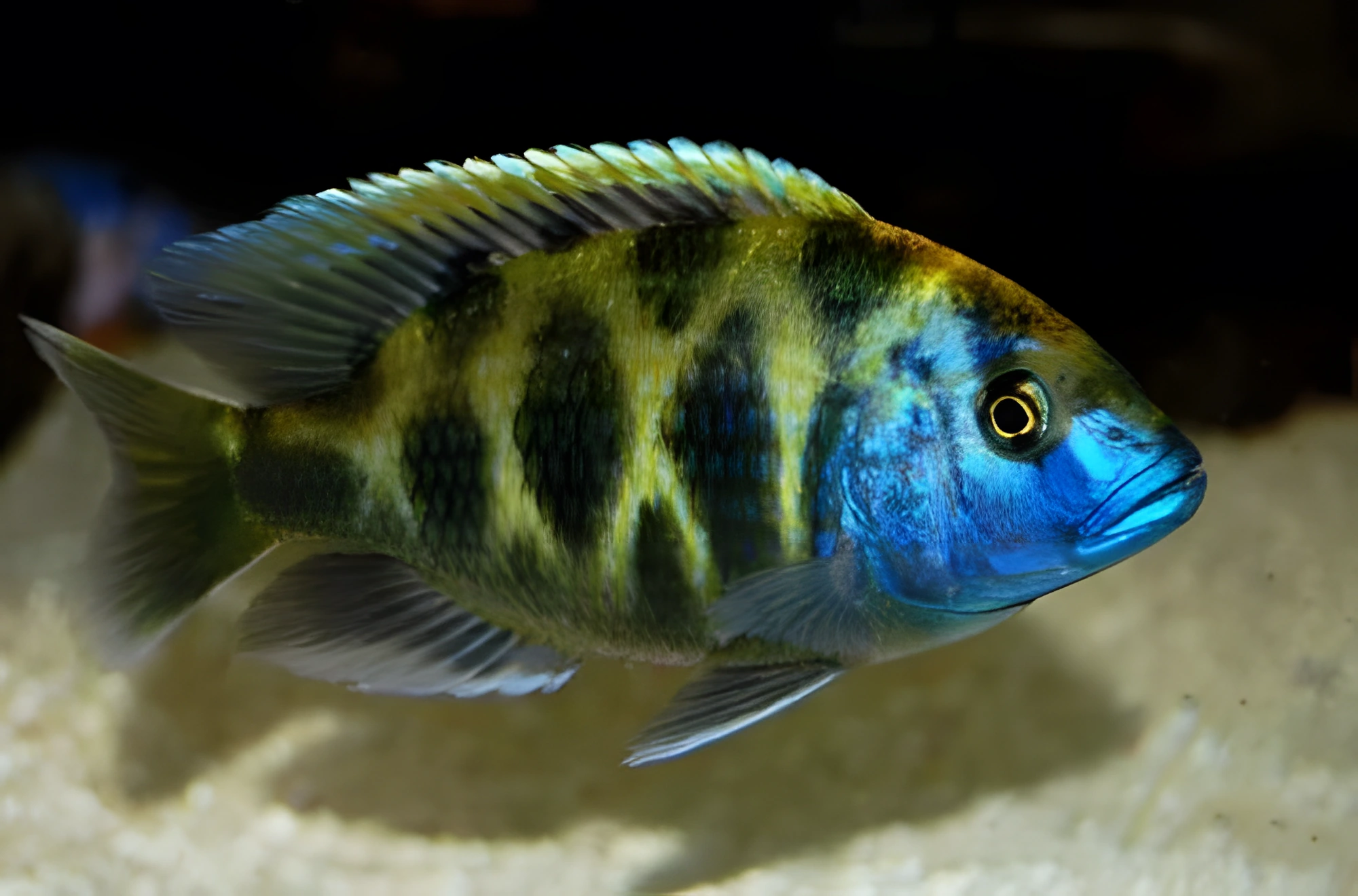
Nimbochromis venustus, also known as the Golden Leopard, belongs to the Cichlidae family. This species is part of a group of ambush predators inhabiting Lake Malawi in Africa. It has developed a unique hunting strategy by playing dead: the fish lies on the bottom near the shore or among rocks, waiting for prey to appear. As soon as an unsuspecting fish swims close, a lightning-fast attack follows. This hunting method is similar to the behavior of another lake inhabitant – Livingston's Cichlid.
- Required aquarium volume
- 470 L
- Size in aquarium
- 25 cm
- Temperature
- 23 – 28 °C
- Temperament
- Predator (dangerous to small, incompatible)
Parameters
Water pHNeutral (7) – Slightly alkaline (8)
Water dHMedium hardness (10) – Very hard (25)
Water salinityvery low (up to ~3 g/L)
Size in aquarium25 cm
Lifespan10 years
TemperamentPredator (dangerous to small, incompatible)
Toward small fishpredator
Required aquarium volume470 L
Lightingmoderate (regular)
Substratesand or gravel + stones/boulders
Water flowmoderate or strong
FeedingMeat with plant additives (omnivores)
CareHarem (1 male and several females)
Description
These large cichlids can reach up to 25 cm (10 inches) in length. They have a stocky build and a rather large mouth. The coloration of males varies from golden hues with a blue head to a completely blue body. A characteristic feature is a pattern resembling a giraffe's markings, with large dark spots outlined by light edges. Females and juveniles have a beige coloration, and their pattern is less distinct.
Habitat
The Golden Leopard is endemic to Lake Malawi. It is found along the entire coastline, preferring areas with sandy and rocky substrates at depths of 15–20 meters (50–65 feet). Juveniles stay higher up, closer to the rocks. In their natural environment, their diet consists of small fish and various invertebrates.
Behavior and Compatibility
Male Golden Leopards show intolerance towards each other. In a relatively small aquarium (even 500 liters is considered small for them), this can lead to fatal fights. The optimal solution is to keep them in a harem, with 3–4 females per male. The male perceives the aquarium as his territory and the females as his companions. Finding suitable tank mates is extremely difficult: some species can quickly become potential prey, while others will be considered aggressors encroaching on the male's territory. Aquarists should acquire already formed groups (male/females), as the fish create a kind of "family," and the male may not accept new females.
Care and Maintenance
A spacious aquarium of about 500 liters (130 gallons) is perfect for the Golden Leopard. The decor should focus on the substrate: use coarse sand with several smooth stones scattered haphazardly. A massive pile of rocks and stones can be placed along one of the side walls or as a background. It is recommended to secure them with special glue to prevent collapse. It is important to install this structure directly on the bottom of the tank and then cover it with substrate. The reason is that these fish like to dig in the substrate and can undermine it, which could cause the pile of stones to topple if they are not resting on the very bottom. The presence of plants in the decor is not mandatory and is at the aquarist's discretion. If you decide to use plants, choose hard-leaved species, as the fish may nip at their leaves. A key aspect is water preparation; its composition should maximally match the parameters of Lake Malawi, which has specific characteristics: the dH value ranges from medium to high hardness, and the pH fluctuates around 8.0. Detailed information on pH and dH parameters, as well as methods for their regulation, can be found in the "Hydrochemical Composition of Water" section. Aquarium maintenance includes weekly water changes of 10–20% followed by cleaning the substrate of fish waste. Installing a powerful filtration system allows for extending maintenance intervals to two weeks or more, depending on financial capabilities. The minimum set of necessary equipment includes filtration, lighting, heating, and aeration systems. If necessary, additional options can be added to simplify care.
Diet
Although the Golden Leopard is a predator in the wild, feeding live fish is not mandatory when kept in a home aquarium. It readily accepts pieces of fish and shrimp, including frozen ones, which allows for purchasing food from supermarket fish departments. To maintain a balanced diet, it is strongly recommended to supplement with vegetable flakes. These cichlids should be fed 3–4 times a week; the amount of meat products should be comparable to the volume of a small fish.
Breeding and Reproduction
The Golden Leopard cichlid successfully breeds in home aquariums; harem keeping only facilitates this process. During the breeding season, the male chooses a spawning site, usually a flat stone, cleaned of debris and located away from strong currents. The male invites the females to his improvised "nest," where the female lays 60 to 120 eggs. After this, she immediately takes the eggs into her mouth – this is an evolutionarily developed protective mechanism characteristic of most cichlids. While the female collects the eggs, the male stays nearby and displays his anal fin to her. It has a pattern of light spots that strongly resemble eggs. The female mistakenly tries to collect them too, and at this moment, the male releases milt, and fertilization occurs. The female incubates the eggs throughout the incubation period (about 3 weeks), and after the fry emerge, she provides them with shelter for another 10 days. When the fry begin to swim freely throughout the aquarium, they should be removed.
Diseases
Under favorable conditions and with a balanced diet, health problems generally do not arise. However, failure to meet the necessary requirements significantly increases the risk of diseases. Among Lake Malawi cichlids, the most common is the eponymous disease "Malawi bloat." The main reason for its appearance is keeping fish in unsuitable conditions. More detailed information on symptoms and treatment methods can be found in the "Diseases of Aquarium Fish" section.
How to choose
When choosing a Golden Leopard, prioritize active individuals with clean skin and clear, age-appropriate coloration. Avoid fish with signs of emaciation, such as a sunken belly, or, conversely, an unnaturally bloated abdomen, which may indicate Malawi bloat. Carefully inspect the fins: they should be intact, without signs of erosion, white growths, or bruises.
- Refuse to buy if there are dead individuals or specimens with visible ulcers and spots in the aquarium with the fish;
- Pay attention to breathing: rapid gill movement or frequent hovering at the surface can be a sign of water quality problems or the presence of parasites;
- Observe their behavior: a healthy fish should show curiosity, not constantly hide in corners or lie on the bottom without apparent reason (except for natural stress behavior in the store).
Since this species is a territorial predator, it is advisable to clarify the keeping conditions in the store and their diet with the seller beforehand. It is recommended to purchase juveniles, as they adapt more easily to new conditions, and adult males can show increased aggression towards tank mates.
Frequently asked questions
The essentials: size, tank volume, water parameters and care
How big does Golden Leopard get?
An adult reaches 25 cm in length. Plan the tank around the maximum size: the fish quickly outgrows a cramped setup.
What size aquarium does Golden Leopard need?
The minimum recommended volume is 470 L. A smaller tank speeds up nitrate build-up and raises stress levels.
What water parameters does Golden Leopard need?
Temperature 23–28 °C, pH 7–8, hardness 10–25 dGH. Stability matters more than exact values: sudden swings are harder on the fish than a small deviation from the ideal.
How long does Golden Leopard live?
Around 10 years when kept properly. Lifespan depends directly on tank volume, water quality and a varied diet.
Is Golden Leopard aggressive?
Temperament: predator (dangerous to small, incompatible). This is a predatory species — any fish small enough to fit in its mouth will eventually be eaten.
How many Golden Leopard should be kept together?
Recommended setup: harem (1 male and several females). Ignoring this is a common cause of stress and disease.
What does Golden Leopard eat?
Diet type: meat with plant additives (omnivores). Feed small portions that are finished within a couple of minutes — overfeeding does more harm than underfeeding.
What is the scientific name of Golden Leopard?
The scientific name of the species is Nimbochromis venustus, family Cichlids (Cichlidae). It also appears in the literature as: Cyrtocara venusta, Haplochromis simulans, Haplochromis venustus.