Temperature23 – 28 °C
Labyrinth fishConservation status: Least concern LC
Other scientific names: Colisa maculatus, Labrus trichopterus, Labrvs trichoptervs, Nemaphoerus maculosus, Osphromenus insulatus, Osphromenus siamensis
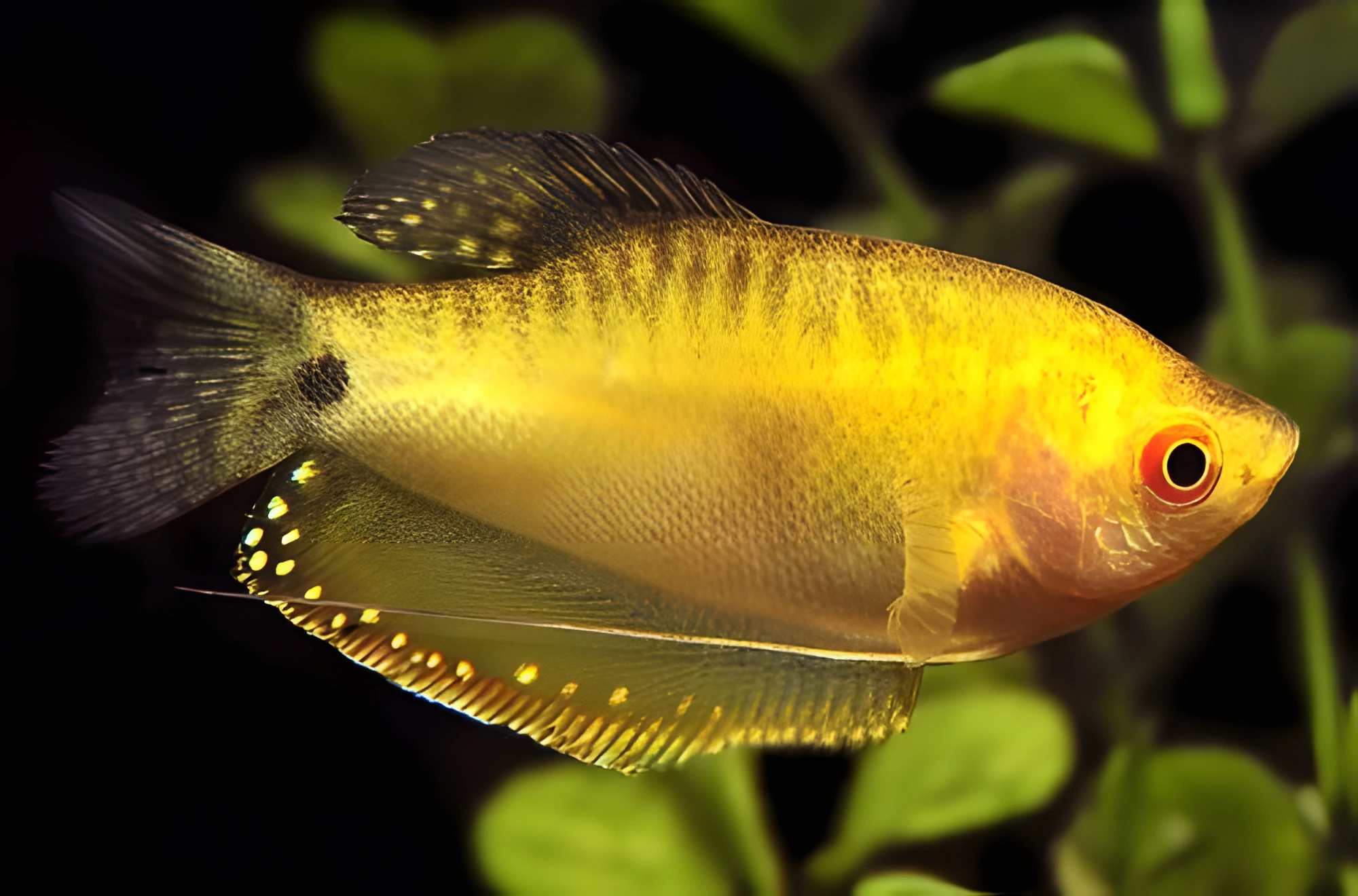
The Gold Gourami, scientifically known as Trichopodus trichopterus, belongs to the Osphronemidae family. Its vibrant yellow hues are the result of selective breeding; such coloration does not occur in its natural habitat. Despite these external features, the Gold Gourami has retained the outstanding hardiness of its ancestors, making it one of the easiest species for aquarists to keep.
- Required aquarium volume
- 150 L
- Size in aquarium
- 15 cm
- Temperature
- 23 – 28 °C
- Temperament
- Semi-peaceful (including aggression during spawning / intraspecific conflicts)
Parameters
Water pHSlightly acidic (6) – Slightly alkaline (8)
Water dHSoft (5) – Very hard (19)
Water salinityno salt (freshwater)
Size in aquarium15 cm
Lifespan4 years
TemperamentSemi-peaceful (including aggression during spawning / intraspecific conflicts)
Toward small fishnot a predator
Required aquarium volume150 L
Lightingmoderate (regular)
Substrateany, but dark
Water flownone or stagnant (no flow)
FeedingAny (universal)
CareBoth solitary and in group (flexible)
Description
The coloration of this fish is rich in golden and bright yellow tones. Given its close relationship with the Blue Gourami, similar features can be observed in the Gold Gourami's pattern, such as a mottled design on the fins and tail, as well as dark, irregular stripes running along the back. The fish's body is elongated and somewhat compressed laterally. The pelvic fins have evolved into filamentous appendages, equipped with sensitive cells that help the fish explore its surroundings. Like other Gourami species, this representative has a labyrinth organ in its oral cavity — a special formation with numerous capillaries that allows it to absorb atmospheric oxygen.
Habitat
This species is artificially bred and perfectly adapted to living in enclosed aquarium environments. It does not inhabit natural wild environments.
Behavior and Compatibility
Although the Gold Gourami is merely a color variation of the Blue Gourami, its behavior is noticeably more belligerent. Adult males often engage in skirmishes for dominance, and the loser is forced to constantly seek refuge, becoming an outcast. It is recommended to keep either a pair (male/female) or a single Gourami in the company of other species, such as cyprinids or catfishes. When choosing tank mates, prioritize fish of similar size with a calm temperament, avoiding overly active individuals. Also, do not introduce species prone to fin-nipping slow-moving fish, as the Gold Gourami, known for its unhurried pace, can easily become their target.
Care and Maintenance
Keeping Gold Gouramis does not require special conditions or water parameters, as the fish is well adapted to a wide range of pH and dH values. Essential equipment includes a filter, which should be positioned to create minimal current, as Gouramis prefer still or slow-moving water. An air pump, heater, and lighting system are also mandatory. It is important to provide the aquarium with a lid: an air layer with increased humidity and temperature forms beneath it, significantly minimizing the risk of damage to the labyrinth organ from temperature contrast when the fish gulps atmospheric air. Maintaining cleanliness in the aquarium is achieved through weekly water changes (at least 25% of the volume) and continuous operation of the filter and air pump. The aquarium layout should be organized considering the behavior of these fish. When keeping multiple Gouramis, one will inevitably become dominant, so the other individuals will require reliable hiding places located in different parts of the aquarium. Hiding places can be natural (driftwood, rock formations) or artificial (sunken ships, castles). Any plants can be used, grouped in such a way that sufficient open swimming space remains. Any substrate is suitable, but a dark option will help enhance the fish's coloration.
Diet
These fish readily accept a variety of dry commercial foods, as well as popular meaty foods such as bloodworms, tubifex, and Artemia. Pet stores offer a wide selection of specialized foods for Gouramis, so choosing a suitable diet is usually not difficult. There is one important and very useful feature of this species: they are known as hydra exterminators. Hydras are tiny pests, often mentioned in school biology textbooks, possessing tentacles and stinging cells with venom. While their presence in an aquarium creates serious problems, for Gouramis they serve as an excellent addition to their diet.
Breeding and Reproduction
During spawning, the male builds a nest of sticky air bubbles on the water's surface, where the eggs will subsequently be laid. If other fish are present in the aquarium besides the Gourami pair, a separate tank of at least 80 L will be required for breeding. The water parameters and equipment in it should match the main aquarium, and dense plant thickets are essential for the decor. The only exception is that the simplest air-lift filter can be used. The stimulus for spawning is the inclusion of meaty foods (live or frozen) in the daily diet. After some time, when the female becomes noticeably rounded, the pair is moved to a separate tank. The male begins to build the nest, usually choosing a corner of the aquarium for this. Upon completion of construction, the male begins to court the female: he swims back and forth in front of her, with his tail held high above his head, and touches her with his fins. The female lays up to 800 eggs in the nest, after which she is returned to the main aquarium. The male remains to guard the clutch and only joins the female after the fry appear.
Diseases
Health problems in these fish are usually absent in an aquarium with a stable biological system and optimal water parameters. However, deteriorating keeping conditions, insufficient nutrition, or contact with a sick fish can provoke a disease outbreak. More detailed information on symptoms and treatment methods can be found in the "Aquarium Fish Diseases" section.
How to choose
When choosing a Gold Gourami in a store, pay attention to the fish's activity and the condition of its skin. Healthy individuals should be active, with clean scales free of white film, ulcers, or damage. Avoid specimens with clamped fins, rapid breathing, or an unnaturally bloated abdomen, as these may indicate parasites or bacterial infections. It is important to observe the fish's behavior: it should show interest in its surroundings, rather than constantly hiding in the corners of the aquarium.
- Check for signs of emaciation, such as sunken flanks.
- Ensure the fish's eyes are clear, without cloudiness.
- Ask the seller to feed the fish to assess their appetite and general health.
- Avoid purchasing individuals from tanks where dead fish or fish with visible signs of disease are present.
Frequently asked questions
The essentials: size, tank volume, water parameters and care
How big does Gold Gourami get?
An adult reaches 15 cm in length. Plan the tank around the maximum size: the fish quickly outgrows a cramped setup.
What size aquarium does Gold Gourami need?
The minimum recommended volume is 150 L. A smaller tank speeds up nitrate build-up and raises stress levels.
What water parameters does Gold Gourami need?
Temperature 23–28 °C, pH 6–8, hardness 5–19 dGH. Stability matters more than exact values: sudden swings are harder on the fish than a small deviation from the ideal.
How long does Gold Gourami live?
Around 4 years when kept properly. Lifespan depends directly on tank volume, water quality and a varied diet.
Is Gold Gourami aggressive?
Temperament: semi-peaceful (including aggression during spawning / intraspecific conflicts). Keep this in mind when choosing tank mates.
How many Gold Gourami should be kept together?
Recommended setup: both solitary and in group (flexible). Ignoring this is a common cause of stress and disease.
What does Gold Gourami eat?
Diet type: any (universal). Feed small portions that are finished within a couple of minutes — overfeeding does more harm than underfeeding.
What is the scientific name of Gold Gourami?
The scientific name of the species is Trichopodus trichopterus, family Osphronemidae. It also appears in the literature as: Colisa maculatus, Labrus trichopterus, Labrvs trichoptervs.