Temperature18 – 22 °C
Natural range
- Central Asia area
- Siberia area
GoldfishConservation status: Least concern LC
Other scientific names: Carasius auratus, Carassius buergeri, Carassius burgeri, Carassius carassius, Carassius chinensis, Carassius coeruleus
Carassius auratus, or the common Goldfish, belongs to the family Cyprinidae. This fish is undoubtedly one of the most well-known and widespread aquarium inhabitants today. Its outstanding popularity is explained not only by its external attractiveness but also by its amazing resilience. It is undemanding in care, easily adapts to the offered diet, consuming any available food. Goldfish readily settle in almost any aquarium and successfully coexist with many species of peaceful fish.
- Required aquarium volume
- 50 L
- Size in aquarium
- 10 – 30 cm
- Temperature
- 18 – 22 °C
- Temperament
- Peaceful, active/mobile
Parameters
Water pHSlightly acidic (6) – Slightly alkaline (8)
Water dHSoft (5) – Very hard (19)
Water salinityno salt (freshwater)
Size in aquarium10 – 30 cm
Lifespan15 years
TemperamentPeaceful, active/mobile
Toward small fishnot a predator
Required aquarium volume50 L
Lightingmoderate (regular)
Substrateany (no restrictions)
Water flowweak
FeedingMeat with plant additives (omnivores)
CareSchooling (usually from 5–6 individuals and more)
Description
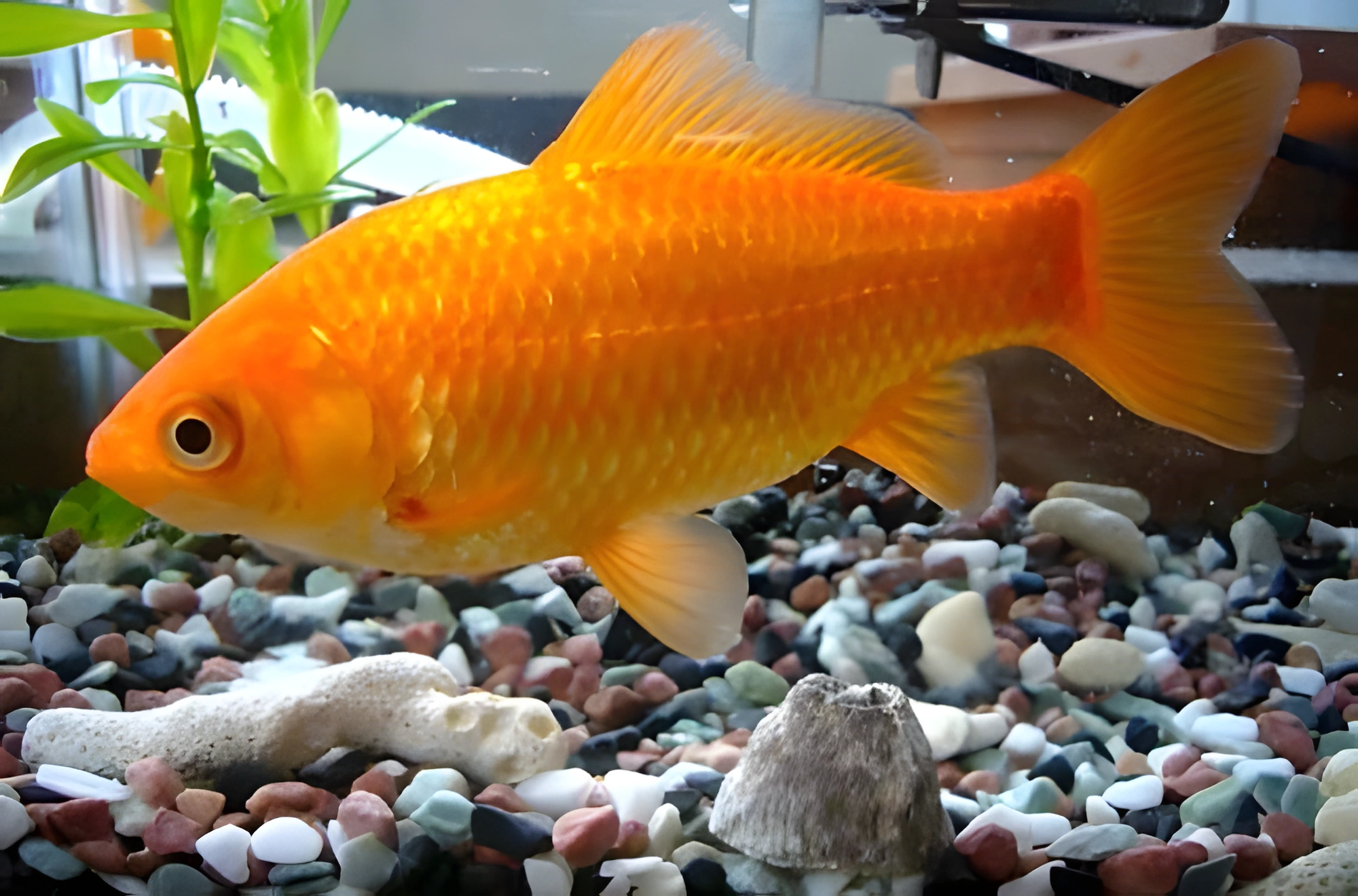
The fish's body has a slightly elongated shape, tapering towards the tail. The head is large and wide. The caudal fin is forked, and the dorsal fin is characterized by a slight curve. The predominant coloration is orange or yellow, the so-called "golden" color. The size of these fish can vary greatly, mainly determined by the volume of the aquarium. In a small aquarium of about 100 liters, they can reach 10 cm or more, while in a pond they can grow up to 30–35 cm. The average lifespan is 10 to 15 years. However, specimens living for 20 years or more are not uncommon with good care in both aquariums and ponds.
Habitat
Modern Goldfish trace their lineage back to wild carp relatives, known as Prussian carp, crucian carp, or Gibel carp (Carassius gibelio). The original habitat of these fish covers the waters of Central Asia and Siberia, where they prefer slow-moving or stagnant waters of rivers, lakes, and ponds. Their diet consists of vegetation, detritus, as well as small crustaceans and insects. In the early 16th century, these fish were first brought to Japan and China, where they were used to adorn imperial gardens. With the advent of colonialism, Goldfish arrived in Europe, which marked the beginning of active selective breeding. Today, more than 125 different varieties and strains are known.
Behavior and Compatibility
They are peaceful, which makes them well-suited to most other good-natured and calm fish species. They feel comfortable both alone and in a community with one or more species. Other varieties of Goldfish can make excellent tankmates.
Care and Maintenance
Goldfish are known for producing a significant amount of waste, and they are also quite demanding of high oxygen content in the water. It should be noted that organic waste actively interacts with oxygen, reducing its concentration. Due to these characteristics, it is recommended to choose a spacious aquarium with a large water surface area. An optimal option for one fish is considered to be a rectangular aquarium of 40 liters or more, with an additional 10 liters needed for each subsequent individual. Thus, in a 100-liter aquarium, no more than 7 specimens should be kept. If you choose a round tank, do not fill it completely, as the largest water-to-air contact area is in the middle; filling it 3/4 full will be optimal. Weekly water changes of approximately 25% of the volume, as well as the installation of a powerful filter, will help manage waste accumulation. However, if there are only one or two fish in the aquarium, filtration may not be necessary. A lighting system and an aerator are welcome, while a heater is not mandatory, as the fish feel perfectly fine at room temperature. Moreover, Goldfish can successfully tolerate temperatures slightly above freezing if it decreases gradually, by a few degrees per day. Aquarium decoration can be done to your taste, but a few points should be considered: plants must have a strong root system so they are not uprooted; decorative elements such as stones, driftwood, or grottoes should not have sharp edges. Vegetation should be chosen from cold-water species.
Diet
These fish are omnivores, so they readily accept all types of food: dry (in flakes, pellets, tablets), frozen, and live. It is important to remember that live food can be a source of various parasites for fish; for this reason, it is preferable to use frozen meat products. The market offers a wide range of specialized foods developed specifically for Goldfish, which contain all the necessary vitamins and trace elements.
Breeding and Reproduction
Breeding at home usually does not present great difficulties. Since sexual differences are quite subtle, it is recommended to acquire a group of several fish to ensure spawning. Spawning can be arranged directly in the main aquarium; when decorating it, it is advisable to use Brazilian Elodea, as it tolerates low temperatures well, actively releases oxygen, and serves as a refuge for fry. The stimulus for the onset of the breeding season is a gradual lowering of water temperature to 11–12°C over several days, followed by its gradual equalization with room temperature. This creates a short-term imitation of natural conditions, where temperature fluctuations coincide with the arrival of spring in temperate latitudes. Meat products should definitely be added to the daily diet. As the temperature rises, the male begins to actively court the female, chasing her throughout the aquarium and inviting her into the plant thickets. Such behavior can continue for several days, after which spawning occurs. Up to 10 thousand eggs can be laid in 2–3 hours, which attach to plants with sticky threads. Since parents do not care for their offspring and may eat the eggs, it is recommended to transfer the plants with eggs to a separate tank, for example, a three-liter jar filled with water from the main aquarium. Initially, the fry are dark brown or black, which helps them camouflage among the plants; their natural hues appear only after several months. When they reach a length of 2–3 cm, they can be moved to live with their parents. Specialized foods should be used to feed the fry. This is how Goldfish are bred.
Diseases
In a balanced aquarium, where a stable biological system has been established and good nutrition is provided, health problems generally do not arise. However, factors such as contact with sick fish, the use of contaminated live food, or relocation can provoke outbreaks of various diseases. More detailed information on symptoms and treatment methods can be found in the "Aquarium Fish Diseases" section.
How to choose
When choosing a goldfish, pay attention to its behavior and appearance. A healthy individual should swim actively, maintain balance confidently, and show interest in its surroundings. Avoid fish that lie at the bottom for long periods, drift erratically, or constantly stay at the surface, as this often indicates swim bladder problems or general exhaustion. Inspect the entire aquarium: the presence of dead or obviously sick fish in it is a reason to refuse to purchase from that location.
When visually inspecting the fish, pay attention to the following signs:
- Scales should be tightly pressed to the body, without visible damage, ulcers, or white spots resembling semolina grains;
- Fins should be intact, without signs of deterioration, redness, or mucous coating;
- Eyes should be clear, without cloudiness or signs of popeye;
- The fish's breathing should be even, without excessively frequent gill cover movements.
Avoid purchasing fish with clamped fins, as this is one of the first signs of stress or an incipient illness. If traces of medication are visible in the aquarium with the fish, for example, the water has a specific tint, it is better to postpone the purchase until the inhabitants' course of treatment is completed. Before purchasing, it is recommended to observe the behavior of the chosen individual for some time to ensure there are no hidden defects or coordination disorders.
Frequently asked questions
The essentials: size, tank volume, water parameters and care
How big does Goldfish get?
An adult reaches 10–30 cm in length. Plan the tank around the maximum size: the fish quickly outgrows a cramped setup.
What size aquarium does Goldfish need?
The minimum recommended volume is 50 L. A smaller tank speeds up nitrate build-up and raises stress levels.
What water parameters does Goldfish need?
Temperature 18–22 °C, pH 6–8, hardness 5–19 dGH. Stability matters more than exact values: sudden swings are harder on the fish than a small deviation from the ideal.
How long does Goldfish live?
Around 15 years when kept properly. Lifespan depends directly on tank volume, water quality and a varied diet.
Is Goldfish aggressive?
Temperament: peaceful, active/mobile. Keep this in mind when choosing tank mates.
How many Goldfish should be kept together?
Recommended setup: schooling (usually from 5–6 individuals and more). Ignoring this is a common cause of stress and disease.
What does Goldfish eat?
Diet type: meat with plant additives (omnivores). Feed small portions that are finished within a couple of minutes — overfeeding does more harm than underfeeding.
What is the scientific name of Goldfish?
The scientific name of the species is Carassius auratus, family Cyprinids (Cyprinidae). It also appears in the literature as: Carasius auratus, Carassius buergeri, Carassius burgeri.