Temperature23 – 28 °C
Natural range
- Lake Malawi area
- Southern Lake Malawi area
CichlidsConservation status: Least concern LC
Other scientific names: Chromis auratus, Pseudotropheus auratus, Tilapia aurata
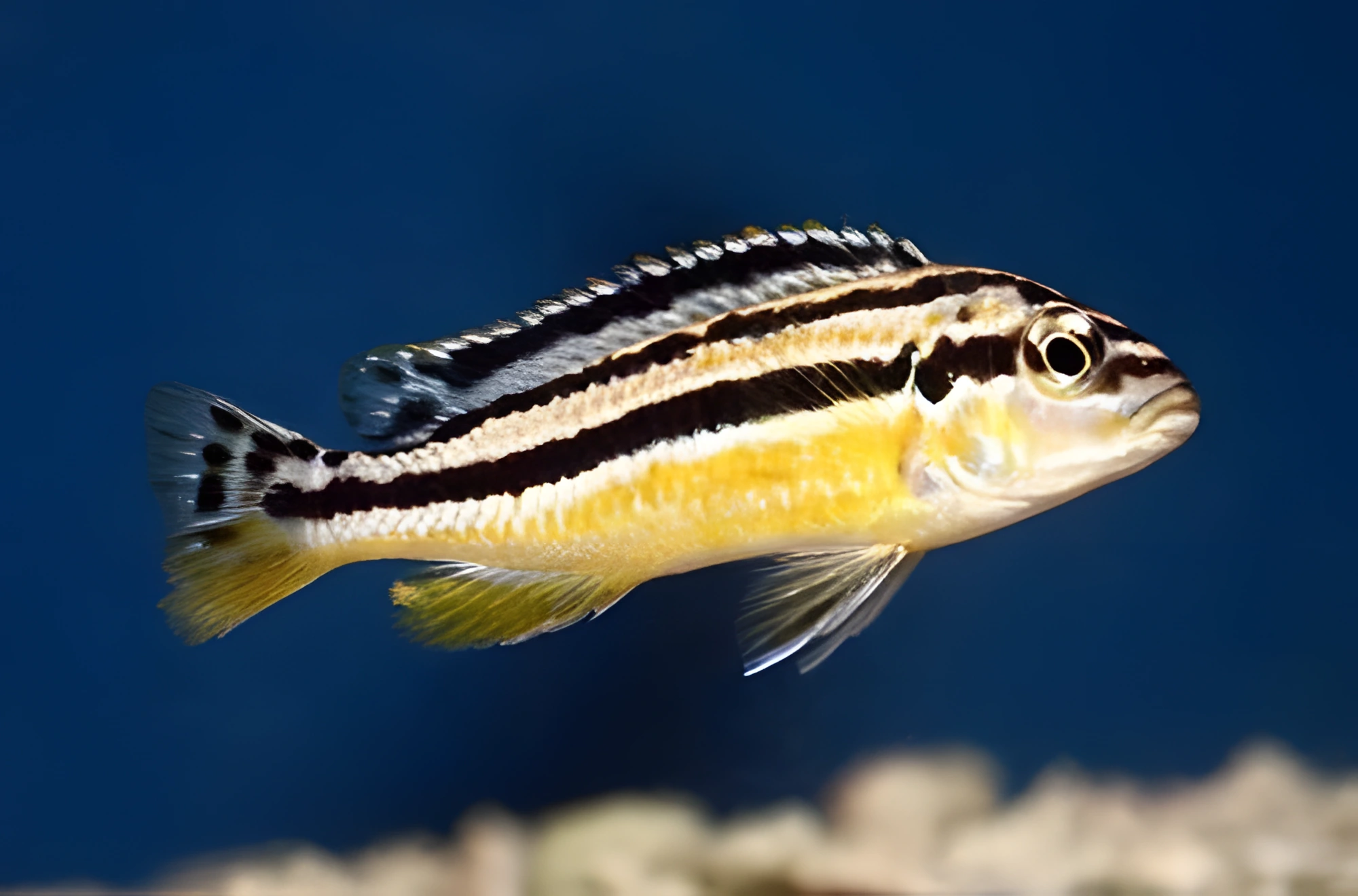
Melanochromis auratus, also known as the Golden Cichlid (scientific name Melanochromis auratus), belongs to the Cichlidae family. These fish are characterized by their striking golden coloration, adorned with large horizontal stripes. However, keeping them presents certain difficulties due to their high aggression and complex intraspecific relationships. Even cohabitation of males and females often proves undesirable, making it difficult to select suitable tankmates.
- Required aquarium volume
- 200 L
- Size in aquarium
- 11 cm
- Temperature
- 23 – 28 °C
- Temperament
- Aggressive / incompatible / unfriendly
Parameters
Water pHNeutral (7) – Slightly alkaline (8.5)
Water dHMedium hardness (10) – Hard (15)
Water salinityvery low (up to ~3 g/L)
Size in aquarium11 cm
Lifespan5 years
TemperamentAggressive / incompatible / unfriendly
Toward small fishnot a predator
Required aquarium volume200 L
Lightingmoderate (regular)
Substratefine sand
Water flowmoderate or strong
FeedingPlant-based (algae, vegetables)
CareHarem (1 male and several females)
Description
This fish has a slender, elongated body and a rounded head. Its dorsal fin extends almost the entire length of its back. The oral cavity contains incisors – teeth that are closely spaced, used for scraping algae from rock surfaces. The coloration of males and females differs significantly, but the main colors are retained. Males have a dark coloration, with a yellow back and a similar horizontal stripe running along the entire body. Their dorsal fin is translucent, with dark spots forming a line, and the tail is black, with yellow speckles along the upper edge. The anal and pelvic fins are black, with a bluish trim. Females, in contrast, are predominantly golden, with dark horizontal stripes. Their tail is light, with dark speckles in the upper part. The dorsal fin is body-colored and has a distinct black stripe. Other fins are light, with a golden hue. Young individuals of both sexes outwardly resemble females. Males that have reached 6 months of age and established their territory gradually acquire their characteristic coloration. When kept in an aquarium with only females, a dominant individual may eventually acquire the external characteristics of a male.
Habitat
Golden Cichlids are endemic to Africa's Lake Malawi, where they inhabit rocky areas along the southern and western extremities. This species is listed in the Red Book with the status of “least concern,” which is characteristic of many inhabitants of closed lake systems on the African continent. In their natural environment, their diet consists primarily of tough fibrous algae growing on rocks and stones, as well as plankton and zooplankton.
Behavior and Compatibility
Melanochromis auratus is extremely aggressive towards both other species and its own kind, especially males. In natural conditions, they live in polygamous groups within a specific territory, where one male has 6–8 females; any competitor will be immediately attacked. Successful keeping of a group of these fish is only possible in very large aquariums (exceeding 400 L) combined with a sufficient number of shelters. The presence of other males is strictly unacceptable, as they will be subjected to aggression not only from the dominant male but also from the females. Adding other fish species is also undesirable, as they will likely be destroyed. In small tanks of 150–200 L, only one male or several females can be kept, and no other options are acceptable. In a small space, when keeping a pair (male/female), the latter will be constantly attacked.
Care and Maintenance
Since these fish produce a significant amount of waste, weekly water changes of 25–50% are essential for their successful keeping. The water in the aquarium must have a high degree of mineralization and a high pH level (alkaline). To maintain these parameters, coral sand or fine aragonite gravel can be used as a substrate, as they help increase carbonate hardness and alkalinity. A similar effect is achieved by using marble chips in the filter material. The filter must have high performance to effectively maintain biological balance. In such conditions, decomposition products of organic residues (excrement, uneaten food, plant fragments) can become particularly dangerous and quickly lower the pH level, which will negatively affect the aquarium inhabitants. When decorating the aquarium, many shelters in the form of grottoes, caves, and rocky embankments should be provided. It is important to install them directly on the bottom of the tank, and then cover them with substrate. Fish like to dig in the sand, and if the structures stand directly on it, a collapse may occur. Live plants will be quickly eaten, so for variety, artificial plants of orange, red, or brown colors can be added, but avoid green ones.
Diet
An important part of the Golden Cichlid's diet should be plant-based supplements. In addition, they readily accept various types of dry foods (such as pellets and flakes) and meat products (bloodworms, insect larvae, mosquito larvae, and others). Dried spirulina is highly recommended as the main food, supplemented with other products at your discretion.
Breeding and Reproduction
Breeding Golden Cichlids is quite possible in a home aquarium. These fish are caring parents and meticulously look after their offspring. If you plan to breed, provide a large aquarium so that each fish has enough space to hide. During the spawning period, females show aggression comparable to that of males. An increase in water temperature to 26–28°C serves as a stimulus for reproduction. The start of spawning can be determined by the male's coloration, which becomes significantly more intense, its colors can almost double in brightness. Females lay about 40 eggs and immediately take them into their mouths. Then the female stimulates the male to release milt, which she inhales, thereby fertilizing the eggs directly in her mouth. The eggs develop for 21 days, and fry appear. The young should be fed Artemia nauplii and finely ground dry foods with vegetable additives. Initially, the female carefully guards the offspring, and at the slightest danger, the fry hide in her mouth. After 3 months, the young reach 2–3 cm in size, and after another six months, males and females develop individual coloration. At this point, it is advisable to move the males to a separate tank or sell them in a timely manner, before the dominant male begins his “dark deeds.”
Diseases
“Malawi Bloat” is a typical disease for fish inhabiting the eponymous lake. Its occurrence is primarily associated with unsuitable keeping conditions and incorrect feeding, especially a lack of plant components in the diet. Old water that has not been changed for more than a week also poses a serious threat: decomposition products accumulate in it, leading to acidification and, as a result, a disturbance of the internal salt balance in the fish's body. Detailed information on symptoms and treatment methods can be found in the “Diseases of Aquarium Fish” section.
How to choose
When choosing a Golden Cichlid, it is important to consider its extremely aggressive nature, so only healthy individuals without visible damage to fins and scales should be purchased. In the store, you can often see one dominant male with dark coloration, while the other individuals will have the yellow coloration of females or young fish. Avoid buying fish with signs of emaciation, sunken bellies, or unnatural behavior, such as a constant desire to hide in a corner, which may indicate stress or disease. Keep in mind that due to intraspecific aggression, purchasing several individuals requires a spacious aquarium with many shelters, and cohabitation with other fish species carries a high risk of their demise.
Frequently asked questions
The essentials: size, tank volume, water parameters and care
How big does Golden Cichlid get?
An adult reaches 11 cm in length. Plan the tank around the maximum size: the fish quickly outgrows a cramped setup.
What size aquarium does Golden Cichlid need?
The minimum recommended volume is 200 L. A smaller tank speeds up nitrate build-up and raises stress levels.
What water parameters does Golden Cichlid need?
Temperature 23–28 °C, pH 7–8.5, hardness 10–15 dGH. Stability matters more than exact values: sudden swings are harder on the fish than a small deviation from the ideal.
How long does Golden Cichlid live?
Around 5 years when kept properly. Lifespan depends directly on tank volume, water quality and a varied diet.
Is Golden Cichlid aggressive?
Temperament: aggressive / incompatible / unfriendly. Keep this in mind when choosing tank mates.
How many Golden Cichlid should be kept together?
Recommended setup: harem (1 male and several females). Ignoring this is a common cause of stress and disease.
What does Golden Cichlid eat?
Diet type: plant-based (algae, vegetables). Feed small portions that are finished within a couple of minutes — overfeeding does more harm than underfeeding.
What is the scientific name of Golden Cichlid?
The scientific name of the species is Melanochromis auratus, family Cichlids (Cichlidae). It also appears in the literature as: Chromis auratus, Pseudotropheus auratus, Tilapia aurata.