Temperature22 – 30 °C
Natural range
- Cambodia area
- Vietnam area
- Malaysia area
- Southeast Asia area
Labyrinth fishConservation status: Least concern LC
Other scientific names: Osphronemus saigonensis, Trichogaster pectoralis
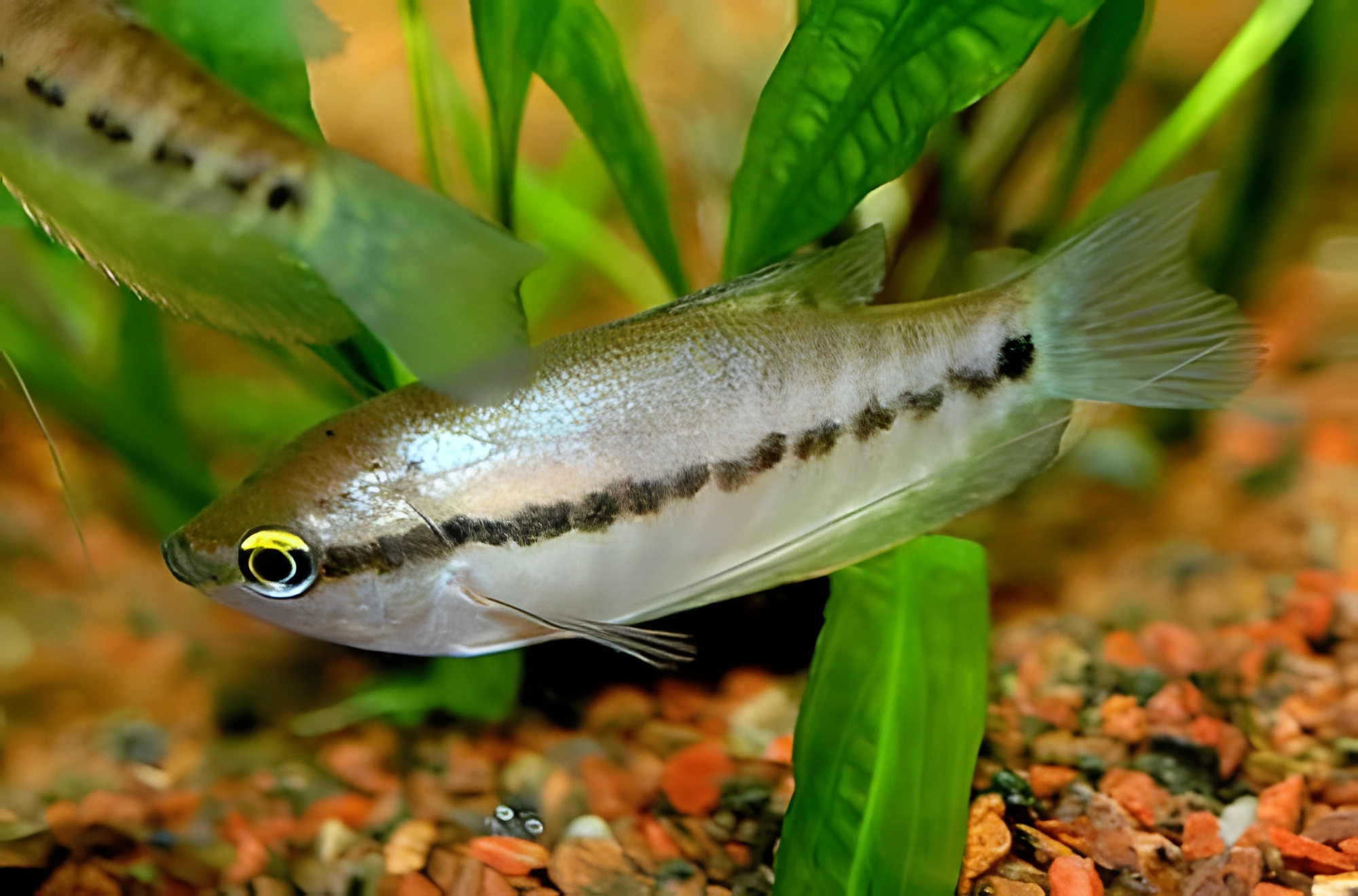
The Snakeskin Gourami, scientifically known as Trichopodus pectoralis, belongs to the family Osphronemidae. This rather large fish has remarkable coloration. The spotted pattern and the predominance of yellow-brown hues on its body resemble snake skin, which is how the species got its name. Its high endurance and unpretentiousness to conditions make the Snakeskin Gourami an excellent choice for beginner aquarists.
- Required aquarium volume
- 130 L
- Size in aquarium
- 20 cm
- Temperature
- 22 – 30 °C
- Temperament
- Peaceful, active/mobile
Parameters
Water pHSlightly acidic (6) – Alkaline (8.8)
Water dHVery soft (2) – Very hard (30)
Water salinityno salt (freshwater)
Size in aquarium20 cm
Lifespan6 years
TemperamentPeaceful, active/mobile
Toward small fishnot a predator
Required aquarium volume130 L
Lightingdimmed
Substrateany, but dark
Water flownone or stagnant (no flow)
FeedingPlant-based with meat additives
CareMixed (solitary / pair / group)
Description
This fish is characterized by an elongated oval shape and a body slightly flattened laterally. Its pectoral fins are notably long, exceeding those of other Gourami species. The pelvic fins, filamentous and extremely sensitive, serve the fish for tactile exploration of its surroundings. During evolution, members of this family developed a special "labyrinth" organ, allowing them to absorb oxygen directly from atmospheric air by gulping bubbles from the water surface. This organ, located in the oral cavity, works in conjunction with the gills and is a small sac permeated by numerous capillaries, resembling a miniature labyrinth. Body coloration varies from gray-olive to light yellow. A dark horizontal dotted line runs along the sides, and sometimes diagonal stripes resembling a zebra are visible across the body. Males are distinguished by the orange or reddish tint on the edge of their pelvic fin.
Males are characterized by a more slender build, with pointed dorsal and anal fins, whereas in females, these fins are rounded. Also, the edges of the pelvic fins in males are colored in orange or reddish hues.
Habitat
Trichopodus pectoralis is widely distributed in the waters of Southeast Asia, found in the territories of modern Cambodia, Vietnam, and Malaysia. In recent decades, this species has also been introduced to archipelagos such as the Philippines and Indonesia. Among the local population, the Snakeskin Gourami is popular as food and is intentionally cultivated. In their natural habitat, these fish prefer shallow ponds, swamps, and rice paddies, choosing shallow bodies of water with weak currents and abundant vegetation. During the rainy season, they swim into flooded forest areas in search of food. Their diet consists mainly of aquatic plants.
Behavior and Compatibility
Despite its size, the Snakeskin Gourami is the most peaceful species among all Gouramis and poses no threat even to very small fish or fry. However, this peacefulness also has a downside: it is strictly not recommended to keep them together with active, fast-moving, or especially aggressive species. In such company, the Snakeskin Gourami will experience constant stress.
Care and Maintenance
The large size of this fish requires a significant aquarium volume and high-performance equipment capable of effectively removing organic waste. Particular attention should be paid to the filtration system: the filter must be powerful but create minimal water movement, as a strong current will cause discomfort to the fish, which is accustomed to still or slow-moving water. Other essential equipment includes an aerator, heater, and a lighting system set to subdued light. In aquarium decoration, it is recommended to use an abundant amount of both rooted and floating plants, arranging them in groups to leave enough free swimming space. The presence of shelters, such as grottoes, snags, roots, or artificial decorative objects (e.g., sunken ships, castles, amphorae), plays an important role. A dark substrate is desirable, as it effectively highlights the fish's light coloration.
Diet
In a home aquarium, this fish readily accepts all varieties of dry commercial and live foods. An important aspect is the mandatory inclusion of plant-based supplements in its diet. An optimal diet includes specialized dry food for Gouramis, mixed with plant-based flakes or pellets, which are commercially available, as well as bloodworms as a supplement two or three times a week. Feeding is done once or twice a day, depending on the chosen diet. If live food is available, a single feeding is sufficient; otherwise, the fish are fed twice a day.
Breeding and Reproduction
Breeding this species presents no difficulty and does not require significant effort. Spawning can occur in a community tank, as the parents do not harm their offspring. However, if other fish species inhabit the aquarium, they may pose a threat to Gourami eggs and fry, which should be taken into account. The stimulus for spawning is the inclusion of meaty foods in the daily diet and a gradual reduction of the water level in the aquarium to 20 cm over a week. The water temperature must be maintained within 28°C. After some time, the female begins to fill with eggs, and the male starts building a nest from bubbles and plant fragments. The nest, as a rule, is small and located under the leaves of floating plants. After the nest is completed, the courtship period begins. The male swims around the female, touching her with his fins, thereby inviting her to the nest. When the pair is under the nest, the female releases a small portion of eggs, which the male fertilizes, after which the procedure is repeated. This species is highly prolific: an adult female can lay up to 5000 eggs. Unlike some other Gourami species, immediately after spawning, the parents lose all interest in their offspring. Consequently, eggs that do not fall into the nest will simply float on the water surface. Males of other "labyrinth" fish species exhibit different behavior – they collect all the eggs and transfer them to the nest, remaining to guard the clutch until the fry appear. However, they are also prone to eating their own offspring, which the Snakeskin Gourami will never do. Fry should be fed specialized microfoods, Artemia, and infusoria.
Diseases
This species is extremely hardy, and in a stable aquarium with an established biological system, health problems are extremely rare. The occurrence of diseases is often due to a significant deterioration of keeping conditions, poor nutrition, or contact with already sick fish. More detailed information on symptoms and treatment methods can be found in the "Diseases of Aquarium Fish" section.
How to choose
When selecting individuals, preference should be given to active fish with clean fins and no visible damage to the body. It is important to ensure clear eyes and the absence of plaque or ulcers on the scales. Avoid purchasing fish that appear emaciated, stay near the water surface in an apathetic state, or show signs of unnatural abdominal distension.
- Inspect the condition of the scales for the absence of spots and erosions.
- Check the behavior of the fish in the community tank: they should show curiosity, not constantly hide in corners.
- Ask the seller about the keeping conditions and diet to assess the adaptation of the individuals to aquarium foods.
Frequently asked questions
The essentials: size, tank volume, water parameters and care
How big does Snakeskin Gourami get?
An adult reaches 20 cm in length. Plan the tank around the maximum size: the fish quickly outgrows a cramped setup.
What size aquarium does Snakeskin Gourami need?
The minimum recommended volume is 130 L. A smaller tank speeds up nitrate build-up and raises stress levels.
What water parameters does Snakeskin Gourami need?
Temperature 22–30 °C, pH 6–8.8, hardness 2–30 dGH. Stability matters more than exact values: sudden swings are harder on the fish than a small deviation from the ideal.
How long does Snakeskin Gourami live?
Around 6 years when kept properly. Lifespan depends directly on tank volume, water quality and a varied diet.
Is Snakeskin Gourami aggressive?
Temperament: peaceful, active/mobile. Keep this in mind when choosing tank mates.
How many Snakeskin Gourami should be kept together?
Recommended setup: mixed (solitary / pair / group). Ignoring this is a common cause of stress and disease.
What does Snakeskin Gourami eat?
Diet type: plant-based with meat additives. Feed small portions that are finished within a couple of minutes — overfeeding does more harm than underfeeding.
What is the scientific name of Snakeskin Gourami?
The scientific name of the species is Trichopodus pectoralis, family Osphronemidae. It also appears in the literature as: Osphronemus saigonensis, Trichogaster pectoralis.