Temperature22 – 28 °C
Natural range
- Sumatra area
- Borneo area
- Indonesia area
- Malaysia area
Predators UnusualConservation status: Near threatened NT
Other scientific names: Ophicephalus pleurophthalmus, Ophicephalus spiritalis, Ophicephalus urophthalmus, Ophiocephalus pleurophthalmus
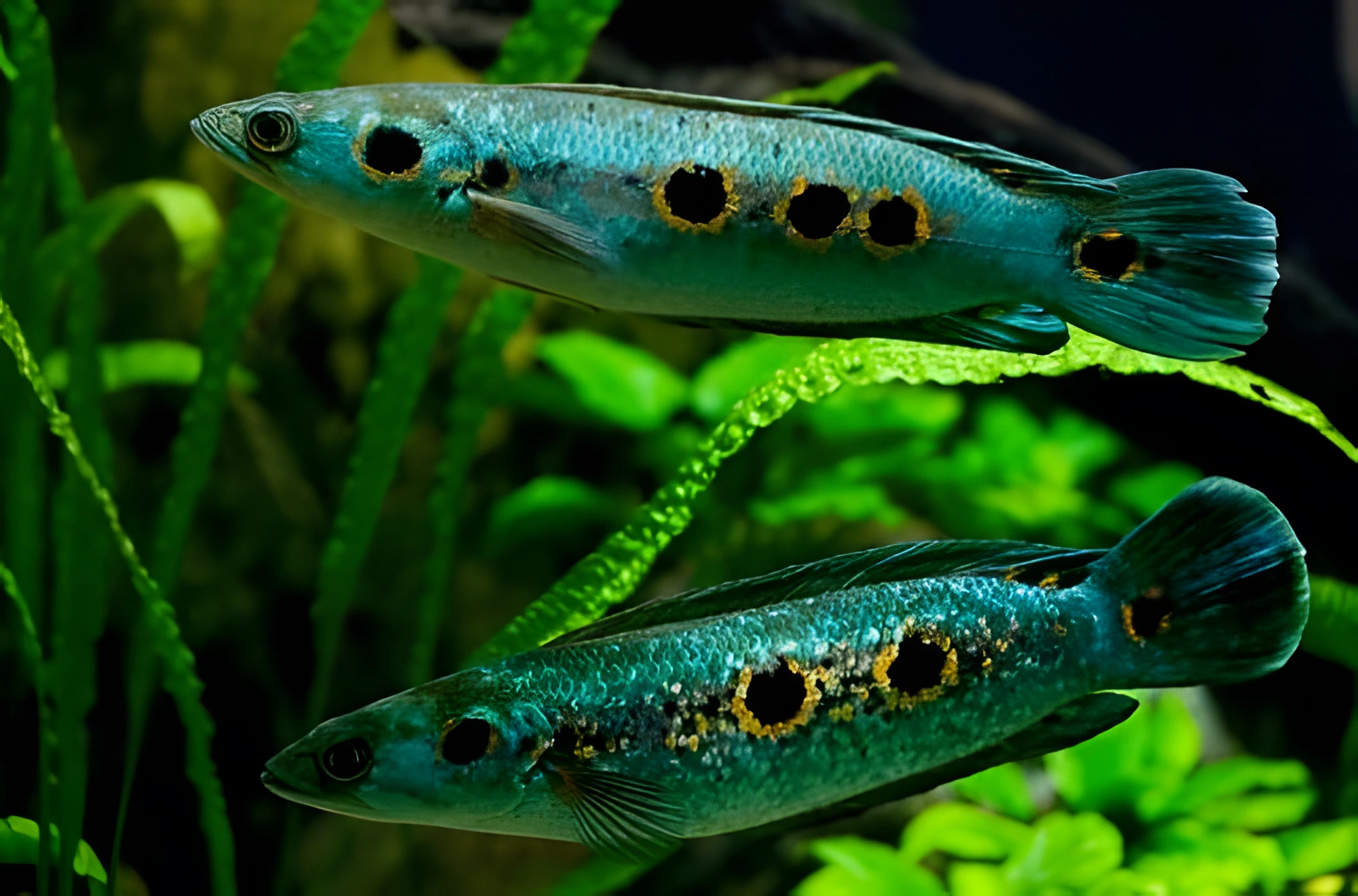
The Ornate Snakehead (Channa pleurophthalma) is a species belonging to the family Channidae, or Snakeheads. Its scientific name is Channa pleurophthalma. A distinctive feature of its appearance is the expressive black spots with light-colored outlines that adorn the fish's body and gave the entire species its name.
- Required aquarium volume
- 500 L
- Size in aquarium
- 40 cm
- Temperature
- 22 – 28 °C
- Temperament
- Semi-peaceful (including aggression during spawning / intraspecific conflicts)
Parameters
Water pHSlightly acidic (6) – Neutral (7.5)
Water dHVery soft (3) – Hard (15)
Water salinityno salt (freshwater)
Size in aquarium40 cm
Lifespan15 years
TemperamentSemi-peaceful (including aggression during spawning / intraspecific conflicts)
Toward small fishpredator
Required aquarium volume500 L
Lightingdimmed
Substrateany, but dark
Water flownone or stagnant (no flow)
FeedingMeat / protein (live, frozen, fresh)
CareBoth solitary and in group (flexible)
Description
Adults grow up to 40 cm in length. A distinguishing characteristic of this species, unlike many other Snakeheads, is not only its elongated but also somewhat laterally compressed body, rather than being almost cylindrical like a snake. The fish's body features two or three large black spots, surrounded by an orange outline, making them resemble eyes. Additional 'eyespots' are present on the operculum and at the base of the caudal fin. Males are distinguished by a predominance of blue hues in their coloration, while females have dominant greenish tones. However, it's worth noting that the coloration is not always vibrant: sometimes gray shades may prevail, while the characteristic spotted pattern remains. Young fish are more modestly colored: a basic gray color is combined with a light belly, and the dark spots are not as clearly defined.
Habitat
This species originates from Southeast Asia, found in the river systems of Sumatra and Borneo (Kalimantan) islands. It can be found in various biotopes, from clear shallow streams with fast currents to tropical swamps where the water takes on a dark brown hue due to abundant fallen vegetation and a high concentration of tannins.
Behavior and Compatibility
This species is one of the rare representatives of Snakeheads capable of coexisting peacefully in groups once they reach adult size. Most other species lead solitary lives and show aggression towards their conspecifics. Given the significant size of the Ornate Snakehead and its predatory lifestyle, a species-specific aquarium is recommended for it. In very spacious tanks, cohabitation with large fish species that will not be perceived as potential prey is possible.
Care and Maintenance
The recommended aquarium volume for keeping a single fish starts from 500 liters. A distinctive feature of the Ornate Snakehead, setting it apart from many other members of its genus, is its active swimming in the water column, rather than constant dwelling near the bottom. Therefore, when aquascaping, ample open spaces for free movement should be provided, along with several shelters created from large snags or dense plant thickets. Dim lighting is preferable; floating vegetation can be placed on the water's surface for shading. It is important to note that these fish are capable of escaping from the aquarium if the distance from the water surface to the edge is sufficiently small. To prevent such incidents, a reliable lid or other protective device must be used. Since Snakeheads have the unique ability to breathe atmospheric air, a lack of access to air can lead to their demise. When using a lid, an air gap must be left between it and the water surface. The fish are quite sensitive to changes in water parameters. When performing aquarium maintenance and water changes, it is extremely important to avoid sharp fluctuations in pH, GH, and temperature. The Snakehead is a predator; it eats everything it can swallow. In its natural environment, its diet consists of small fish, amphibians, various insects, worms, crustaceans, and other similar organisms. In home conditions, it can be adapted to alternative fresh or frozen foods, such as fish fillets, shrimp, mussel meat, large earthworms, and other suitable products. Offering live food is not mandatory. Sources: Wikipedia, FishBase.
Diet
This species is a predator; its diet includes everything it can swallow. In its natural habitat, it feeds on small fish, amphibians, insects, worms, as well as crustaceans and other similar organisms. In a home aquarium, it can be successfully accustomed to alternative fresh or frozen foods, such as pieces of fish, shrimp, mussels, as well as large earthworms and other nutritious products. Feeding live organisms is not a necessity.
Breeding and Reproduction
Reliable information on the breeding of the Ornate Snakehead in captivity is currently unavailable. In their natural habitat, fish form temporary pairs that exhibit parental care. Spawning occurs in coastal areas of water bodies among dense vegetation. It is known that parents may build a bubble nest where the eggs incubate, and after the fry hatch, the pair jointly guards the offspring from predators.
Diseases
Snakeheads are susceptible to a number of specific conditions, often related to water quality and the presence of parasites. Individuals recently offered for sale often have internal parasites, requiring treatment with anthelmintic agents. High sensitivity to the accumulation of nitrogenous compounds and excess organic matter in the water can lead to bacterial infections, manifesting as fin erosion, a film on the body, or cloudy eyes. In severe forms of disease, ruffled scales and abdominal swelling are often observed, indicating damage to internal organs. For prevention, it is necessary to maintain clean water, avoid using live fish from questionable sources as food, and ensure regular filtration.
How to choose
When purchasing, choose active fish with clean skin without visible ulcers, damage, or grayish film. It is important to pay attention to behavior: a healthy individual should show interest in its surroundings, rather than exhibiting apathy or constantly hovering near the water surface, unless this is normal for the species under specific conditions. Be sure to ask the seller what the fish eats, as accustoming a predator to non-live foods can be difficult. Avoid purchasing individuals with signs of emaciation, sunken bellies, or obvious body deformities.
Frequently asked questions
The essentials: size, tank volume, water parameters and care
How big does Ornate Snakehead get?
An adult reaches 40 cm in length. Plan the tank around the maximum size: the fish quickly outgrows a cramped setup.
What size aquarium does Ornate Snakehead need?
The minimum recommended volume is 500 L. A smaller tank speeds up nitrate build-up and raises stress levels.
What water parameters does Ornate Snakehead need?
Temperature 22–28 °C, pH 6–7.5, hardness 3–15 dGH. Stability matters more than exact values: sudden swings are harder on the fish than a small deviation from the ideal.
How long does Ornate Snakehead live?
Around 15 years when kept properly. Lifespan depends directly on tank volume, water quality and a varied diet.
Is Ornate Snakehead aggressive?
Temperament: semi-peaceful (including aggression during spawning / intraspecific conflicts). This is a predatory species — any fish small enough to fit in its mouth will eventually be eaten.
How many Ornate Snakehead should be kept together?
Recommended setup: both solitary and in group (flexible). Ignoring this is a common cause of stress and disease.
What does Ornate Snakehead eat?
Diet type: meat / protein (live, frozen, fresh). Feed small portions that are finished within a couple of minutes — overfeeding does more harm than underfeeding.
What is the scientific name of Ornate Snakehead?
The scientific name of the species is Channa pleurophthalma, family Snakeheads (Channidae). It also appears in the literature as: Ophicephalus pleurophthalmus, Ophicephalus spiritalis, Ophicephalus urophthalmus.