Temperature15 – 28 °C
Natural range
- Northeast India area
- West Bengal area
Predators Unusual
The scientific name Channa andrao belongs to the Channa andrao snakehead, a representative of the family Channidae (snakeheads). Although this fish was described by researcher Ralf Britz in 2013, it was known to aquarists earlier under many other names. Among them, the most common are Assam Snakehead and Bleher's Blue Snakehead. Among Russian-speaking audiences, this fish is often called the Dwarf Blue Snakehead or even “Andryusha,” due to its phonetic similarity to the English pronunciation.
- Required aquarium volume
- 70 L
- Size in aquarium
- 10 – 11 cm
- Temperature
- 15 – 28 °C
- Temperament
- Aggressive / incompatible / unfriendly
Parameters
Water pHSlightly acidic (6) – Slightly alkaline (8)
Water dHVery soft (3) – Very hard (20)
Water salinityno salt (freshwater)
Size in aquarium10 – 11 cm
Lifespan8 years
TemperamentAggressive / incompatible / unfriendly
Toward small fishpredator
Required aquarium volume70 L
Lightingdimmed
Substrateany, but dark
Water flownone or stagnant (no flow)
FeedingMeat / protein (live, frozen, fresh)
CarePair (male/female)
Description
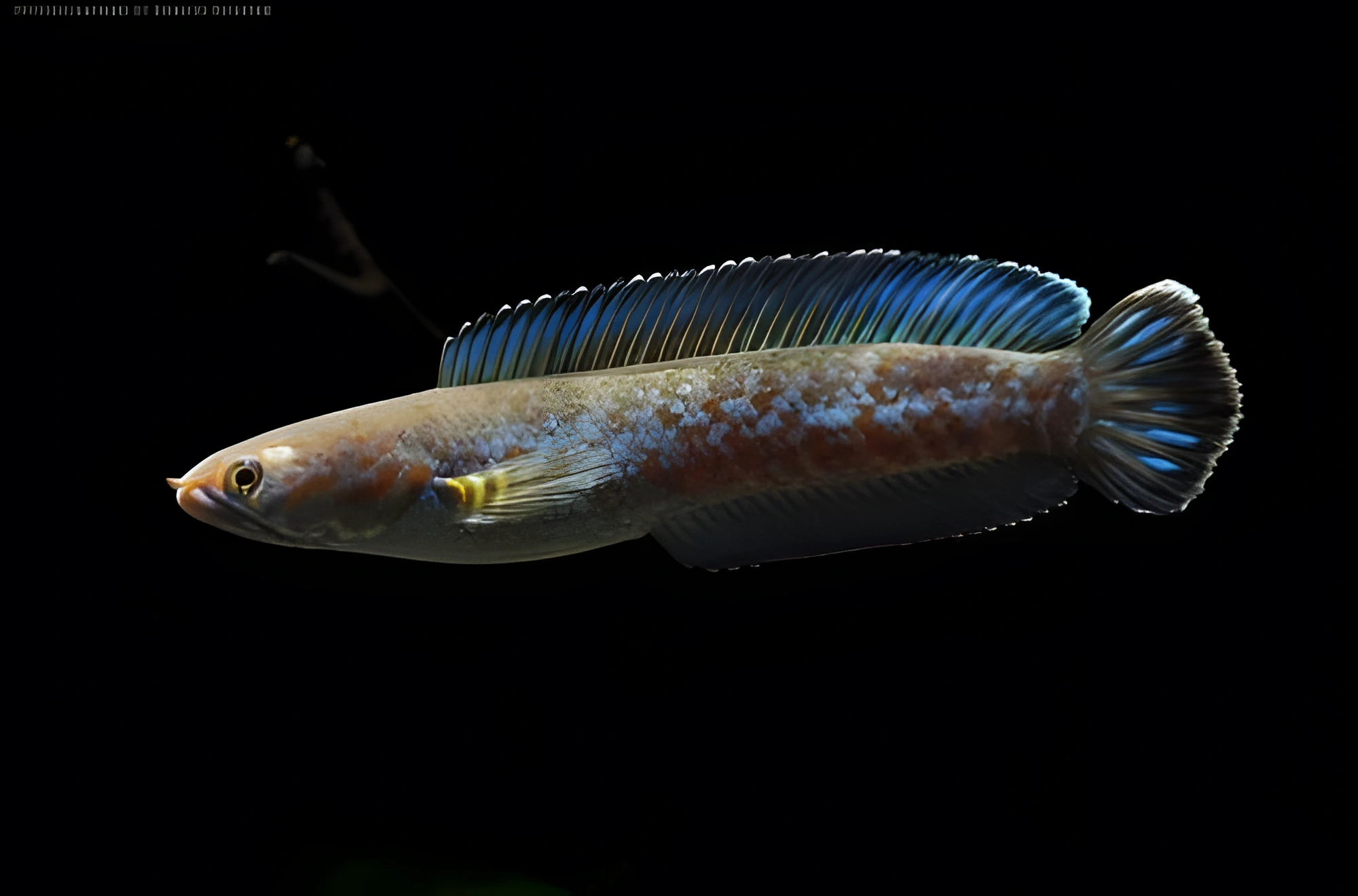
Adult snakeheads reach a length of 11 cm or more. Males are distinguished by a dark body coloration, adorned with numerous blue or light blue markings in the form of speckles and dots. Females additionally show orange hues. The fins and tail are decorated with blue pigment between the rays, with a characteristic light edging. Since they encounter drying water bodies in their natural habitat, these fish have developed an adaptive mechanism during evolution that allows them to breathe atmospheric air. It is thanks to this that they can stay in burrows and emerge from them to hunt.
Habitat
This species originates from South Asia. Channa andrao is endemic to the swampy areas of the Brahmaputra River basin, located in northeastern India. These places are situated between the Raidak and Sankosh rivers, near the town of Barobisha. The habitat is characterized by relatively cool water, the temperature of which can drop to 15°C even in summer, due to the active melting of Himalayan glaciers. The water level here is also unstable and depends on the alternation of dry and wet seasons. A typical biotope is a shallow forest swamp with turbid water and an abundance of aquatic, including submerged, vegetation. During the dry months, when the monsoons subside, the swamps can dry out, turning into muddy puddles. Snakeheads survive this period in deep, water-filled burrows, emerging only to hunt.
Behavior and Compatibility
Fry and juvenile fish can be kept in groups. However, as they mature and reach sexual maturity, they begin to show aggression towards each other. Nevertheless, during maturation, pairs can form that are then able to coexist peacefully. In most cases, keeping these fish individually is preferable. Channa andrao is a predator, but due to its modest size, it can get along with species of comparable size that inhabit the water column or near the surface. At the same time, bottom-dwelling and territorial fish, such as various catfish and loaches, should not be considered as tank mates.
Care and Maintenance
For keeping a single fish, the optimal aquarium volume starts from 70–80 liters. Here, the bottom area is more important than the tank height, which can be as little as 30 cm. The fish prefers dim lighting and many shelters at the bottom, for which soft substrate, a layer of fallen leaves, natural snags, as well as floating and rooted plants are used. Snakeheads can climb out of the aquarium, so it must be equipped with a lid or other protective device. It is also important to ensure an air gap between the lid and the water surface, which the fish needs for breathing. This species is hardy, adapts well to a wide range of pH and GH values, and is not sensitive to the oxygen level in the water. Special requirements apply to the temperature regime. Seasonal temperature fluctuations are recommended: for example, in the summer months, it can be kept at the upper limit of the permissible range, and in winter – at the lower. Thus, for several months, the aquarium can do without heating. Aquarium maintenance is standard: it includes weekly partial water changes, removal of accumulated waste, equipment prophylaxis, and cleaning of glass and decor elements (if necessary) from plaque. In their natural environment, they feed on insects and their larvae, worms, other invertebrates, as well as small fish, amphibians, and anything they can swallow. In a home aquarium, alternative products such as fresh or frozen pieces of fish meat, shrimp, mussels, earthworms, large bloodworms, etc., are acceptable. Additions of ordinary dry foods are welcome, but they should be considered exclusively as a source of vitamins and trace elements, not a complete replacement for the main diet. Sources: Wikipedia, FishBase
Diet
In natural conditions, the diet of Channa andrao consists of insects and their larvae, various worms, other invertebrates, as well as small fish, amphibians, and anything the fish is capable of swallowing. For a home aquarium, alternative products can be used, including fresh or frozen pieces of fish meat, shrimp, mussels, as well as earthworms and large bloodworms. In addition, it is desirable to add ordinary dry foods, but exclusively as a source of vitamins and trace elements, not replacing the main diet with them.
Breeding and Reproduction
Channa andrao is a mouth-brooding species. For successful breeding, it is recommended to acquire a group of 6–8 young individuals and allow them to form a pair independently. After a pair has formed, the other fish must be removed, as the breeders show high territorial aggression during spawning and fry care. Spawning is stimulated by imitating seasonal changes: maintaining a consistently high water temperature without regular water changes and aquarium maintenance. During spawning, the pair performs characteristic embraces, after which the male collects the fertilized eggs in his mouth. Incubation lasts about 3–5 days. After the fry hatch, the parents may continue to care for them for several weeks, with the female often laying unfertilized eggs, which serve as food for the growing offspring.
Diseases
Snakeheads are sensitive to water quality, so the accumulation of nitrogenous compounds and excess organic matter often lead to the development of bacterial infections, manifesting as fin rot, the appearance of a light fringe on them, or ulcerative skin lesions. The species is also prone to internal parasite infections, which requires control when acquiring individuals. Disease prevention involves maintaining high water purity, regular water changes, and providing a balanced diet. If symptoms of malaise appear, such as reduced activity, buoyancy problems, or refusal to feed, it is necessary to promptly check water parameters and exclude the presence of infectious agents.
How to choose
When choosing a Channa andrao, pay attention to the fish's activity and the condition of its skin: there should be no ulcers, wounds, or signs of fin damage on the body. A healthy individual should show curiosity and interest in its surroundings, and not appear apathetic or emaciated. It is important to consider that this species is a territorial predator, so when purchasing a group of fish for subsequent pair formation, it is worth choosing individuals of comparable size. There is a risk of acquiring wild-caught fish, which may be carriers of parasites, so it is recommended to clarify the origin of the fish and its quarantine conditions at the store beforehand.
Frequently asked questions
The essentials: size, tank volume, water parameters and care
How big does Channa andrao get?
An adult reaches 10–11 cm in length. Plan the tank around the maximum size: the fish quickly outgrows a cramped setup.
What size aquarium does Channa andrao need?
The minimum recommended volume is 70 L. A smaller tank speeds up nitrate build-up and raises stress levels.
What water parameters does Channa andrao need?
Temperature 15–28 °C, pH 6–8, hardness 3–20 dGH. Stability matters more than exact values: sudden swings are harder on the fish than a small deviation from the ideal.
How long does Channa andrao live?
Around 8 years when kept properly. Lifespan depends directly on tank volume, water quality and a varied diet.
Is Channa andrao aggressive?
Temperament: aggressive / incompatible / unfriendly. This is a predatory species — any fish small enough to fit in its mouth will eventually be eaten.
How many Channa andrao should be kept together?
Recommended setup: pair (male/female). Ignoring this is a common cause of stress and disease.
What does Channa andrao eat?
Diet type: meat / protein (live, frozen, fresh). Feed small portions that are finished within a couple of minutes — overfeeding does more harm than underfeeding.
What is the scientific name of Channa andrao?
The scientific name of the species is Channa andrao, family Snakeheads (Channidae).