Temperature22 – 25 °C
Natural range
- Thailand area
- Laos area
- Cambodia area
- Vietnam area
CyprinidsConservation status: Least concern LC
Other scientific names: Labeo neilli, Osteochilus duostigma, Osteochilus hasselti, Osteochilus kuhlii, Osteochilus melanopterus, Osteochilus neilli
The Hard-lipped Barb, also known by its scientific names Osteochilus hasseltii or Osteochilus vittatus, is part of the Cyprinidae family. This large, active fish includes several subspecies, each distinguished by the coloration of its caudal fin. In Asian countries, it is often caught on an industrial scale. Although it is quite unpretentious and does not require complex care, its significant size as an adult limits its popularity among aquarium enthusiasts.
- Required aquarium volume
- 680 L
- Size in aquarium
- 30 cm
- Temperature
- 22 – 25 °C
- Temperament
- Peaceful, active/mobile
Parameters
Water pHSlightly acidic (6) – Slightly alkaline (8)
Water dHSoft (5) – Hard (12)
Water salinityno salt (freshwater)
Size in aquarium30 cm
Lifespan10 years
TemperamentPeaceful, active/mobile
Toward small fishnot a predator
Required aquarium volume680 L
Lightingdimmed
Substratesandy (regular, light)
Water flownone or stagnant (no flow)
FeedingSinking (plant-based)
CareSchooling (usually from 5–6 individuals and more)
Description
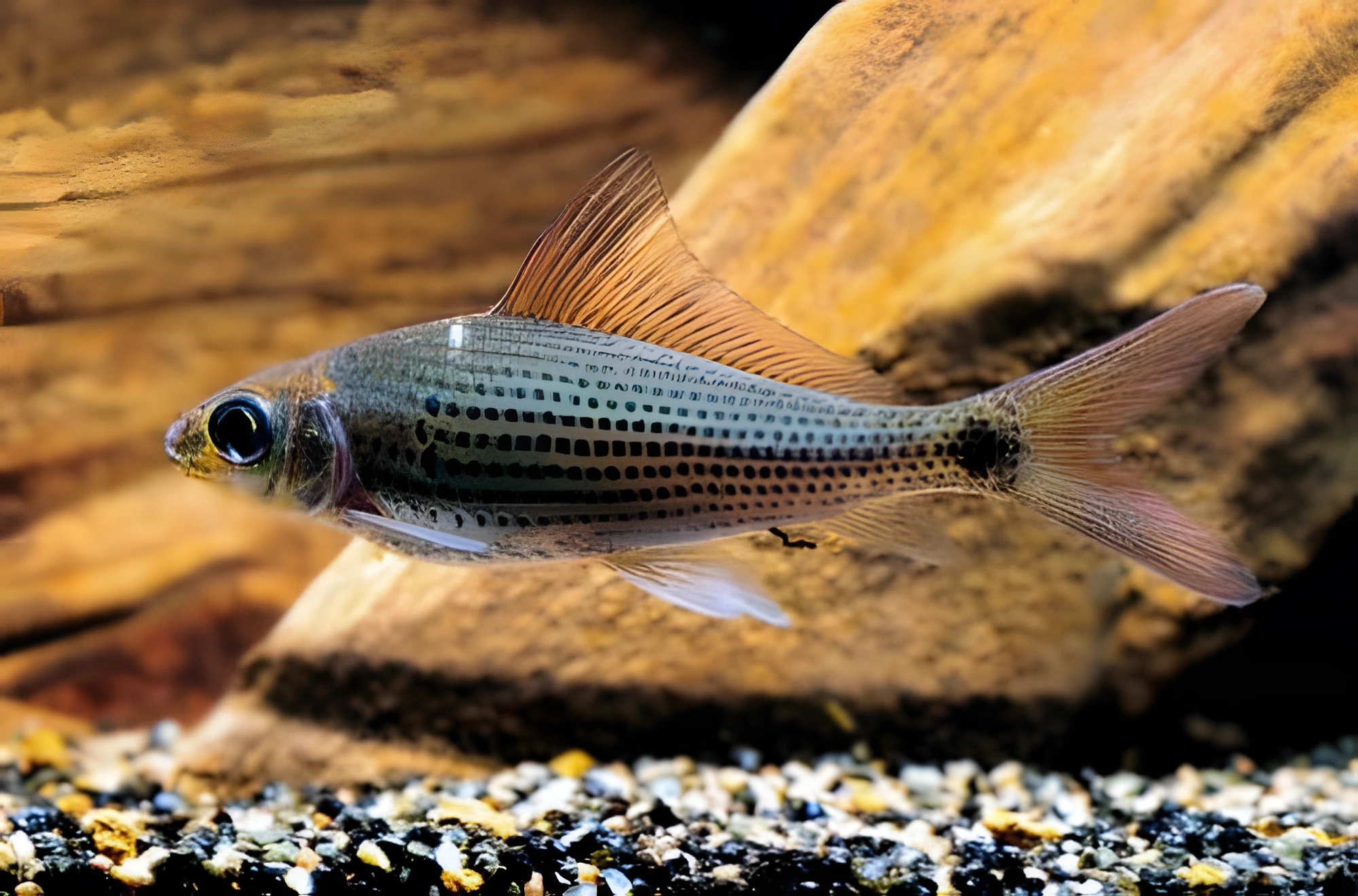
These individuals grow up to 30 cm in length. It is almost impossible to distinguish males from females by external signs. The fish's coloration is silvery, and horizontal rows of black dots run along its body, extending from the head to the tail. The caudal fin can be translucent or have a reddish tint, depending on the specific subspecies.
Habitat
The natural habitat of this species covers most of Southeast Asia, including territories of modern states such as Thailand, Laos, Cambodia, Vietnam, as well as the islands of Borneo, Sumatra, and Java. The Hard-lipped Barb prefers to live in large and medium-sized rivers, lakes, and reservoirs, favoring areas with slow currents and soft substrate. During the rainy season, they migrate to flooded areas of tropical forests for spawning.
Behavior and Compatibility
Despite their size, adult Hard-lipped Barbs are quite timid and can be easily frightened by smaller but aggressive species. They get along well with other active fish of similar or slightly smaller size. Very small aquarium inhabitants may accidentally become their prey, so it is not recommended to keep them with these giants. The Hard-lipped Barb is a schooling fish; within the group, a peculiar hierarchy forms, including dominant and subdominant individuals. Therefore, fish should be kept in groups of at least 5 individuals to avoid aggression towards other species.
Care and Maintenance
For keeping this species, an aquarium of impressive volume, at least 600 liters, is necessary. The Hard-lipped Barb feels better in dim lighting, so in addition to a low-power lighting system, it is recommended to use floating plants that create additional shading. Soft sand is preferred as a substrate, and large snags, roots, and tree branches are suitable for bottom decor. Rooted plants should not be planted directly into the substrate; it is better to use special pots for them, which are then embedded in the substrate. Essential equipment includes a filtration system appropriate for the tank volume, an aerator, heaters, and a combination of lamps. Water conditions should maintain a weak internal current, low content of dissolved calcium and magnesium salts (dGH indicator), and a pH level close to neutral. More detailed information on pH and dGH parameters can be found in the section "Hydrochemical composition of water." Aquarium care involves weekly water changes of 20–25% of the volume with fresh water, as well as regular cleaning of the substrate from organic waste and removal of plaque from the glass.
Diet
Belonging to omnivorous species, the Hard-lipped Barb readily consumes all types of food — dry, frozen, and live, especially with vegetable additives. The main requirement for food is that it must be sinking, not remaining on the water surface. In search of food, these fish constantly dig up the bottom, which can lead to damage to plant roots and consumption of delicate young shoots. Feeding is recommended two to three times a day, giving an amount of food that the fish can eat in 5 minutes.
Breeding and Reproduction
In Southeast Asia, these fish are bred on special fish farms for commercial purposes. Reproduction of the Hard-lipped Barb in home aquariums is practically impossible.
Diseases
This species possesses exceptional endurance. Health problems, if they arise, are in most cases directly related to unsuitable keeping conditions or poor-quality food. If signs of illness are detected, first of all, the water parameters and quality should be thoroughly checked, corrected to normal if necessary, and only then should treatment begin. More detailed information on symptoms and treatment methods is presented in the section "Diseases of Aquarium Fish."
How to choose
When selecting individuals, attention should be paid to their activity and the absence of visible damage, such as ulcers, white spots, or fin rot. The fish should show interest in its surroundings, rather than constantly hiding in the corners of the aquarium. Avoid purchasing specimens with signs of emaciation or an unnaturally bloated abdomen.
- prefer individuals with clear eyes and intact scales
- check how the fish react to food in the store to ensure their healthy appetite
- clarify the keeping conditions in the retail aquarium, as stress from transportation and changes in water parameters can negatively affect the species' adaptation
Frequently asked questions
The essentials: size, tank volume, water parameters and care
How big does Hard-lipped Barb get?
An adult reaches 30 cm in length. Plan the tank around the maximum size: the fish quickly outgrows a cramped setup.
What size aquarium does Hard-lipped Barb need?
The minimum recommended volume is 680 L. A smaller tank speeds up nitrate build-up and raises stress levels.
What water parameters does Hard-lipped Barb need?
Temperature 22–25 °C, pH 6–8, hardness 5–12 dGH. Stability matters more than exact values: sudden swings are harder on the fish than a small deviation from the ideal.
How long does Hard-lipped Barb live?
Around 10 years when kept properly. Lifespan depends directly on tank volume, water quality and a varied diet.
Is Hard-lipped Barb aggressive?
Temperament: peaceful, active/mobile. Keep this in mind when choosing tank mates.
How many Hard-lipped Barb should be kept together?
Recommended setup: schooling (usually from 5–6 individuals and more). Ignoring this is a common cause of stress and disease.
What does Hard-lipped Barb eat?
Diet type: sinking (plant-based). Feed small portions that are finished within a couple of minutes — overfeeding does more harm than underfeeding.
What is the scientific name of Hard-lipped Barb?
The scientific name of the species is Osteochilus vittatus, family Cyprinids (Cyprinidae). It also appears in the literature as: Labeo neilli, Osteochilus duostigma, Osteochilus hasselti.