Temperature23 – 28 °C
Other scientific names: Trichogaster leeri, Trichopus cantoris, Trichopus leerii
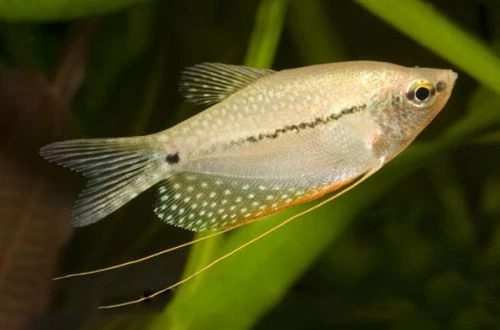
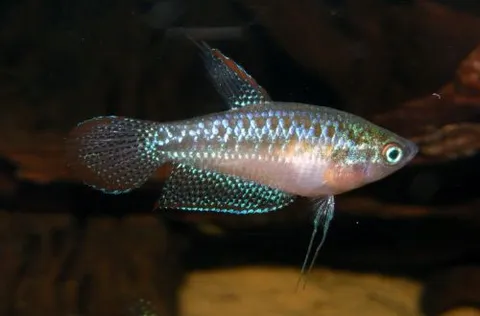
The Pearl Gourami, known scientifically as Trichopodus leerii, is a member of the Osphronemidae family. This fish is rightfully considered one of the most attractive among freshwater aquarium inhabitants. Its name is due to its unique mosaic pattern, consisting of numerous speckles and dots that resemble tiny pearls in color. Distinguished by its extraordinary hardiness and unpretentiousness, this species is perfectly suited even for beginner aquarists.
The fish is characterized by an elongated oval body shape, which is moderately compressed laterally. Its dorsal and anal fins are elongated, and in males, they are pointed. The pelvic fins are filamentous structures that function as highly sensitive sensory organs, which the Gourami uses to explore its surroundings. Like other labyrinth fish, it can absorb atmospheric oxygen directly from the air by gulping it from the water surface. In the fish's oral cavity, there is a special organ rich in numerous capillaries, which is a precursor to lungs. The main body coloration varies from brownish to reddish-brown hues, adorned with numerous light speckles and dots, which also extend to the tail and fins. A delicate brown lacy stripe runs along the body, gradually narrowing towards the caudal fin. The male differs from the female by a more slender physique, as well as elongated and pointed dorsal and anal fins. During spawning, the chest area of males acquires a rich red hue.
The Pearl Gourami is native to Southeast Asia. European researchers first discovered it in the mid-19th century. In the wild, these fish can be found in the territories of modern Thailand and Malaysia, as well as on the islands of Borneo and Sumatra. Despite a significant decline in wild populations in recent decades, this factor does not affect the aquarium fish market due to established mass production in Eastern Europe and the Far East. In natural conditions, Gouramis inhabit lowland swamps with acidic water environments, rivers and backwaters with abundant vegetation, as well as small ponds and lakes. Their diet primarily consists of various crustaceans, insect larvae, and zooplankton.
This species is the most peaceful among gouramis, making it an ideal choice for forming a small community of fish. In a new environment, they can be timid, preferring to hide behind shelters until they adapt to the aquarium. It is important to choose either members of the same species or other calm fish of similar size as tank mates. Very small fish can become prey, as they serve as a food source for gouramis in their natural habitat.
For comfortable keeping, it is recommended to acquire a spacious aquarium of approximately 140–150 L, equipped with a built-in lid. Such a lid not only prevents accidental entry of debris, dust, and foreign objects into the water but also contributes to the formation of an air layer with increased humidity and temperature. This air layer reduces the risk of damage to the fish's labyrinth organ during the process of gulping atmospheric air. The essential minimum set of equipment includes a filter, heater, aerator, and lighting system. The filter should ensure effective water purification while minimizing water movement. In decorating the aquarium, prioritize large plants with well-developed root systems, optimally placing them along the back and side walls of the tank. The presence of floating plants, which create additional shading, is welcome. Place several shelters and hiding spots in the form of grottoes, driftwood, or artificial decorations (e.g., a sunken ship or castle), ensuring their number corresponds to the number of fish. Dark substrate is preferred, and the particle size can be any.
In aquarium conditions, these fish readily accept a variety of dry foods, available as both flakes and granules. Specialized products developed by many manufacturers specifically for gouramis are easily found on the market. To enrich their daily menu, you can regularly add bloodworms, mosquito larvae, as well as chopped fresh vegetables such as lettuce leaves, spinach, or cucumbers. When using specialized foods, it is important to follow the recommendations on the packaging. If other types of food are offered, the optimal feeding frequency will be twice a day. If meat products are included in the diet, it is reasonable to reduce the feeding frequency to once a day.
Pearl Gouramis breed quite easily in a home aquarium. During spawning, males build bubble nests and engage in skirmishes with each other. These clashes are more ritualistic; serious injuries are extremely rare; the fish touch mouths and push each other. If more than two fish are kept in the aquarium, it is advisable to have an additional tank (quarantine aquarium) so that the fry are safe and do not become victims of adult individuals. Spawning is triggered under the following conditions: the presence of dense thickets of root plants, a reduction of the water level to 15–20 cm, maintaining a temperature of 28°C and a pH close to 7.0, and the inclusion of meat products in the daily diet. After some time, the female begins to accumulate eggs, and the male starts building a nest from air bubbles and plant fragments. Upon completion of construction, the courtship period begins – the male swims around the female, inviting her to the nest, while his coloration becomes brighter and his fins spread. Adults can produce up to 2000 eggs, which are carefully transferred to the nest and remain under the male's protection until the fry emerge.
These fish are hardy and undemanding, but they require a high ambient temperature. In cold water, Pearl Gouramis become more susceptible to diseases.
When selecting Pearl Gouramis in a store, pay attention to the activity and appearance of the individuals. A healthy fish should have clean fins without signs of erosion or white film, clear eyes, and no visible ulcers or spots on the body. Avoid specimens with sunken bellies, signs of emaciation, or those that constantly stay at the water surface, unless it is due to fright. Given the timid nature of the species, fish may hide in the store, so ask the seller to feed them: healthy gouramis show interest in food. Before purchasing, be sure to clarify the quarantine conditions in the store, as the risk of introducing infections with new individuals is high, and upon arrival home, it is recommended to keep them in a separate tank for at least two weeks.
The essentials: size, tank volume, water parameters and care
An adult reaches 10 cm in length. Plan the tank around the maximum size: the fish quickly outgrows a cramped setup.
The recommended volume is 140 L. A smaller tank speeds up nitrate build-up and raises stress levels.
Temperature 23–28 °C, pH 6–8, hardness 5–19 dGH. Stability matters more than exact values: sudden swings are harder on the fish than a small deviation from the ideal.
Around 8 years when kept properly. Lifespan depends directly on tank volume, water quality and a varied diet.
Temperament: peaceful (regular). Keep this in mind when choosing tank mates.
Recommended setup: small group (5–6 individuals). Ignoring this is a common cause of stress and disease.
Diet type: any (universal). Feed small portions that are finished within a couple of minutes — overfeeding does more harm than underfeeding.
The scientific name of the species is Trichopodus leerii, family Osphronemidae. It also appears in the literature as: Trichogaster leeri, Trichopus cantoris, Trichopus leerii.
Matched by family, categories and overlapping keeping conditions
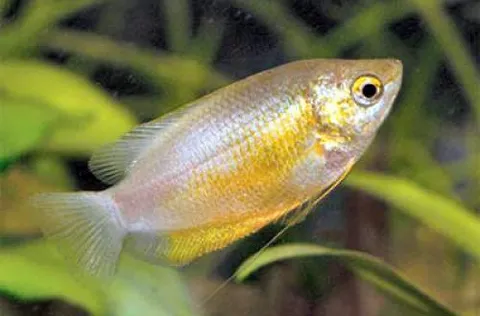
Trichogaster labiosa
Trichogaster labiosa, more commonly known as the Thick-lipped Gourami or Labiosa, belongs to the family Osphronemidae. This fish will be a wonderful addition to any aquarium. Thanks to its modest size and natural,…
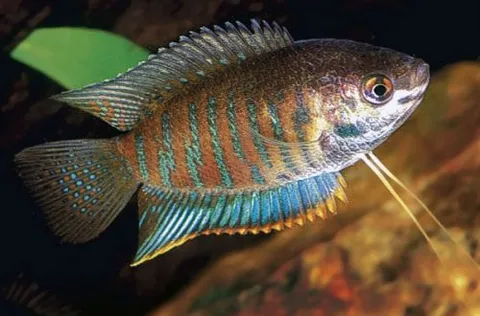
Trichogaster fasciata
Trichogaster fasciata, also known as the Banded Gourami or Striped Gourami, belongs to the family Osphronemidae. This fish possesses a range of qualities that make it an excellent choice for beginner aquarists: it is…
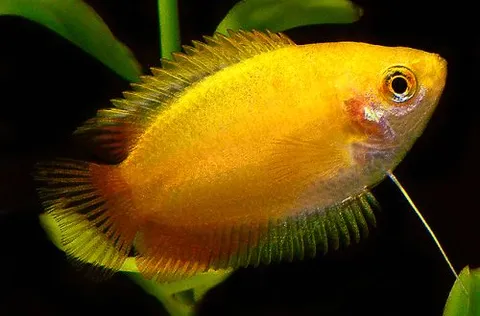
Trichogaster chuna
Trichogaster chuna, more commonly known as the Honey Gourami, is a member of the Osphronemidae family. This small, graceful fish is characterized by its soft coloration, ranging from silvery-gray to delicate yellow.…
Trichopsis pumila
The Dwarf Gourami, or Pumila, known scientifically as Trichopsis pumila, is a member of the Osphronemidae family. This aquarium fish is popular due to its interesting coloration, as well as its ease of care and…