Temperature16 – 25 °C
Natural range
- Myanmar area
- Thailand area
- Laos area
- Cambodia area
CyprinidsConservation status: Least concern LC
Other scientific names: Brachydanio albolineatus, Branchydanio albolineatus, Danio pulcher, Danio stoliczkae, Danio tweedei, Danio tweediei
The fish known as the Pearl Danio (scientific name Danio albolineatus) belongs to the family Cyprinidae. These are attractive, schooling fish, characterized by their unpretentiousness. They are rightly considered among the most accessible for keeping and breeding in a home aquarium.
- Required aquarium volume
- 80 L
- Size in aquarium
- 5 cm
- Temperature
- 16 – 25 °C
- Temperament
- Peaceful, active/mobile
Parameters
Water pHSlightly acidic (6) – Slightly alkaline (8)
Water dHSoft (5) – Very hard (19)
Water salinityno salt (freshwater)
Size in aquarium5 cm
Lifespan5 years
TemperamentPeaceful, active/mobile
Toward small fishnot a predator
Required aquarium volume80 L
Lightingmoderate (regular)
Substraterocky (rock formations, boulders, etc.)
Water flowmoderate
FeedingAny (universal)
CareGroup (8–10 individuals)
Description
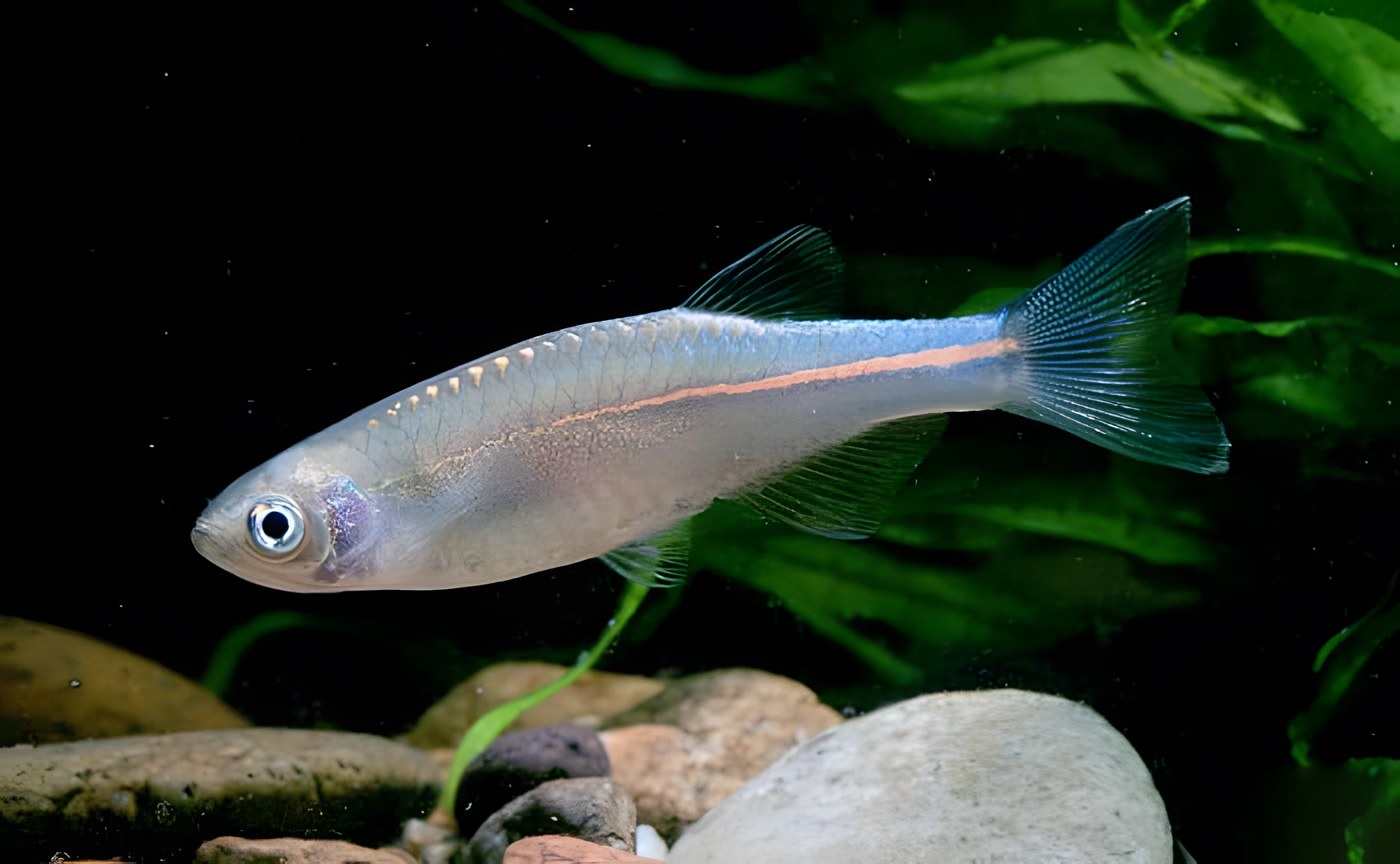
In nature, this species exhibits a variety of colorations depending on the region of origin. However, in the aquarium market, individuals raised in commercial hatcheries in Asia and Eastern Europe are more commonly found. Hybrid varieties, which are highly sought after and are the result of mixing several geographical color forms, are often supplied from these hatcheries. The Pearl Danio, most closely resembling its wild ancestors, is characterized by a light, silvery body coloration with an iridescent, pearlescent sheen. In the posterior part of the body, closer to the tail, blue or bluish hues usually predominate. A bright orange-red stripe runs along the entire length of the body, extending to the tail. The selective form, the Pearl Danio, has a slightly different coloration. Blue is dominant in this form, and in some cases, it can cover the entire body, even obscuring the contrasting orange-red stripe. Another common color form features fish with a light blue or bluish back and a silvery belly. Two narrow orange lines run along their bodies. This variety is also found in the wild. Thus, despite the names "Pearl" or "Pearlescent," this species can have a very diverse palette of colors, with blue being the most common. Adult fish reach a length of about 5 cm. Females usually appear larger and have less vibrant coloration, while males are distinguished by their more intense colors.
Habitat
The natural habitat of this species covers the Malay Peninsula, located in Southeast Asia. These fish inhabit the waters of modern states such as Myanmar, Thailand, Laos, Cambodia, Vietnam, Peninsular Malaysia, and the Indonesian island of Sumatra. They can be found in large river systems, including the Mekong, Chao Phraya, Mae Klong, Irrawaddy, and Salween, as well as in many small tributaries. These aquatic inhabitants prefer areas with clean, well-oxygenated water and rocky bottoms.
Behavior and Compatibility
This is a very peaceful and active species that is recommended to be kept in schools of 8 or more individuals. In such a group, the fish feel secure and display their most vibrant coloration. This is especially noticeable in males, who compete with each other for the attention of females. Thanks to their friendly nature and lack of strict requirements for keeping conditions, the Pearl Danio coexists successfully with many other popular aquarium fish species of similar temperament and size.
Care and Maintenance
Two main behavioral characteristics of these fish—their high activity and preference for the upper water layers—determine the specifics of aquarium design. It is important to provide ample open swimming space, avoiding excessive overgrowth of the aquarium. Tall plants are best placed along the tank walls, and dense thickets of floating plants should be avoided. A rocky substrate of fine gravel with stones of various sizes is suitable as a bottom material. Additionally, several natural snags, branches, or driftwood roots can be placed on the bottom. When choosing equipment, key attention should be paid to the filtration system. A powerful internal filter is recommended, which not only cleans the water but also creates an internal current. Water movement helps keep Danios in good condition, mimicking natural river conditions. Minimum necessary equipment also includes an aerator, heater, and lighting system. Water parameters have a wide permissible range, which usually eliminates difficulties with water preparation. Aquarium maintenance involves weekly partial water changes with fresh water, combined with siphoning organic waste from the substrate.
Diet
These fish are not demanding about food and readily accept all types of dry, frozen, and live foods. Maintaining vibrant coloration directly depends on the diet, so it is advisable to combine various types of products. For example, flakes and granules are recommended to be alternated with bloodworms and daphnia to ensure your Pearl Danio continues to delight with bright colors. Aqvium flake food is excellent for aquarium fish. Check out our new product, which has become a bestseller on Ozon with a rating of 4.9. Flake food is suitable for most aquarium fish. The raw materials for it are produced in accordance with new European Union standards (EU 2018/848) and contain vitamins A, C, D3, E, as well as Omega 3-6. The product can be purchased on Ozon.
Breeding and Reproduction
The Pearl Danio is an egg-laying species: females scatter eggs in the water column, and males fertilize them at that time. However, parental instincts in these fish are poorly developed. Immediately after spawning, adult individuals may eat both their eggs and subsequently hatched fry. To ensure the survival of offspring, breeding is recommended in a separate tank—a spawning aquarium. The setup of such an aquarium should be simple, with the main focus on the substrate, which should consist of particles large enough to create gaps between them. Excellent choices include, for example, pebbles or decorative glass beads. When the eggs sink to the bottom, a significant portion of them falls into these gaps, becoming inaccessible to adult fish. A similar effect can be achieved by using a fine-mesh net secured to the bottom. Another way to ensure egg survival is to use low-growing, fine-leaved plants or mosses, such as Riccia and Java moss, which cover most of the substrate (in this case, the type of substrate does not matter). Dense plant thickets can reliably hide eggs as well as a special substrate. The size of the spawning aquarium is usually 20–30 liters. The equipment set includes a heater and a simple air-driven sponge filter. Such a filter minimizes the risk of accidentally sucking in eggs and fry. Spawning occurs in dim light, so a light source is not required at the initial stage. Additional information on breeding Danios can be found in the relevant section. The stimulus for the start of the breeding period is an increase in water temperature to the upper permissible limit of 24–25°C at a neutral pH, as well as daily inclusion of protein-rich food—bloodworms, daphnia, artemia in live or frozen form—in the diet. After some time, females become noticeably rounded, and males acquire brighter coloration and begin to actively court their chosen mates. By this point, a separate tank should be prepared, filled with water from the main aquarium. Then, several females and the brightest males are transferred to the spawning tank. To stimulate spawning, small portions of cool water should be added every few hours, gradually lowering the temperature to about 20°C. If this procedure is carried out in the evening, the fish may spawn by morning. The end of spawning is easiest to determine by the females, who will become more slender. Adult fish are returned to the main aquarium. Fry appear after 24-36 hours, and after another day, they begin to swim freely. Feeding is done with specialized food in the form of a suspension or powder. Live Artemia nauplii are a good choice. Details on caring for Danio eggs and fry can be found in the article.
Diseases
Balanced nutrition and maintaining optimal keeping conditions are the best prevention for diseases in freshwater fish. In case of signs of illness (changes in coloration or behavior), the first step should be to check water quality and, if necessary, normalize its parameters, and then proceed with treatment. More detailed information on symptoms and treatment methods is presented in the "Aquarium Fish Diseases" section. Source of scientific data: FishBase.
How to choose
When choosing Pearl Danios, preference should be given to active and lively individuals that stay in a school. Healthy fish should have clean fins without signs of damage, growths, or ulcers, as well as a smooth body without deformities or signs of emaciation. In the store, the fish should show curiosity and react quickly to external stimuli. Avoid purchasing individuals that stay isolated, appear apathetic, or have an unnaturally bloated belly, as this may indicate hidden diseases or stress.
Frequently asked questions
The essentials: size, tank volume, water parameters and care
How big does Pearl Danio get?
An adult reaches 5 cm in length. Plan the tank around the maximum size: the fish quickly outgrows a cramped setup.
What size aquarium does Pearl Danio need?
The minimum recommended volume is 80 L. A smaller tank speeds up nitrate build-up and raises stress levels.
What water parameters does Pearl Danio need?
Temperature 16–25 °C, pH 6–8, hardness 5–19 dGH. Stability matters more than exact values: sudden swings are harder on the fish than a small deviation from the ideal.
How long does Pearl Danio live?
Around 5 years when kept properly. Lifespan depends directly on tank volume, water quality and a varied diet.
Is Pearl Danio aggressive?
Temperament: peaceful, active/mobile. Keep this in mind when choosing tank mates.
How many Pearl Danio should be kept together?
Recommended setup: group (8–10 individuals). Ignoring this is a common cause of stress and disease.
What does Pearl Danio eat?
Diet type: any (universal). Feed small portions that are finished within a couple of minutes — overfeeding does more harm than underfeeding.
What is the scientific name of Pearl Danio?
The scientific name of the species is Danio albolineatus, family Cyprinids (Cyprinidae). It also appears in the literature as: Brachydanio albolineatus, Branchydanio albolineatus, Danio pulcher.