Temperature18 – 28 °C
Natural range
- Eastern Brazil area
- Southern Brazil area
CichlidsConservation status: Least concern LC
Other scientific names: Acara gymnopoma, Acara minuta, Chromis brasiliensis, Chromys unimaculata, Geophagus olfersi, Geophagus tuberosus
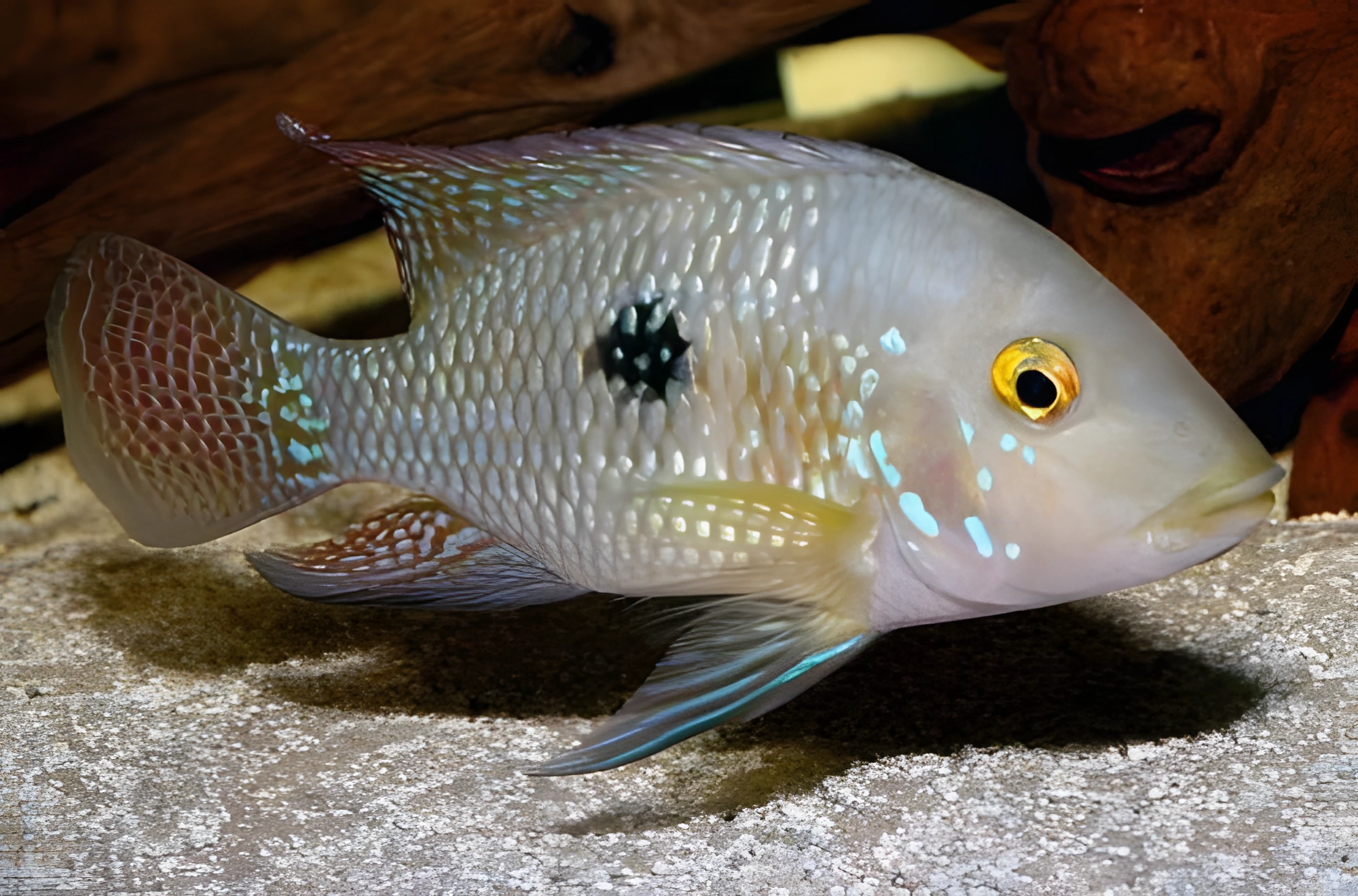
Geophagus brasiliensis, also known as the Pearl Cichlid or Brazilian Geophagus, belongs to the Cichlidae family. It is a beautiful but rather temperamental fish, characteristic of South American cichlids. It cannot be called easy to keep, as it requires a significantly sized aquarium and impeccable water quality, which implies the use of expensive and effective filtering equipment. Furthermore, it is not overly friendly towards its tank mates. Therefore, this species is not recommended for beginner aquarists.
- Required aquarium volume
- 300 L
- Size in aquarium
- 15 – 25 cm
- Temperature
- 18 – 28 °C
- Temperament
- Aggressive / incompatible / unfriendly
Parameters
Water pHSlightly acidic (6) – Slightly alkaline (8)
Water dHSoft (5) – Hard (15)
Water salinityincreased (10–15 g/L)
Size in aquarium15 – 25 cm
Lifespan12 years
TemperamentAggressive / incompatible / unfriendly
Toward small fishnot a predator
Required aquarium volume300 L
Lightingdimmed
Substratesandy (regular, light)
Water flowweak or moderate
FeedingAny (universal)
CarePair (male/female)
Description
Adult males can reach 25 cm in length, while females are significantly smaller, measuring 13–15 cm. The coloration of males is more expressive and vibrant, and they often develop a nuchal hump on their head — a characteristic feature for many cichlid species. The body pattern of the Pearl Cichlid consists of numerous turquoise speckles on a gray-blue background. These speckles are precisely what gave the species its name. It should be noted that the described characteristics refer to ornamental forms offered for sale. Wild representatives of the Brazilian Geophagus can differ significantly in size, body shape, and coloration, depending on their region of origin.
Habitat
The natural habitat of these fish covers the river systems of eastern and southern Brazil, as well as Uruguay, which flow into the Atlantic Ocean. The Pearl Cichlid has been introduced to a number of other countries, including the USA, the Philippines, Australia, and Taiwan. Representatives of this species predominantly inhabit coastal zones and lower reaches of rivers; populations are found in brackish lagoons that have permanent or temporary connections to the ocean.
Behavior and Compatibility
This species is characterized by its quarrelsome nature, especially during spawning, when males actively defend their territory from other fish. Smaller aquarium inhabitants may suffer under such conditions. In a significant aquarium of 500 liters or more, the Pearl Cichlid coexists well with non-aggressive fish of similar size. In smaller aquariums, it is wiser to limit to a single specimen or a pair, for example, a male and a female.
Care and Maintenance
For a single pair of these fish, the minimum recommended aquarium volume is 300 liters. The Pearl Cichlid inhabits a wide variety of natural conditions, so there are no particularly strict requirements for aquarium decor. As a recommendation, one can suggest using a soft sandy substrate, several snags, and smooth flat stones. It is also advisable to create subdued lighting and consider placing artificial plants, as live ones may be uprooted or damaged. Water parameters such as pH, dGH, temperature, and possible salinity have quite wide acceptable values. However, successful keeping of the fish is only possible with high water quality, achieved through the use of powerful filtration systems and regular weekly water changes of 50–70% of the volume. When using a sandy substrate, it is important to ensure that mechanical filtration is adapted to prevent sand particles from entering and causing malfunction.
Diet
The Pearl Cichlid readily accepts all common types of aquarium foods: dry, live, and frozen. To ensure full development, it is important to include plant-based and protein supplements in the daily diet. It is recommended to choose specialized foods for South American cichlids, which contain all the necessary trace elements.
Breeding and Reproduction
The Pearl Cichlid is a biparental species that forms stable pairs. To stimulate spawning, it is recommended to diversify the diet, including live foods, and maintain the water temperature in the range of 24–27 °C. The female lays 150 to 1500 eggs on a pre-cleaned substrate, such as a flat stone or a snag. Both parents actively guard the clutch and care for the offspring. Larvae appear after 36–48 hours, and after a week, the fry begin to swim freely and feed. Artemia nauplii and small plankton are used as starter food. It is recommended to sort the juveniles as they grow to prevent cannibalism.
Diseases
The main cause of most diseases in Leaf Fish is unsuitable keeping conditions and poor-quality nutrition. If initial symptoms are observed, it is first necessary to check water parameters and the concentration of dangerous substances such as ammonia, nitrites, and nitrates. If the indicators deviate from the norm, they should be brought back into order, and only then should treatment begin. More detailed information on symptoms and treatment methods can be found in the "Aquarium Fish Diseases" section.
How to choose
When purchasing, choose active fish with clean fins and no body damage. Healthy specimens exhibit a characteristic pearlescent sheen on their scales and vibrant coloration. Avoid fish with signs of lethargy, clamped fins, or an unnaturally bloated abdomen, as these may indicate illness. In the store, it is important to assess the keeping conditions in the aquarium: water cleanliness and the absence of dead specimens in the main tank. If possible, inquire about the age of the fish, as young individuals adapt more easily to new conditions, and also observe their reaction during feeding.
Frequently asked questions
The essentials: size, tank volume, water parameters and care
How big does Pearl Cichlid get?
An adult reaches 15–25 cm in length. Plan the tank around the maximum size: the fish quickly outgrows a cramped setup.
What size aquarium does Pearl Cichlid need?
The minimum recommended volume is 300 L. A smaller tank speeds up nitrate build-up and raises stress levels.
What water parameters does Pearl Cichlid need?
Temperature 18–28 °C, pH 6–8, hardness 5–15 dGH. Stability matters more than exact values: sudden swings are harder on the fish than a small deviation from the ideal.
How long does Pearl Cichlid live?
Around 12 years when kept properly. Lifespan depends directly on tank volume, water quality and a varied diet.
Is Pearl Cichlid aggressive?
Temperament: aggressive / incompatible / unfriendly. Keep this in mind when choosing tank mates.
How many Pearl Cichlid should be kept together?
Recommended setup: pair (male/female). Ignoring this is a common cause of stress and disease.
What does Pearl Cichlid eat?
Diet type: any (universal). Feed small portions that are finished within a couple of minutes — overfeeding does more harm than underfeeding.
What is the scientific name of Pearl Cichlid?
The scientific name of the species is Geophagus brasiliensis, family Cichlids (Cichlidae). It also appears in the literature as: Acara gymnopoma, Acara minuta, Chromis brasiliensis.