Temperature27 – 32 °C
Natural range
- Pará area
- Brazil area
CatfishConservation status: Near threatened NT
The Gold Nugget Pleco, or Plecostomus "Golden Nugget," scientifically known as Baryancistrus xanthellus, belongs to the Loricariidae family, which includes armored catfish. These catfish are of great interest to aquarists due to their striking spotted coloration. However, before deciding to acquire them, it's important to consider their behavioral characteristics, as their quarrelsome nature can create difficulties for other aquarium inhabitants.
- Required aquarium volume
- 250 L
- Size in aquarium
- 22 cm
- Temperature
- 27 – 32 °C
- Temperament
- Aggressive / incompatible / unfriendly
Parameters
Water pHSlightly acidic (6) – Slightly alkaline (8)
Water dHVery soft (3) – Hard (15)
Water salinityno salt (freshwater)
Size in aquarium22 cm
Lifespan10 years
TemperamentAggressive / incompatible / unfriendly
Toward small fishnot a predator
Required aquarium volume250 L
Lightingany
Substraterocky (rock formations, boulders, etc.)
Water flowmoderate or strong
FeedingPlant-based (algae, vegetables)
CareBoth solitary and in group (flexible)
Description
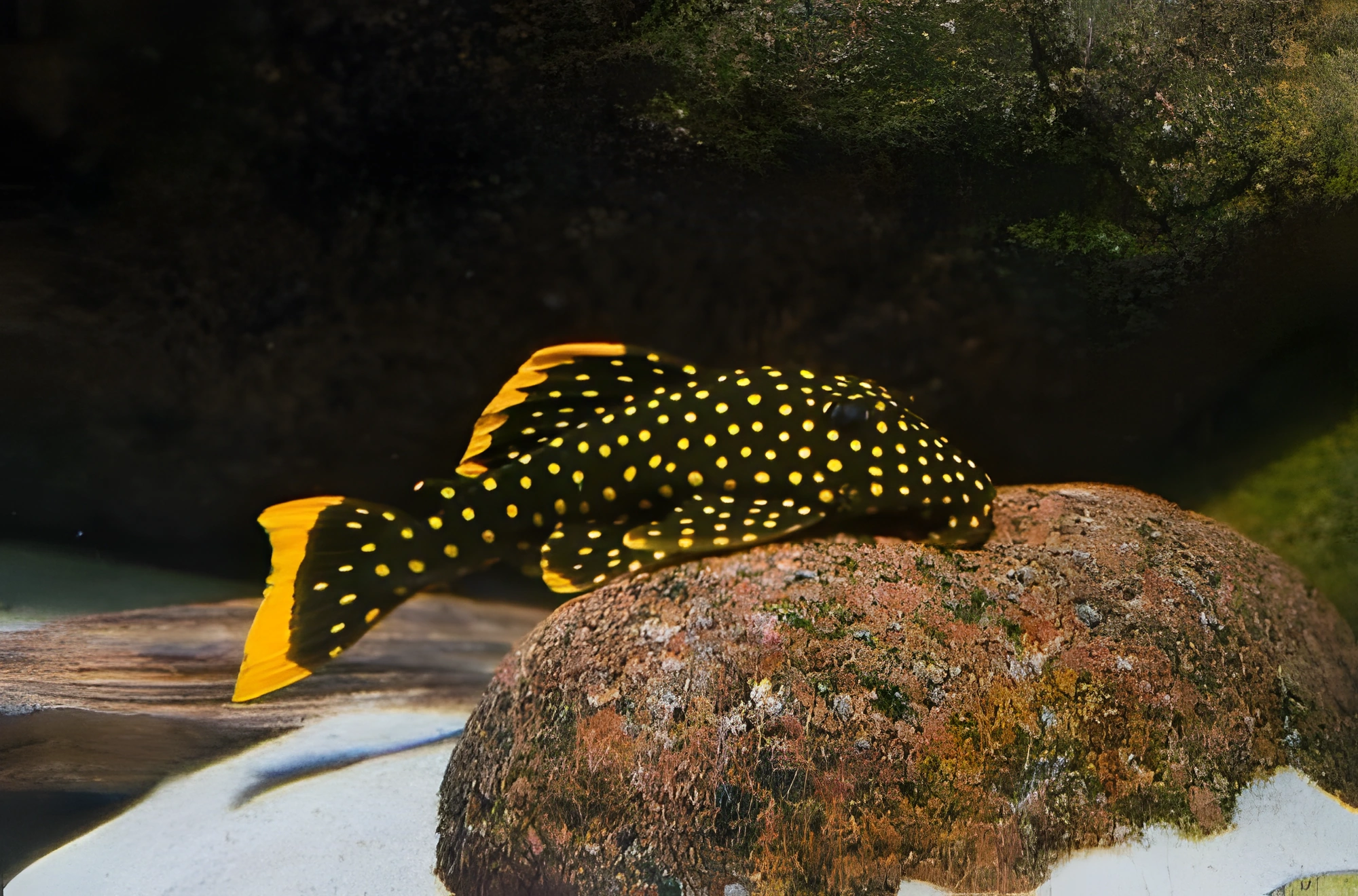
These catfish grow up to 22 cm in length. Their body is somewhat flattened and adorned with large fins. Their scales have transformed into hard plates, giving the surface a rough texture due to numerous small spines. The first rays of their fins are thickened, becoming sharp spines. This "armor" serves as reliable protection against numerous predators. Their coloration is eye-catching: a dark body is dotted with contrasting yellow spots, and the edges of the caudal and dorsal fins are the same bright color. Sexual dimorphism is weakly expressed, and differences between males and females are not obvious.
Habitat
Its homeland is South America, specifically the Brazilian state of Pará. This catfish can be found in a limited area of the Xingu River basin, a right tributary of the Amazon, between its confluence with the Iriri River and the reservoir formed by the Belo Monte hydroelectric power plant. Juveniles often gather in groups in shallow waters, while adults prefer a solitary lifestyle in the main river channels, where the bottom is covered with stones.
Behavior and Compatibility
Juveniles are peaceful and often live in large groups, but their behavior changes significantly with age. Adult catfish, especially males, begin to show aggression towards any fish, including their own kind, that enters their territory. Suitable tank mates are species that inhabit the water column or surface. Bottom-dwelling inhabitants, especially in small aquariums, should be excluded. However, if the tank volume allows, it is quite possible for more than two Plecostomus to coexist.
Care and Maintenance
For the comfortable keeping of one or two catfish, the minimum aquarium volume should be 250 liters. The decor should replicate the natural riverbed environment with rocky or sandy substrates, complemented by several large boulders and driftwood. If desired, live plants that can attach to surfaces, such as Anubias, Bolbitis, Microsorum pteropus, and similar species, can be added. Plants that require rooting in the substrate are undesirable, as they are likely to be uprooted soon after planting. When keeping Gold Nugget Plecos, it is crucial to maintain high water quality, ensuring its temperature and hydrochemical parameters are within acceptable limits, as well as a sufficient level of dissolved oxygen. These conditions are achieved through regular aquarium maintenance, including water changes and removal of organic waste, as well as the installation of necessary equipment, primarily filtration and aeration systems.
Diet
In their natural habitat, these catfish forage by scraping diatom and filamentous algae from the surface of rocks and driftwood. Along with algae, a small amount of invertebrates also enters their diet. In a home aquarium, their diet should be similar. It is recommended to include foods with a high content of plant components, as well as regularly place pieces of green vegetables and fruits on the bottom. Additional treats in the form of live or frozen bloodworms and brine shrimp will also be beneficial.
Breeding and Reproduction
Breeding these catfish presents certain difficulties, as they are not very friendly towards each other outside the breeding season, and it is also difficult to determine their sex. To guarantee the formation of at least one pair, it is often necessary to acquire several individuals in the hope that there will be a female and a male among them. A group of several adult fish, in turn, will require a spacious aquarium. As the breeding season approaches, males actively court females, inviting them to their territory on the bottom. When the female is ready to reproduce, they form a temporary pair and lay several dozen eggs, after which the female leaves the nest. The male remains to guard the clutch until the fry emerge and are able to swim independently.
Diseases
Most health problems in fish often arise from unsuitable keeping conditions. Maintaining a stable and comfortable habitat is a key factor for successful keeping. If symptoms of illness appear, the first step is to check the water quality. If deviations are found, it is important to take immediate measures to eliminate them. If the symptoms do not disappear or worsen, medicinal treatment may be required. More detailed information on symptoms and treatment methods can be found in the "Diseases of Aquarium Fish" section.
How to choose
When purchasing, choose individuals with active behavior and clean skin without signs of damage or white film. It is important to ensure there is no sunken belly, which may indicate emaciation or digestive problems, as this species is sensitive to transport and keeping conditions. It is recommended to acquire fish that have already undergone an adaptation period in the store, as freshly imported specimens are often under severe stress and do not tolerate changes in water parameters well.
Frequently asked questions
The essentials: size, tank volume, water parameters and care
How big does Gold Nugget Pleco get?
An adult reaches 22 cm in length. Plan the tank around the maximum size: the fish quickly outgrows a cramped setup.
What size aquarium does Gold Nugget Pleco need?
The minimum recommended volume is 250 L. A smaller tank speeds up nitrate build-up and raises stress levels.
What water parameters does Gold Nugget Pleco need?
Temperature 27–32 °C, pH 6–8, hardness 3–15 dGH. Stability matters more than exact values: sudden swings are harder on the fish than a small deviation from the ideal.
How long does Gold Nugget Pleco live?
Around 10 years when kept properly. Lifespan depends directly on tank volume, water quality and a varied diet.
Is Gold Nugget Pleco aggressive?
Temperament: aggressive / incompatible / unfriendly. Keep this in mind when choosing tank mates.
How many Gold Nugget Pleco should be kept together?
Recommended setup: both solitary and in group (flexible). Ignoring this is a common cause of stress and disease.
What does Gold Nugget Pleco eat?
Diet type: plant-based (algae, vegetables). Feed small portions that are finished within a couple of minutes — overfeeding does more harm than underfeeding.
What is the scientific name of Gold Nugget Pleco?
The scientific name of the species is Baryancistrus xanthellus, family Armored Catfishes (Loricariidae).