Temperature18 – 26 °C
Natural range
- Indian subcontinent area
- Pakistan area
- India area
- Sri Lanka area
CyprinidsConservation status: Least concern LC
Other scientific names: Barbus vittatus
Puntius vittatus, known as the Greenstripe Barb, belongs to the carp family (Cyprinidae). This unpretentious fish adapts well to aquarium conditions, breeds easily, and coexists harmoniously with most peaceful tank inhabitants. Despite its merits, it is not as commonly found among aquarists compared to other barbs, possibly due to its subdued coloration.
- Required aquarium volume
- 60 L
- Size in aquarium
- 3.5 – 5 cm
- Temperature
- 18 – 26 °C
- Temperament
- Peaceful (regular)
Parameters
Water pHSlightly acidic (6) – Neutral (7.5)
Water dHVery soft (2) – Hard (12)
Water salinityno salt (freshwater)
Size in aquarium3.5 – 5 cm
Lifespan4 years
TemperamentPeaceful (regular)
Toward small fishnot a predator
Required aquarium volume60 L
Lightingdimmed
Substrateany (no restrictions)
Water flowweak or moderate
FeedingSmall / appropriate size / pieces
CareGroup (8–10 individuals)
Description
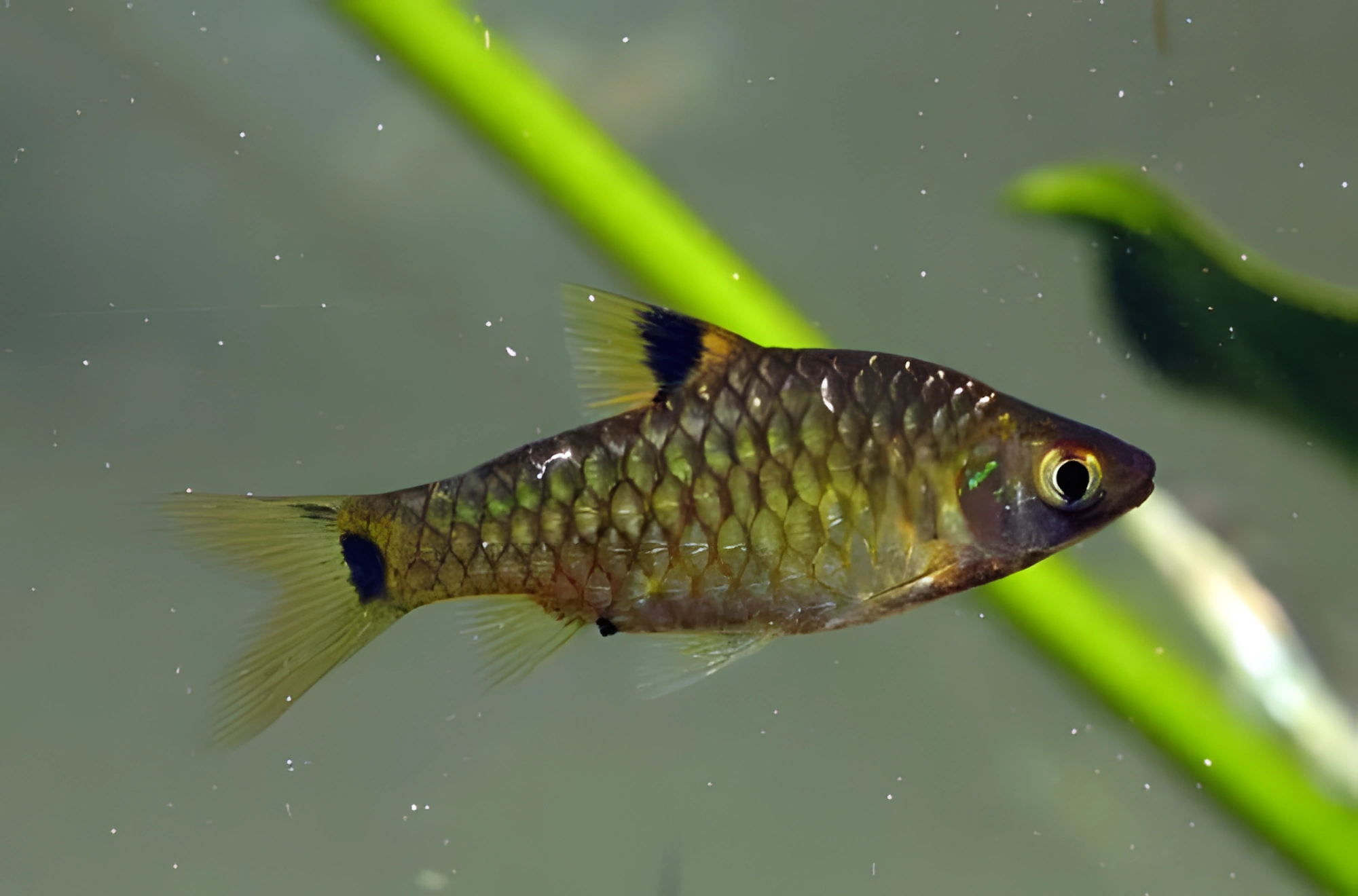
Adult Greenstripe Barbs reach a length of approximately 4.5 cm. Males have a grey body with a noticeable green sheen, especially pronounced above the lateral line. Females have a more modest, silvery coloration, without distinct green tones. At the base of the caudal and dorsal fins, both sexes display a characteristic pattern: a black mark or spot on a red background.
Habitat
This species is widely distributed throughout the Indian subcontinent, as well as in Pakistan. Their natural habitat consists of lowland water bodies characterized by slow currents and silty bottoms. These fish inhabit tributaries of large rivers, backwaters, various canals, as well as marshy areas and rice paddies. Interestingly, some researchers believe that several related species may be grouped under this common name, which, according to them, significantly narrows the actual habitat range.
Behavior and Compatibility
This is a peaceful and adaptable species that gets along well with other aquarium inhabitants of comparable size, especially those originating from Asia and Southeast Asia. Successful cohabitation is also possible with representatives from other continents, such as characins. It is recommended to keep these fish in schools of at least 8–10 individuals so that they feel comfortable and display their natural activity.
Care and Maintenance
For a small school of Greenstripe Barbs, an aquarium of 60 liters or more will be quite suitable. The choice of design is not critical; however, it has been observed that dense plant growth, including floating species, and a dark substrate enhance the vibrancy of their coloration. For example, in an insufficiently planted aquarium with bright lighting, the green iridescence on the fish's body may fade. Keeping Greenstripe Barbs usually does not cause difficulties, even for beginners, provided standard care procedures are followed: weekly partial water changes, regular removal of organic debris, monitoring of hydrochemical parameters (pH and dGH), and preventive equipment maintenance. Additionally, a reliable filtration system plays a key role in maintaining a stable aquatic environment. When choosing a filter, it is advisable to select devices that do not create a strong current, as these fish are poorly adapted to fast-moving water.
Diet
These fish are not particularly demanding regarding their diet. In a home aquarium, their nutrition can consist entirely of high-quality dry foods, such as flakes and granules. Nevertheless, adding live or frozen treats to their menu, such as bloodworms or brine shrimp, will be very beneficial and contribute to their health.
Breeding and Reproduction
The reproduction of Greenstripe Barbs follows a strategy typical for most carp species. During spawning, females scatter hundreds of eggs in the water column, which are then fertilized by males. Parental instincts are absent in these fish, so after spawning, adult individuals may eat both eggs and newly hatched fry. Because of this, the survival rate of offspring in a community tank is extremely low. To successfully preserve all or most of the offspring, it is necessary to prepare a separate spawning tank in advance, ensuring identical water parameters — temperature, pH, and dGH. Typically, small containers, such as three-liter jars, equipped with a simple air-driven sponge filter and a heater, are used for these purposes. Additional lighting is not required; ambient room light is sufficient. Artificial plants or shade-loving mosses and ferns can be used as decorations. After spawning, the eggs are carefully transferred to the prepared breeding tank. The incubation period is approximately 24–48 hours. After another day, the fry begin to swim actively. In the first few days, the fry should be fed microscopic foods, such as infusoria. After about a week, their diet can be expanded to include brine shrimp nauplii and other small foods.
Diseases
In a balanced aquarium ecosystem, closely matching the requirements of this species, diseases are extremely rare. Illnesses often arise due to deteriorating habitat quality, contact with already sick fish, or physical injuries. If these factors could not be avoided, the “Aquarium Fish Diseases” section will provide detailed information on symptoms and treatment methods.
How to choose
When selecting Greenstripe Barbs, pay attention to the overall activity of the school in the aquarium. Healthy individuals should be active, without visible damage to scales, fins, or signs of ulcers or growths on the body. Avoid purchasing fish that isolate themselves, have rapid breathing, or are noticeably emaciated.
Since this species often comes from wild catch, it is important to ensure the absence of external parasites. It is recommended to acquire individuals that show natural interest in food and do not exhibit signs of shyness when approached at the glass. It is advisable to inquire with the seller about the adaptation period of the batch, as recently arrived fish are subject to high stress.
Frequently asked questions
The essentials: size, tank volume, water parameters and care
How big does Greenstripe Barb get?
An adult reaches 3.5–5 cm in length. Plan the tank around the maximum size: the fish quickly outgrows a cramped setup.
What size aquarium does Greenstripe Barb need?
The minimum recommended volume is 60 L. A smaller tank speeds up nitrate build-up and raises stress levels.
What water parameters does Greenstripe Barb need?
Temperature 18–26 °C, pH 6–7.5, hardness 2–12 dGH. Stability matters more than exact values: sudden swings are harder on the fish than a small deviation from the ideal.
How long does Greenstripe Barb live?
Around 4 years when kept properly. Lifespan depends directly on tank volume, water quality and a varied diet.
Is Greenstripe Barb aggressive?
Temperament: peaceful (regular). Keep this in mind when choosing tank mates.
How many Greenstripe Barb should be kept together?
Recommended setup: group (8–10 individuals). Ignoring this is a common cause of stress and disease.
What does Greenstripe Barb eat?
Diet type: small / appropriate size / pieces. Feed small portions that are finished within a couple of minutes — overfeeding does more harm than underfeeding.
What is the scientific name of Greenstripe Barb?
The scientific name of the species is Puntius vittatus, family Cyprinids (Cyprinidae). It also appears in the literature as: Barbus vittatus.