Temperature23 – 28 °C
Natural range
- Lake Malawi area
- East Africa area
CichlidsConservation status: Least concern LC
Other scientific names: Metriaclima zebra, Pseudotropheus zebra, Tilapia zebra
Maylandia zebra, known as Zebra Mbuna or Blue Pseudotropheus zebra, belongs to the family Cichlidae. Although previously classified under the genus Pseudotropheus, the outdated name is still actively used. This fish is a classic representative of cichlids, endowed with both vibrant coloration and a rather aggressive disposition. A distinctive feature of the species is a high degree of hostility towards other aquarium inhabitants, so a species-specific tank is recommended for keeping them. Given the special care requirements, it may be advisable for beginner aquarists to refrain from acquiring this species.
- Required aquarium volume
- 200 L
- Size in aquarium
- 6 cm
- Temperature
- 23 – 28 °C
- Temperament
- Aggressive / incompatible / unfriendly
Parameters
Water pHNeutral (7.2) – Alkaline (8.8)
Water dHMedium hardness (10) – Very hard (25)
Water salinityno salt (freshwater)
Size in aquarium6 cm
Lifespan10 years
TemperamentAggressive / incompatible / unfriendly
Toward small fishnot a predator
Required aquarium volume200 L
Lightingmoderate (regular)
Substratesand or gravel + stones/boulders
Water flowmoderate
FeedingPlant-based (algae, vegetables)
CareHarem (1 male and several females)
Description
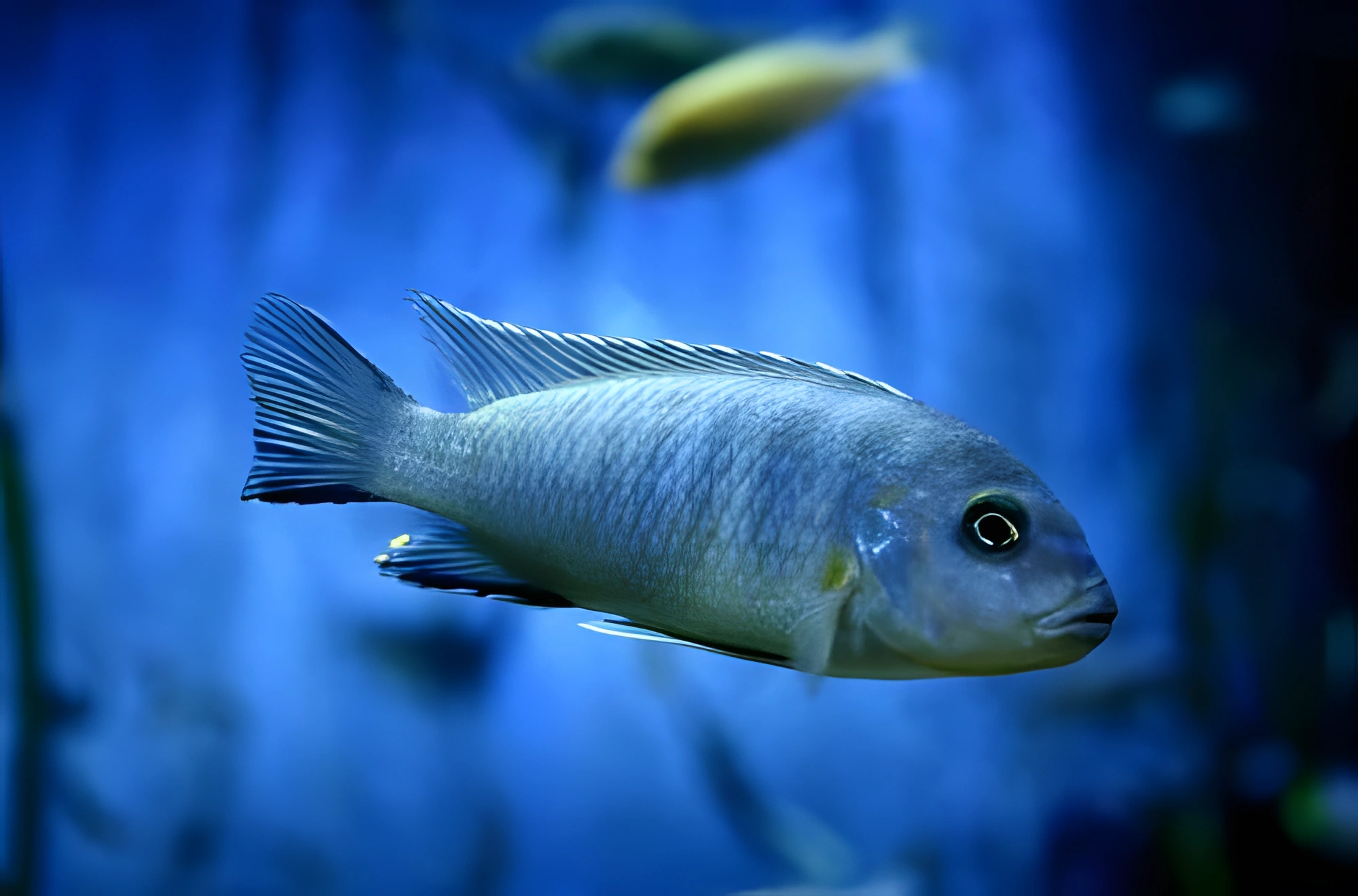
The fish has an elongated body, a slightly convex head, and dorsal and anal fins that taper towards the ends. The coloration of these fish is very diverse: individuals of blue, orange, black and white, and bluish-black colors are found. Such color diversity is due to both natural species characteristics and the results of artificial selection. It should be noted that it can be quite difficult for a simple aquarium enthusiast to visually identify this species. To avoid mistakes, it is recommended to purchase Zebra Mbuna exclusively from reliable professional aquarists or pet stores with a proven reputation. This is because many cichlids from Lakes Malawi and Tanganyika have significant external similarities, which often leads to one species being sold as another.
The male differs from the female in larger size and more intense coloration. His anal fin has a pattern of several colored spots. In addition, males have a peculiar growth in the forehead area, which becomes more pronounced over time.
Habitat
The only habitat of wild Zebra Mbuna is Lake Malawi in Africa. They inhabit coastal rocky areas, reefs, and islands, found at various depths. The fish belong to the Mbuna group, which translates from the local dialect as “rock dwellers.”
Behavior and Compatibility
This fish exhibits extremely aggressive and quarrelsome behavior towards other fish species. Moreover, males show pronounced belligerence towards each other. Keeping them in small groups, including one male and 2–3 females, is possible, but only if the aquarium volume is at least 200 liters and its design provides sufficient shelters. Otherwise, in a confined space, females will inevitably be subjected to attacks. If you plan to keep several cichlids, you should adhere to the rule: each male should have a minimum of 200 liters of water.
Care and Maintenance
Cichlids from Lake Malawi require similar keeping conditions. The key requirement is high water quality and purity. It should be slightly alkaline, with medium to high hardness. More detailed information on water composition and methods for changing its parameters can be found in the “Hydrochemical composition of water” section. It is recommended to change 10–15% of the water volume weekly; if filtration is insufficiently effective, the volume of replaced water should be increased to 25%. The substrate must also be cleaned at least once a week. Zebra Cichlids are extremely sensitive to pollution. This means that the filtration system plays a central role in maintaining the biological balance of the aquarium. It is advisable to choose the most productive filter that fits your budget. Other important equipment includes a heater, aerator, and lighting system. The aquarium design should mimic the natural habitat. Live plants are usually absent; only a few plastic decorative elements may be used. Most of the space should be occupied by rock and stone formations with numerous crevices and grottoes. Coarse sand is suitable as a substrate.
Diet
Most dry foods are suitable for these fish. However, an optimal diet should primarily consist of plant-based components. Examples include flakes enriched with algae (often spirulina), or chopped dry nori seaweed, which is used in rolls and available in many supermarkets. It is important to periodically supplement the diet with protein-rich foods such as bloodworms, artemia, and similar feeds. However, excessive consumption of protein food should be avoided, as this can lead to obesity and digestive problems in the fish.
Breeding and Reproduction
When kept in a harem group, the appearance of fry does not take long. During the breeding season, the male's coloration becomes even brighter, serving to attract the female. He chooses a suitable spot on the sandy bottom, usually free of obstacles, and digs several pits that serve as spawning sites. The female sequentially lays eggs in these depressions, immediately taking them into her mouth. This procedure is repeated in several such pits. As a result, the female's mouth fills with a large number of eggs. Fertilization occurs in an unusual way: the pattern on the male's anal fin mimics eggs, and the female, mistakenly taking them for a new batch of eggs, tries to swallow them. At this moment, the male releases milt, and fertilization occurs. The female incubates the offspring for 3–4 weeks before releasing the fry into free swimming. Throughout this period, she cannot feed, so if the female did not receive enough food before breeding, the offspring may be at risk of being eaten. A similar reproductive strategy is characteristic of most Lake Malawi cichlids and ensures a high survival rate of fry in conditions of strong competition.
Diseases
Under favorable keeping conditions and a balanced diet, health problems in fish usually do not arise. The main causes of diseases are poor water quality and an unbalanced diet. When several males are kept together, which is not recommended, physical injuries are often observed, which can lead to the development of various fungal and bacterial secondary infections. More detailed information on symptoms and treatment methods is available in the “Diseases of aquarium fish” section.
How to choose
When choosing individuals, you should contact experienced breeders or specialized stores, as due to the high species diversity and similarity of Lake Malawi cichlids, there is a risk of acquiring another species. Healthy fish should be active and have a bright, rich coloration characteristic of their morph. Avoid purchasing individuals with signs of emaciation, fin damage, plaque or spots on the body, or fish that appear apathetic or hide in the corner of the aquarium when feeding.
Frequently asked questions
The essentials: size, tank volume, water parameters and care
How big does Zebra Mbuna get?
An adult reaches 6 cm in length. Plan the tank around the maximum size: the fish quickly outgrows a cramped setup.
What size aquarium does Zebra Mbuna need?
The minimum recommended volume is 200 L. A smaller tank speeds up nitrate build-up and raises stress levels.
What water parameters does Zebra Mbuna need?
Temperature 23–28 °C, pH 7.2–8.8, hardness 10–25 dGH. Stability matters more than exact values: sudden swings are harder on the fish than a small deviation from the ideal.
How long does Zebra Mbuna live?
Around 10 years when kept properly. Lifespan depends directly on tank volume, water quality and a varied diet.
Is Zebra Mbuna aggressive?
Temperament: aggressive / incompatible / unfriendly. Keep this in mind when choosing tank mates.
How many Zebra Mbuna should be kept together?
Recommended setup: harem (1 male and several females). Ignoring this is a common cause of stress and disease.
What does Zebra Mbuna eat?
Diet type: plant-based (algae, vegetables). Feed small portions that are finished within a couple of minutes — overfeeding does more harm than underfeeding.
What is the scientific name of Zebra Mbuna?
The scientific name of the species is Maylandia zebra, family Cichlids (Cichlidae). It also appears in the literature as: Metriaclima zebra, Pseudotropheus zebra, Tilapia zebra.