Temperature23 – 27 °C
Natural range
- Lake Tanganyika area
- Southwestern Lake Tanganyika area
CichlidsConservation status: Near threatened NT
Julidochromis dickfeldi, scientifically known as Julidochromis dickfeldi, belongs to the Cichlidae family. These fish form strong pair bonds and display pronounced jealousy towards their conspecifics. However, they can coexist peacefully with representatives of other species. Keeping and breeding this species is not particularly difficult if they are provided with appropriate water parameters and a balanced diet.
- Required aquarium volume
- 70 L
- Size in aquarium
- 8 cm
- Temperature
- 23 – 27 °C
- Temperament
- Semi-peaceful (aggression when space is limited)
Parameters
Water pHSlightly alkaline (8) – Alkaline (9.2)
Water dHMedium hardness (10) – Very hard (25)
Water salinityno salt (freshwater)
Size in aquarium8 cm
Lifespan6 years
TemperamentSemi-peaceful (aggression when space is limited)
Toward small fishnot a predator
Required aquarium volume70 L
Lightingmoderate (regular)
Substratesandy (regular, light)
Water flowweak or moderate
FeedingMixed diet (meat + plant-based)
CarePair (male/female)
Description
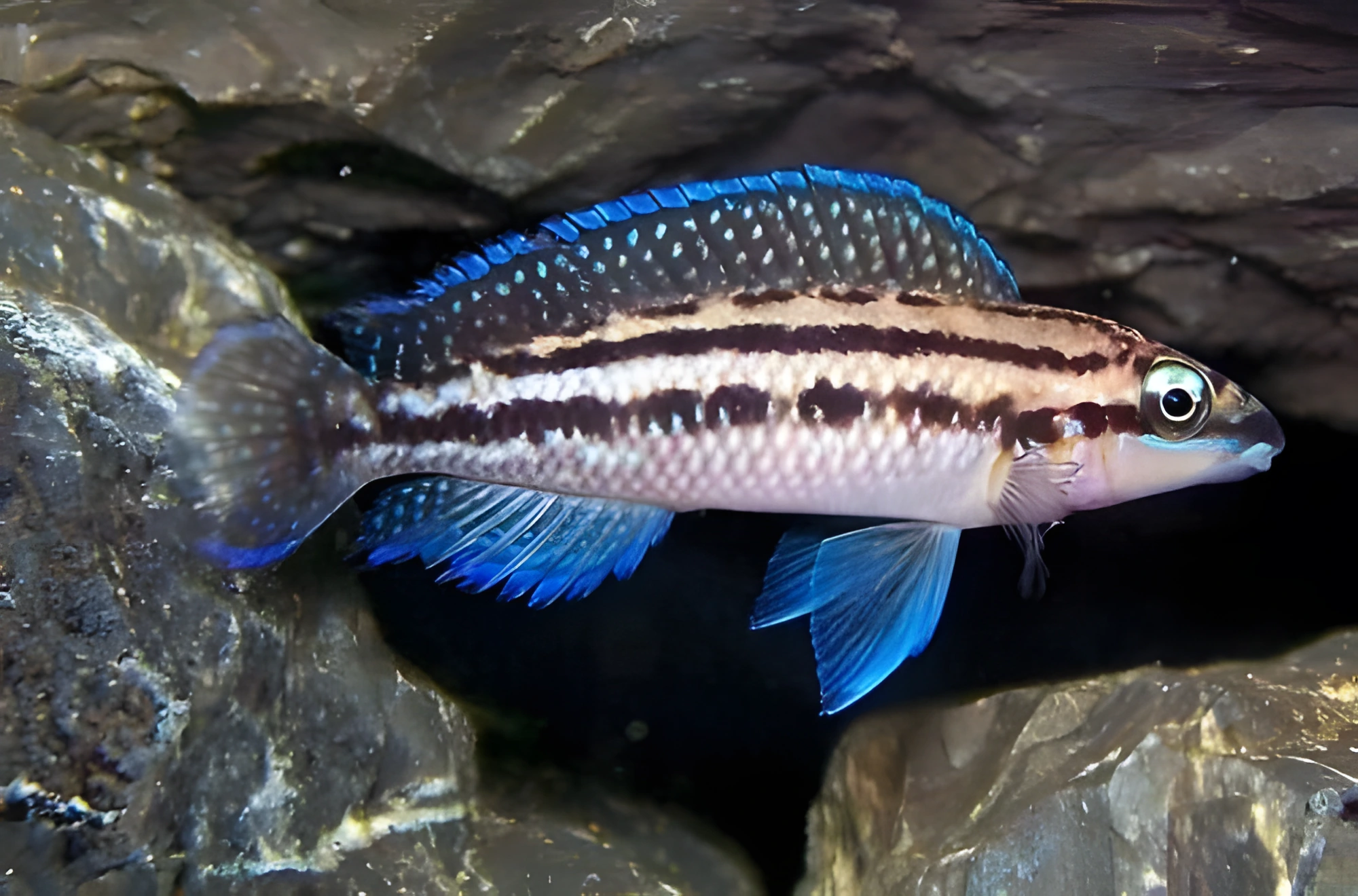
Adults of this fish reach approximately 8 cm in length. Distinguishing between male and female is quite difficult due to weakly expressed sexual dimorphism. Julidochromis dickfeldi have an elongated body and a long dorsal fin that extends from the head to the caudal fin. Their coloration is light, with a noticeable bluish tint and dark horizontal stripes. The fins, including the caudal fin, are blue.
Habitat
This species is endemic to Lake Tanganyika in Africa, located mostly on the border between Tanzania and the Democratic Republic of Congo. Julidochromis dickfeldi are found in shallow waters, preferring rocky areas of the coastline in the southwestern part of the lake, in Zambia.
Behavior and Compatibility
Julidochromis dickfeldi are territorial. In small aquariums, representatives of this species can actively compete for bottom areas, and skirmishes sometimes become aggressive. Therefore, it is recommended to keep only one established pair: a male and a female. Young individuals can be temporarily kept in a group. It should be noted that this species forms permanent pairs that last throughout the fish's life. Julidochromis dickfeldi are calm towards other species that inhabit the middle or upper water layers and are of comparable size.
Care and Maintenance
For keeping a single pair of Julidochromis dickfeldi, an aquarium of at least 70 liters is required. The setup for them does not require special complexities: it is sufficient to use a sandy substrate and create shelters from piles of stones and rock formations. Such an arrangement accurately mimics the natural habitat of this species. Successful keeping of Julidochromis dickfeldi is only possible if high water quality is maintained with optimal pH and dGH values, as well as a sufficient level of dissolved oxygen. To achieve these parameters, an effective filtration and aeration system must be installed. In addition, regular aquarium maintenance is critically important. It includes removing organic residues, such as excrement and uneaten food, and weekly water changes of 15–20% of the volume with fresh water.
Diet
The diet of these fish must include protein components with the addition of plant elements. As an example, live or frozen food such as Artemia and bloodworms can be offered, combined with spirulina flakes or finely chopped pieces of nori. The exclusive use of dry foods is recommended to be limited.
Breeding and Reproduction
The ease of breeding this species is confirmed if an already established pair can be acquired. If the male and female were raised separately, offspring should not be expected from them. Moreover, an attempt to combine them can lead to serious consequences: the male, perceiving an unfamiliar female as a competitor, can kill her. With an established pair and suitable conditions, spawning becomes a regular occurrence. It is not difficult to determine the start of spawning: the main sign is the disappearance of the female. At this time, she lays eggs in a secluded place, remaining to guard them. The male takes a position at the entrance to the shelter, protecting the immediate territory. The incubation period lasts only 2–3 days. The parents continue to care for the fry until they reach a size of 2 cm or more. Later, it is recommended to separate the fry to prevent them from being eaten.
Diseases
The main cause of most diseases in Lake Tanganyika cichlids is unsuitable keeping conditions and poor-quality food, which often leads, for example, to African Bloat. At the first symptoms, it is necessary first to check the water parameters and ensure there are no high concentrations of dangerous substances such as ammonia, nitrites, and nitrates. If the readings deviate from the norm, they should be brought into order, and only then should treatment begin. More detailed information on symptoms and treatment methods is available in the “Aquarium Fish Diseases” section.
How to choose
When choosing healthy individuals, pay attention to the fish's activity: a healthy Julidochromis should exhibit territorial behavior, explore stones and shelters, and not hide in a corner or passively lie on the bottom. Avoid specimens with damaged fins, film on the body, or an unnaturally bloated abdomen, as this may indicate infections or digestive problems.
- choose fish from aquariums with clean water, where there are no dead or obviously sick tankmates
- prefer young individuals, as they adapt more easily to new keeping conditions
- when buying a pair, make sure that the fish do not show excessive aggression towards each other, which can lead to injuries during transportation
Frequently asked questions
The essentials: size, tank volume, water parameters and care
How big does Julidochromis dickfeldi get?
An adult reaches 8 cm in length. Plan the tank around the maximum size: the fish quickly outgrows a cramped setup.
What size aquarium does Julidochromis dickfeldi need?
The minimum recommended volume is 70 L. A smaller tank speeds up nitrate build-up and raises stress levels.
What water parameters does Julidochromis dickfeldi need?
Temperature 23–27 °C, pH 8–9.2, hardness 10–25 dGH. Stability matters more than exact values: sudden swings are harder on the fish than a small deviation from the ideal.
How long does Julidochromis dickfeldi live?
Around 6 years when kept properly. Lifespan depends directly on tank volume, water quality and a varied diet.
Is Julidochromis dickfeldi aggressive?
Temperament: semi-peaceful (aggression when space is limited). Keep this in mind when choosing tank mates.
How many Julidochromis dickfeldi should be kept together?
Recommended setup: pair (male/female). Ignoring this is a common cause of stress and disease.
What does Julidochromis dickfeldi eat?
Diet type: mixed diet (meat + plant-based). Feed small portions that are finished within a couple of minutes — overfeeding does more harm than underfeeding.
What is the scientific name of Julidochromis dickfeldi?
The scientific name of the species is Julidochromis dickfeldi, family Cichlids (Cichlidae).