Temperature23 – 27 °C
Natural range
- Lake Tanganyika area
- East Africa area
CichlidsConservation status: Least concern LC
Julidochromis regani, with the scientific name Julidochromis regani, belongs to the family Cichlidae. This cichlid is quite popular among aquarists. Like many members of its family, it can show aggression towards conspecifics, but at the same time, it can successfully coexist with some other fish species. If you plan to keep an African cichlid, Julidochromis regani can be an excellent choice.
- Required aquarium volume
- 110 L
- Size in aquarium
- 15 cm
- Temperature
- 23 – 27 °C
- Temperament
- Semi-peaceful (including aggression during spawning / intraspecific conflicts)
Parameters
Water pHNeutral (7.5) – Alkaline (9)
Water dHMedium hardness (10) – Very hard (25)
Water salinityno salt (freshwater)
Size in aquarium15 cm
Lifespan10 years
TemperamentSemi-peaceful (including aggression during spawning / intraspecific conflicts)
Toward small fishnot a predator
Required aquarium volume110 L
Lightingmoderate (regular)
Substratefine sand
Water flowmoderate
FeedingHigh protein (predominantly meat)
CarePair (male/female)
Description
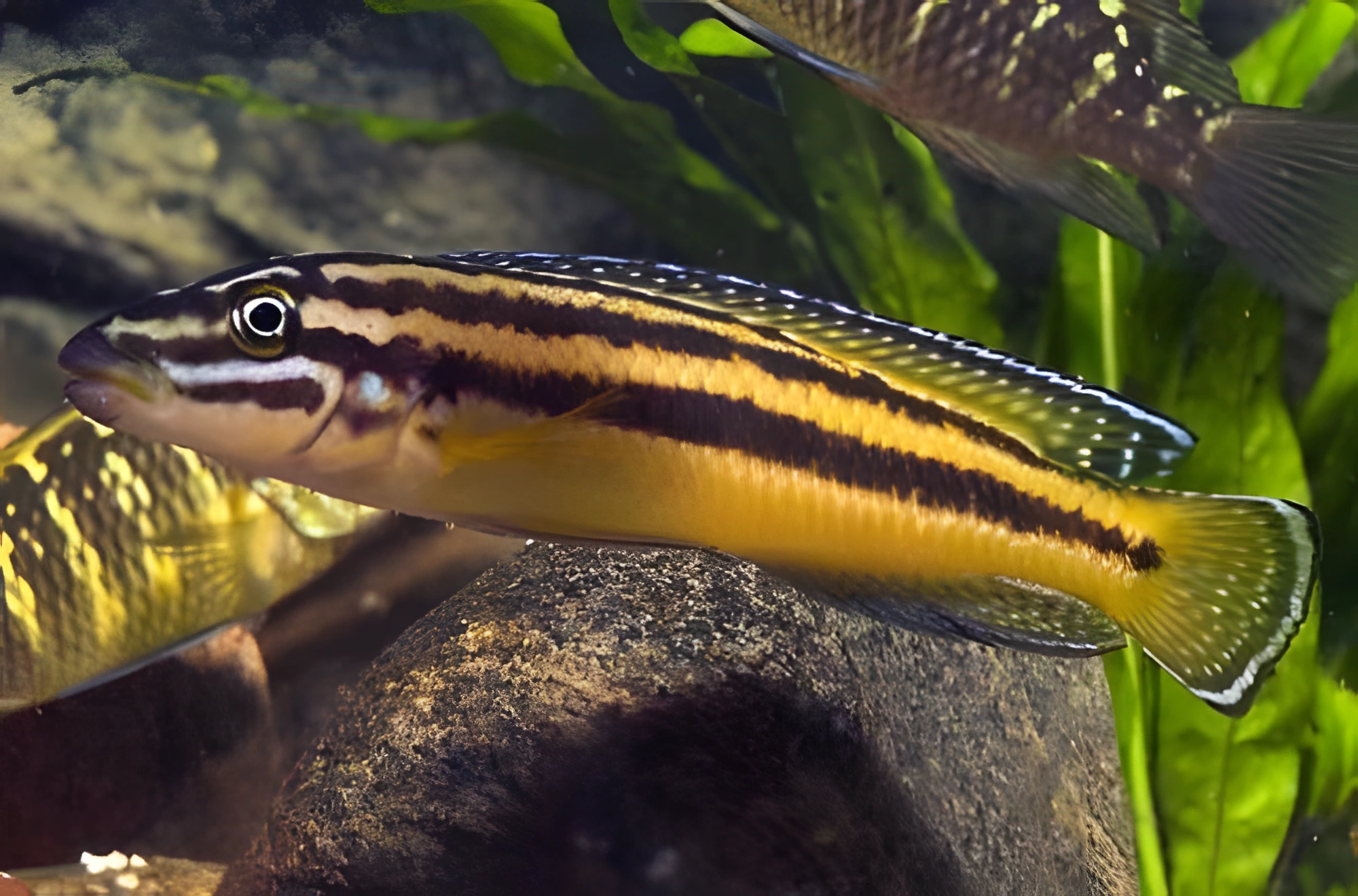
The fish has an elongated body with a pronounced, convex head. Among the species variations, there are individuals with a slightly different head shape. A very long dorsal fin extends almost the entire length of the back. The rounded tail is adorned with a white edge. The main coloration is yellow, with several rows of longitudinal dark brown stripes.
Habitat
This fish is endemic to the African Lake Tanganyika and is not found in any other bodies of water. Its natural habitat is areas with sandy bottoms where a large number of stones are scattered. Some other species of this genus prefer rocky coastal zones.
Behavior and Compatibility
This fish exhibits territorial behavior and can be aggressive towards conspecifics, but it can coexist peacefully with other cichlids from Lake Tanganyika that have a similar temperament. Young individuals usually develop together and eventually form stable male/female pairs that remain inseparable throughout their lives. Formed pairs become particularly intolerant of other members of their species.
Care and Maintenance
To decorate the aquarium, an imitation of Julidochromis regani's natural environment is best. This species will require a spacious and long aquarium, equipped with a rocky bottom arranged in ledges. Grottos, caves, and crevices can be created using stones and rock fragments. As additional shelters, broken clay pots or hollow bricks can be used, for example. A sandy substrate is recommended. The presence of live plants is not mandatory. The water in the aquarium should be slightly alkaline, hard, or medium-hard. More detailed information on water parameters and methods for changing them (pH, GH) is provided in the "Hydrochemical composition of water" section. Since plants are not included in the design, the main burden of maintaining biological balance falls on the filtration system. You should purchase the most powerful filter that fits your financial capabilities. Other necessary equipment includes an aerator, a heater, and a lighting system.
Diet
The diet of cichlids should preferably include live or frozen foods, such as bloodworms or daphnia. The basis of the diet consists of high-protein foods, to which plant components must be added. Once a week, dry foods, such as flakes or pellets, can be offered as a supplement.
Breeding and Reproduction
Breeding these fish is relatively simple but has its peculiarities. It is advisable to acquire an already established pair. Buying a male and female separately does not guarantee pair formation: the fish may not be compatible, which can lead to the male harassing the female, often resulting in her death. Spawning in Julidochromis regani occurs covertly, without a pronounced courtship period. The female lays eggs in her chosen shelter, and the appearance of fry can be a surprise to the aquarist. Parents do not harm their offspring, so there is no need to hastily transfer them to a separate tank. They can remain together until the fry reach a size of 2–2.5 cm; at this stage, it will be necessary to consider their further keeping.
Diseases
The main causes of diseases in fish are unsuitable keeping conditions and poor-quality food. All other problems, including bacterial or fungal infections, are merely consequences of these factors. More detailed information on disease symptoms and treatment methods is available in the "Diseases of aquarium fish" section.
How to choose
When selecting individuals, preference should be given to young fish, as adult pairs adapt extremely poorly to new conditions and can show aggression towards each other. Healthy fish should be active, have clean fins without signs of damage or film, and a plump body without a sunken belly. Avoid purchasing individuals that appear apathetic, stay near the water surface, or have visible wounds, as this often indicates the consequences of intraspecific conflicts or poor keeping quality in the store. It is recommended to acquire a group of 5–6 young individuals so that they can independently form a stable pair, after which the excess fish should be removed to avoid fatal skirmishes.
Frequently asked questions
The essentials: size, tank volume, water parameters and care
How big does Julidochromis regani get?
An adult reaches 15 cm in length. Plan the tank around the maximum size: the fish quickly outgrows a cramped setup.
What size aquarium does Julidochromis regani need?
The minimum recommended volume is 110 L. A smaller tank speeds up nitrate build-up and raises stress levels.
What water parameters does Julidochromis regani need?
Temperature 23–27 °C, pH 7.5–9, hardness 10–25 dGH. Stability matters more than exact values: sudden swings are harder on the fish than a small deviation from the ideal.
How long does Julidochromis regani live?
Around 10 years when kept properly. Lifespan depends directly on tank volume, water quality and a varied diet.
Is Julidochromis regani aggressive?
Temperament: semi-peaceful (including aggression during spawning / intraspecific conflicts). Keep this in mind when choosing tank mates.
How many Julidochromis regani should be kept together?
Recommended setup: pair (male/female). Ignoring this is a common cause of stress and disease.
What does Julidochromis regani eat?
Diet type: high protein (predominantly meat). Feed small portions that are finished within a couple of minutes — overfeeding does more harm than underfeeding.
What is the scientific name of Julidochromis regani?
The scientific name of the species is Julidochromis regani, family Cichlids (Cichlidae).