Temperature18 – 22 °C
GoldfishConservation status: Least concern LC
Other scientific names: Carasius auratus, Carassius buergeri, Carassius burgeri, Carassius carassius, Carassius chinensis, Carassius coeruleus
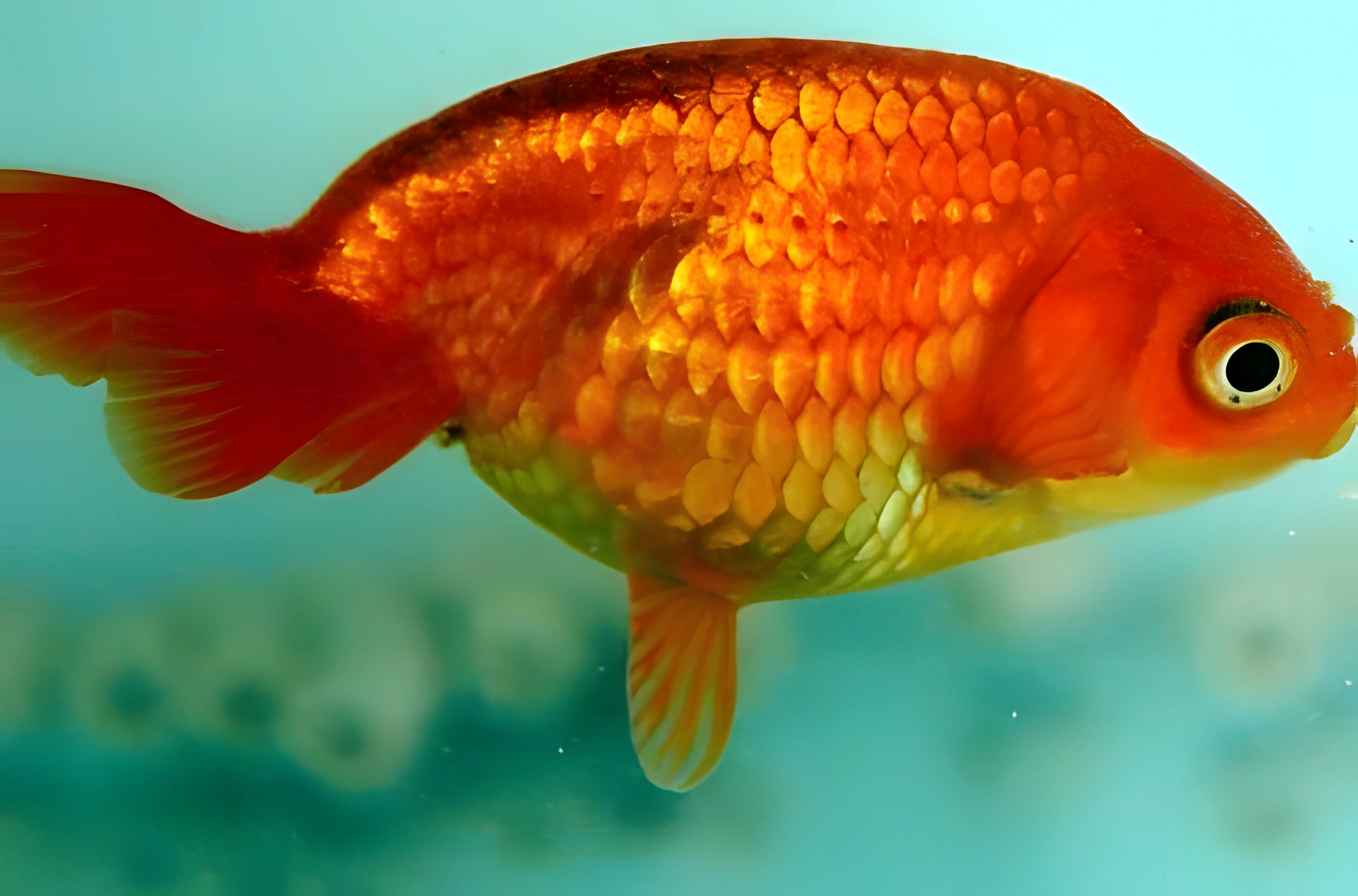
This variety of Goldfish, known in the West as Egg-fish Goldfish, is called Maruko in Japan. The fish owes its name to a remarkable feature—its body shape, which resembles an egg. A distinctive characteristic is its smooth, rounded back, which lacks a dorsal fin. Breeders have developed two varieties: one with a long tail and another with a short tail. All other fins in these fish are comparatively small and of the same size.
- Required aquarium volume
- 60 L
- Size in aquarium
- 16 – 18 cm
- Temperature
- 18 – 22 °C
- Temperament
- Peaceful (regular)
Parameters
Water pHSlightly acidic (6) – Slightly alkaline (8)
Water dHSoft (5) – Very hard (19)
Water salinityno salt (freshwater)
Size in aquarium16 – 18 cm
Lifespan15 years
TemperamentPeaceful (regular)
Toward small fishnot a predator
Required aquarium volume60 L
Lightingmoderate (regular)
Substrateany (no restrictions)
Water flowweak
FeedingAny (universal)
CareBoth solitary and in group (flexible)
Description
The egg-shaped goldfish, also known as eggfish, has a characteristic short and rounded body, resembling an egg in shape. This breed completely lacks a dorsal fin, and its back has a smooth, arched curve. Depending on the breeding line, the fish can have varying tail lengths and fin shapes, including fan-tailed variants. Their coloration is extremely diverse and includes red, orange, white, black, and calico shades. Adult specimens reach sizes of 16–18 cm. Sexual differences become noticeable only during the spawning period: males develop a light rash on their gill covers and small serrations on their pectoral fins.
Habitat
The species is the result of centuries of selective breeding carried out in China, based on the silver crucian carp. It does not occur as an independent population in nature. In aquarium conditions, these fish are adapted to cool water at a temperature of 18–22 °C. They prefer fairly hard water with a neutral or slightly alkaline pH (6–8). Effective filtration and aeration are important conditions, as selectively bred forms are more sensitive to water quality than their wild ancestors.
Behavior and Compatibility
These are peaceful and slow-moving fish, characterized by a calm disposition. Due to their body structure and the absence of a dorsal fin, they swim slower than many other species, so it is not recommended to keep them with active or aggressive tank mates that might nip their fins. The fish are social and feel comfortable in a group of conspecifics with similar body types. They tend to constantly search for food in the substrate, so it is important to choose a substrate without sharp edges.
Care and Maintenance
Keeping Egg-shaped Goldfish requires the same conditions as for other representatives of this species. Spacious aquariums with sufficiently cool, well-oxygenated water will be most beneficial for their well-being. These fish adapt well to a wide range of pH and dGH parameters, which is a significant advantage when preparing water. Regular aquarium maintenance is very important: once a week, a portion of the water should be changed, and accumulated organic waste, such as uneaten food and excrement, should be removed. The aquarium decor is at the owner's discretion. It is important to leave enough open swimming space, avoiding excessive growth of aquatic plants. Since their massive body shape and the absence of a dorsal fin limit their mobility, Egg-shaped Goldfish swim quite slowly. Due to this characteristic, they may struggle to compete for food if their tank mates are more active species. Therefore, it is recommended to choose peaceful fish with similar unhurriedness as tank mates, for example, other goldfish varieties. Their diet can include a variety of aquarium foods: dry, live, and frozen.
Diet
These fish are omnivores and require a varied diet combining plant and animal components. In the aquarium, it is recommended to use specialized dry foods in the form of granules or flakes, which contain essential vitamins and trace elements. Vegetable matter is essential for maintaining normal digestion. When feeding dry mixes, it is advisable to soak them beforehand to avoid swim bladder problems. Feeding should be done in small portions 1–2 times a day.
Breeding and Reproduction
Breeding is carried out in separate spawning aquariums, stimulated by a gradual increase in water temperature. For successful spawning, a group of fish or a pair is usually used. The female lays eggs on fine-leaved plants or special substrates. After the process is complete, the parents should be removed to prevent them from eating the eggs. Fry hatch after a few days and, after transitioning to independent feeding, require high-quality starter foods, such as Artemia nauplii or specialized micro-foods.
Diseases
The species is susceptible to bacterial and fungal infections, especially when sanitary standards in the aquarium are violated. Swim bladder problems are common, caused by the peculiarities of their shortened body structure and improper feeding. To prevent diseases, it is necessary to maintain water cleanliness, avoid overfeeding, and exclude decorations with sharp edges from the aquarium, which could injure the fish. Regular water changes are an essential condition for health.
How to choose
When purchasing, select active individuals with clean scales, without visible damage, ulcers, or film. It is important to pay attention to the condition of the eyes and fins—they should be intact, without signs of damage or hemorrhages. A healthy fish should show interest in food and swim evenly, without coordination problems or an unnatural body tilt. It is recommended to avoid purchasing individuals that constantly lie on the bottom or, conversely, cannot descend from the water surface.
Frequently asked questions
The essentials: size, tank volume, water parameters and care
How big does Egg-shaped Goldfish get?
An adult reaches 16–18 cm in length. Plan the tank around the maximum size: the fish quickly outgrows a cramped setup.
What size aquarium does Egg-shaped Goldfish need?
The minimum recommended volume is 60 L. A smaller tank speeds up nitrate build-up and raises stress levels.
What water parameters does Egg-shaped Goldfish need?
Temperature 18–22 °C, pH 6–8, hardness 5–19 dGH. Stability matters more than exact values: sudden swings are harder on the fish than a small deviation from the ideal.
How long does Egg-shaped Goldfish live?
Around 15 years when kept properly. Lifespan depends directly on tank volume, water quality and a varied diet.
Is Egg-shaped Goldfish aggressive?
Temperament: peaceful (regular). Keep this in mind when choosing tank mates.
How many Egg-shaped Goldfish should be kept together?
Recommended setup: both solitary and in group (flexible). Ignoring this is a common cause of stress and disease.
What does Egg-shaped Goldfish eat?
Diet type: any (universal). Feed small portions that are finished within a couple of minutes — overfeeding does more harm than underfeeding.
What is the scientific name of Egg-shaped Goldfish?
The scientific name of the species is Carassius auratus, family Cyprinids (Cyprinidae). It also appears in the literature as: Carasius auratus, Carassius buergeri, Carassius burgeri.