Temperature22 – 26 °C
Natural range
- Ganges River Basin
- Brahmaputra River Basin
- India area
- Nepal area
LoachesConservation status: Least concern LC
Other scientific names: Lepidocephalichthys menoni, Lepidocephalus annandalei, Lepidocephalus menoni
The scientific name Lepidocephalichthys annandalei refers to a fish known as the Peacock Eel or Annandale's Loach, belonging to the family Cobitidae (Loaches). It owes its name to Dr. N. Annandale, who was the director of the Zoological Survey of India. Another name, Peacock Eel, reflects the unusual pattern on its tail, which will be described below. This fish is distinguished by its unpretentiousness and high endurance. It can successfully adapt to quite significant changes in the external environment that would be fatal for many other species. Thanks to such exceptional adaptability, ease of maintenance, and peaceful disposition, it is perfectly suited even for beginner aquarists.
- Required aquarium volume
- 40 L
- Size in aquarium
- 3 – 5 cm
- Temperature
- 22 – 26 °C
- Temperament
- Peaceful (regular)
Parameters
Water pHSlightly acidic (5.5) – Neutral (7.5)
Water dHVery soft (2) – Hard (15)
Water salinityno salt (freshwater)
Size in aquarium3 – 5 cm
Lifespan4 years
TemperamentPeaceful (regular)
Toward small fishnot a predator
Required aquarium volume40 L
Lightingdimmed or moderate
Substratesoft sandy (including silted)
Water flowweak
FeedingSinking (any)
CareSmall group (3–4 individuals)
Description
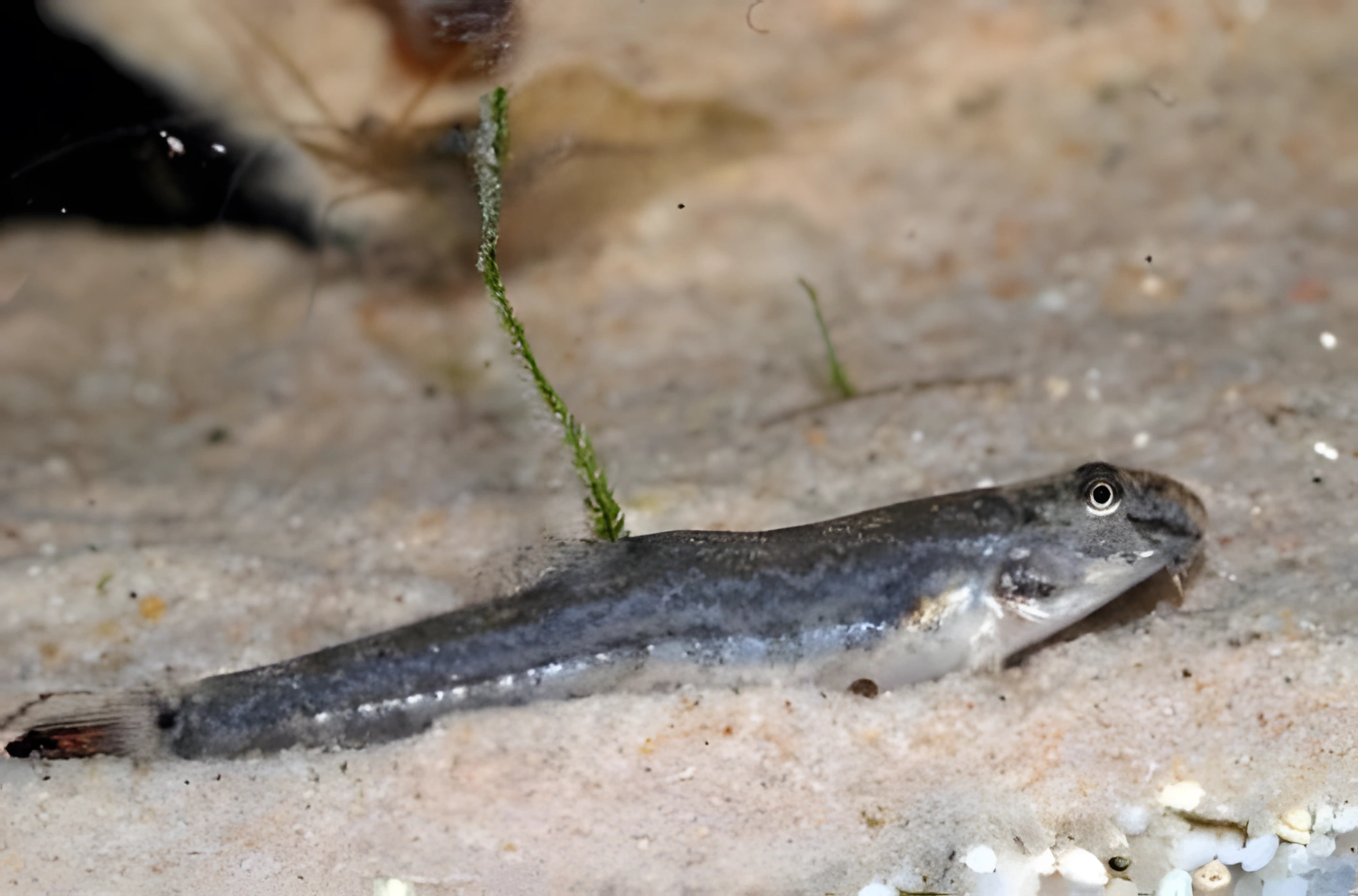
An adult Peacock Eel can reach a length of approximately 4 cm. This fish is characterized by an elongated body and a small head. Near its mouth are barbels, which serve to find food in the silt. Its fins are short and translucent; the pectoral fins are horizontally oriented and are used more for resting on the substrate than for full swimming. The back and sides of the fish are adorned with a gray-brown pattern, while the belly is invariably white. One of the distinguishing features of the species is the variegated coloration of the tail, which features a large black spot against orange hues, evoking associations with a peacock's feather.
Habitat
This species originates from South Asia, inhabiting the waters of India, Nepal, and Bangladesh. Its natural range covers the middle and upper reaches of the Ganges and Brahmaputra rivers, up to their confluence. It can be found in shallow waters, slow-flowing sections of streams, swamps, backwaters, and also in rice paddies. The substrate in these areas usually consists of a thick layer of soft silt, sand, and mixed fallen leaves and branches. During dry periods, when some bodies of water become shallow, these fish can remain in semi-liquid mud for a long time.
Behavior and Compatibility
This species is distinguished by its peaceful disposition and coexists calmly with other species, provided they are comparable in size and temperament. It is preferable to keep them in groups; it is recommended to acquire at least 4 individuals. The presence of other fish neighbors in the aquarium is even necessary for them. In the wild, these loaches orient themselves by the movement of fish swimming in the upper layers of the water to learn in advance about the appearance of predators. The absence of such neighbors can be perceived by them as a sign of danger.
Care and Maintenance
For keeping a small group of 4 individuals, the optimal aquarium volume starts from 40 liters. In the aquarium setup for this species, the substrate plays a key role. Since the Peacock Eel feeds in the bottom layer, sifting portions of the substrate through itself, the substrate must be fine-grained, consisting of sand or similar materials. Various snags can be used as additional decorative elements to serve as shelters. Dim lighting is desirable. When choosing live plants, avoid species that form continuous "carpets" on the bottom, as they can interfere with feeding, as well as plants with weak root systems that can be uprooted. It is better to prefer shade-loving species that can grow out of the substrate on hard surfaces, such as stones or snags. Keeping Annandale's Loach will not cause difficulties even for beginners in aquaristics. The fish is highly resilient and capable of adapting perfectly to a wide variety of conditions. If other species live successfully in your aquarium, the Peacock Eel will also feel comfortable.
Diet
In its natural habitat, this fish finds food by sifting through silt particles in search of various organisms, such as insect larvae and small crustaceans. In a home aquarium, it readily accepts most common foods of appropriate size. Frozen or live foods, such as daphnia, artemia, and bloodworms, are particularly suitable.
Breeding and Reproduction
Based on available sources, a separate block cannot be compiled: the data is insufficient or contradictory. The entry can be updated later when verified information becomes available.
Diseases
The main cause of diseases in aquarium fish is often keeping them in unsuitable conditions, which negatively affects their immunity and makes them vulnerable to various infections. At the first symptoms of illness, it is crucial to first check the hydrochemical composition of the water. It is necessary to ensure that the pH and dGH values are correct, and to rule out exceeding permissible concentrations of nitrogen cycle products or the presence of pollutants. Often, bringing all parameters back to normal promotes recovery. If the symptoms persist, medicinal treatment will be required, which can be found in more detail in the "Diseases of Aquarium Fish" section.
How to choose
When choosing a Peacock Eel, pay attention to the fish's activity and the condition of its skin. Healthy individuals should be active, without visible damage, ulcers, or white film on the body. It is important to note that these fish lead a secretive lifestyle and often burrow into the substrate, so their shyness in the store is normal, not a sign of illness. During inspection, it is recommended to check the following parameters:
- absence of signs of emaciation (sunken belly);
- clean fins, absence of splitting or erosion;
- clear eyes, absence of cloudiness;
- integrity of all barbels, which are important sensory organs.
Avoid purchasing fish that constantly stay near the water surface, unless this is due to fright when a person approaches, as this may indicate problems with breathing or water quality in the aquarium. It is also important to ensure that the fish show no signs of parasitic diseases, such as small white spots on the body or fins.
Frequently asked questions
The essentials: size, tank volume, water parameters and care
How big does Peacock Eel get?
An adult reaches 3–5 cm in length. Plan the tank around the maximum size: the fish quickly outgrows a cramped setup.
What size aquarium does Peacock Eel need?
The minimum recommended volume is 40 L. A smaller tank speeds up nitrate build-up and raises stress levels.
What water parameters does Peacock Eel need?
Temperature 22–26 °C, pH 5.5–7.5, hardness 2–15 dGH. Stability matters more than exact values: sudden swings are harder on the fish than a small deviation from the ideal.
How long does Peacock Eel live?
Around 4 years when kept properly. Lifespan depends directly on tank volume, water quality and a varied diet.
Is Peacock Eel aggressive?
Temperament: peaceful (regular). Keep this in mind when choosing tank mates.
How many Peacock Eel should be kept together?
Recommended setup: small group (3–4 individuals). Ignoring this is a common cause of stress and disease.
What does Peacock Eel eat?
Diet type: sinking (any). Feed small portions that are finished within a couple of minutes — overfeeding does more harm than underfeeding.
What is the scientific name of Peacock Eel?
The scientific name of the species is Lepidocephalichthys annandalei, family Cobitidae (Loaches). It also appears in the literature as: Lepidocephalichthys menoni, Lepidocephalus annandalei, Lepidocephalus menoni.