Temperature20 – 30 °C
Natural range
- Queensland area
- Northern Territory area
Rainbowfish
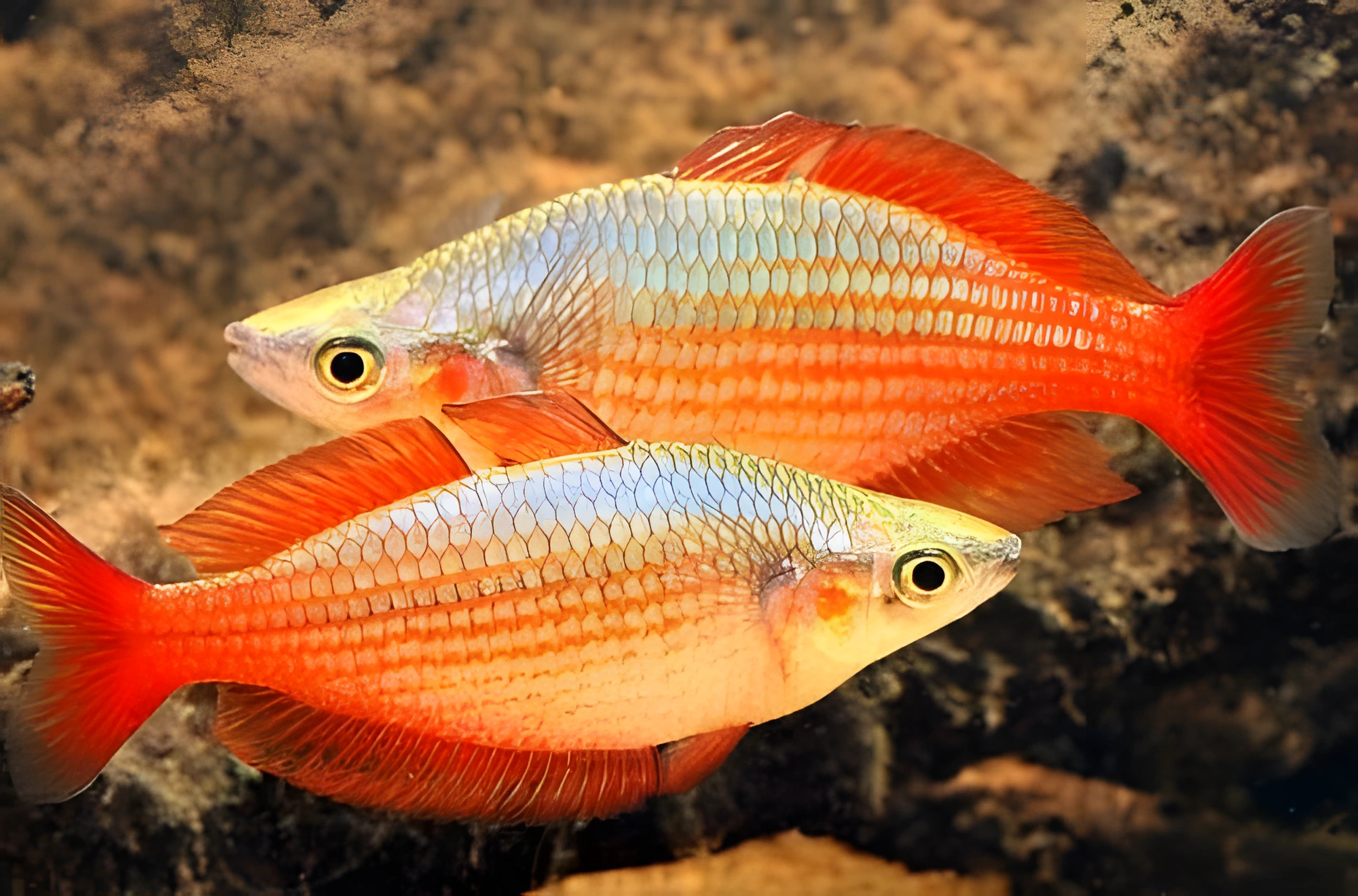
The Eastern Rainbowfish (scientific name – Melanotaenia splendida splendida) belongs to the family Melanotaeniidae. These fish are known for their beauty, peaceful nature, and hardiness. Thanks to their excellent adaptation to a wide range of conditions, they will not cause much trouble for home aquarium owners.
- Required aquarium volume
- 110 L
- Size in aquarium
- 15 cm
- Temperature
- 20 – 30 °C
- Temperament
- Peaceful (regular)
Parameters
Water pHSlightly acidic (5) – Slightly alkaline (8)
Water dHSoft (5) – Very hard (20)
Water salinityno salt (freshwater)
Size in aquarium15 cm
Lifespan5 years
TemperamentPeaceful (regular)
Toward small fishnot a predator
Required aquarium volume110 L
Lightingweak or moderate
Substrateany (no restrictions)
Water flowstrong
FeedingAny (universal)
CareMedium group (6–8 individuals)
Description
Under one commercial name, you can find four to six related subspecies that have similar external features. In addition, there are two similar species that are often confused with each other: the Cherry Rainbowfish and the Red-striped Rainbowfish. Adult individuals can grow up to 15 cm. Their coloration is reddish-brown with a characteristic granular pattern. However, not all fish display an intense red color. The intensity of the coloration depends on various factors, including water quality, diet, and the genetic predisposition of the specific subspecies. Sexual dimorphism is weakly expressed: males are generally slightly larger and have brighter body coloration than females. In a home aquarium, when kept in a school, it can be quite difficult to distinguish a male from a female.
Habitat
The natural habitat of the Eastern Rainbowfish covers various biotopes of the Australian continent, including tropical swamps, freshwater coastal lagoons, river deltas, and streams. Characteristic seasonal changes in these natural conditions (e.g., fluctuations in temperature and hydrochemical composition of the water) have contributed to the development of high adaptive abilities in this species. As a rule, these fish prefer areas of water bodies with calm currents and abundant aquatic vegetation.
Behavior and Compatibility
These fish are active and peaceful, coexisting well with other species of comparable size and temperament. Nevertheless, their activity can create some discomfort for slower aquarium inhabitants. They must be kept in a school, consisting of at least 6–8 individuals of both sexes. It has been observed that males display brighter coloration in the presence of potential rivals, using it to attract the attention of females.
Care and Maintenance
For keeping a school of 6–8 Eastern Rainbowfish, an aquarium of 110 liters or more is quite suitable. The tank design should ideally include both dense thickets of aquatic vegetation and open areas for free swimming. The addition of snags, imitating tree roots and branches, is welcome. Maintaining high water quality is extremely important. An effective filtration system and regular partial water changes will help ensure the necessary conditions. It should be noted that this species tolerates strong water movement poorly, and the filter is the main source of such current. Therefore, when choosing a model and placing the filtration system, special attention should be paid to minimizing internal current in the aquarium.
Diet
This species has no special requirements for diet and food composition. Eastern Rainbowfish readily accept most common foods, both dry and frozen or live. To maintain the best coloration and overall well-being, it is recommended to combine various types of food, such as flakes or granules with bloodworms or artemia.
Breeding and Reproduction
Reproduction of Rainbowfish is possible both in a community tank and in a specially prepared breeding tank. The breeding period is stimulated by an optimal water temperature of 26–28°C, a slightly alkaline environment (pH 7.5), and medium hardness. The breeding tank should be decorated with thickets of fine-leaved plants or their artificial counterparts, among which the fish will lay their eggs. Spawning continues for about two weeks; during this time, the female lays several dozen eggs daily, which are then fertilized by the male. These fish do not have developed parental instincts, so after spawning, they show no interest in their future offspring. If breeding occurred in a community tank, it is recommended to move the eggs to a separate tank with identical water conditions to prevent them from being eaten by other inhabitants. The incubation period is approximately 7–12 days. In the first days of life, fry are only suitable for microscopic food, such as infusoria. After a week, artemia nauplii or specialized powdered foods designed for juveniles can be included in their diet.
Diseases
Health problems usually arise only as a result of injuries or keeping in unsuitable conditions, which leads to a weakening of the immune system and, as a rule, provokes the development of various diseases. At the first signs of illness, the primary task is to check the water parameters for excesses or dangerous concentrations of toxic substances (nitrates, nitrites, ammonia, etc.). After bringing all indicators back to normal, treatment can begin. More detailed information on symptoms and treatment methods is presented in the "Aquarium Fish Diseases" section.
How to choose
When choosing an Eastern Rainbowfish in a store, pay attention to the activity and behavior of the individuals: healthy fish should swim in a school, be active, and show interest in food. Avoid specimens with damaged fins, film on their scales, signs of emaciation, or an unnaturally bloated belly. It is important to check the water condition in the aquarium: it should be clear, without a strong odor, and other inhabitants in neighboring tanks should look healthy. Since rainbowfish are sensitive to stress, it is preferable to acquire individuals from the same batch to minimize the risk of introducing infections and facilitate adaptation in the new aquarium.
Frequently asked questions
The essentials: size, tank volume, water parameters and care
How big does Eastern Rainbowfish get?
An adult reaches 15 cm in length. Plan the tank around the maximum size: the fish quickly outgrows a cramped setup.
What size aquarium does Eastern Rainbowfish need?
The minimum recommended volume is 110 L. A smaller tank speeds up nitrate build-up and raises stress levels.
What water parameters does Eastern Rainbowfish need?
Temperature 20–30 °C, pH 5–8, hardness 5–20 dGH. Stability matters more than exact values: sudden swings are harder on the fish than a small deviation from the ideal.
How long does Eastern Rainbowfish live?
Around 5 years when kept properly. Lifespan depends directly on tank volume, water quality and a varied diet.
Is Eastern Rainbowfish aggressive?
Temperament: peaceful (regular). Keep this in mind when choosing tank mates.
How many Eastern Rainbowfish should be kept together?
Recommended setup: medium group (6–8 individuals). Ignoring this is a common cause of stress and disease.
What does Eastern Rainbowfish eat?
Diet type: any (universal). Feed small portions that are finished within a couple of minutes — overfeeding does more harm than underfeeding.
What is the scientific name of Eastern Rainbowfish?
The scientific name of the species is Melanotaenia splendida splendida, family Rainbowfishes (Melanotaeniidae).