Temperature19 – 25 °C
Natural range
- Ashtamudi Lake area
- Kerala area
CyprinidsConservation status: Endangered EN
Other scientific names: Puntius exclamatio
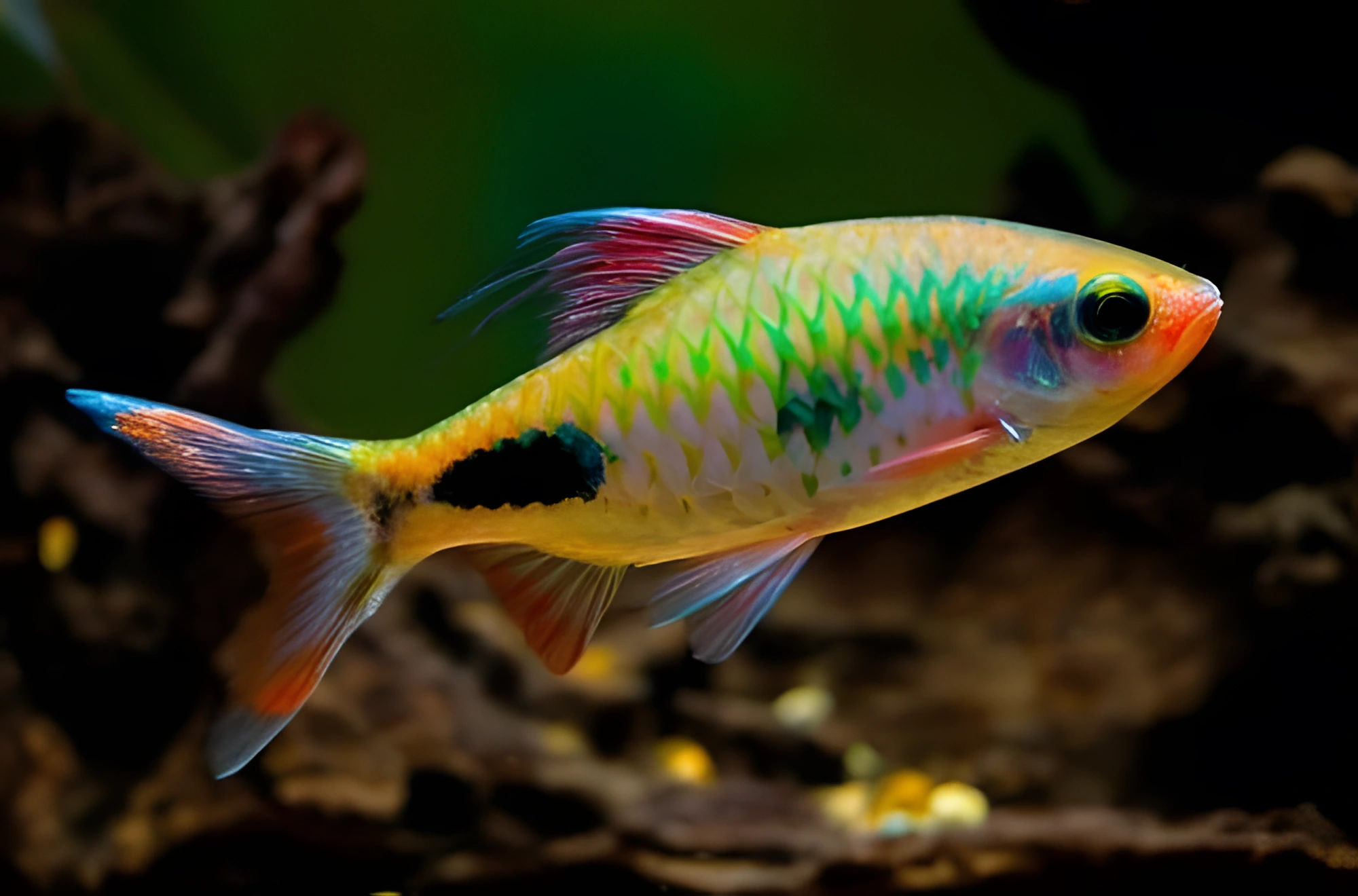
The Exclamation Barb, scientifically known as Dawkinsia exclamatio, belongs to the family Cyprinidae. Its Latin name consists of two parts: "dawkinsia" pays homage to the English ethologist and evolutionary biologist Richard Dawkins, while "exclamatio" translates to "exclamation mark." This latter component is related to the fish's distinctive color pattern, which becomes noticeable when viewed upside down.
- Required aquarium volume
- 200 L
- Size in aquarium
- 8 – 10 cm
- Temperature
- 19 – 25 °C
- Temperament
- Peaceful, active/mobile
Parameters
Water pHSlightly acidic (6) – Neutral (7.5)
Water dHVery soft (2) – Medium hardness (10)
Water salinityno salt (freshwater)
Size in aquarium8 – 10 cm
Lifespan4 years
TemperamentPeaceful, active/mobile
Toward small fishnot a predator
Required aquarium volume200 L
Lightingany
Substratesand or gravel + stones/boulders
Water flowweak or moderate
FeedingMixed diet (meat + plant-based)
CareGroup (8–10 individuals)
Description
These fish reach a length of about 10 cm when fully grown. They attract attention with their bright, iridescent coloration, displaying almost all shades of the rainbow. The distinctive feature that gave the species its name is a dark, elongated stripe located at the base of the caudal fin. Indeed, if the fish assumes a vertical position, this stripe, along with its dark eye, creates the impression of an exclamation mark. Sexual dimorphism is weakly expressed. Females are generally somewhat larger, while males exhibit more intense colors, and during the breeding season, small tubercles appear on their heads.
Habitat
This species is endemic to Lake Ashtamudi and the Kallada River, which flows into it, located in the Indian state of Kerala. Although the Kallada River has a short length, the habitat of these fish is quite diverse. They are found in various biotopes — from clear mountain streams to murky backwaters with silty bottoms.
Behavior and Compatibility
This is a peaceful, schooling fish that prefers to live in groups of 8-10 individuals. It coexists well with many other non-aggressive species of similar size and temperament.
Care and Maintenance
For long-term keeping of a small school of Exclamation Barbs, aquariums of at least 200 liters are required. For decoration, you can use substrate of various sizes (sand, stones) with several large boulders, as well as snags imitating roots or tree branches, and undemanding plants such as Anubias, aquatic mosses, and ferns. These fish are demanding about water purity and do not tolerate the accumulation of organic waste, such as food remnants or excrement. It is important to ensure stable water parameters with appropriate hydrochemical indicators, regularly clean the aquarium, and perform weekly water changes of 30-50% of the volume with fresh water.
Diet
Being an omnivorous species, this fish readily accepts most common foods, including dry flakes, pellets, as well as live or frozen Artemia and bloodworms. To enhance their natural coloration, specialized color-enhancing foods are recommended.
Breeding and Reproduction
The breeding process for these fish does not differ from that of other small cyprinids. During spawning, which in a home aquarium is not tied to a specific season and can begin at any time, females scatter many eggs in the water column, and males fertilize them. The incubation period is 24-48 hours, and after another day, the fry begin to swim freely. Since these fish lack parental instincts, they do not care for their offspring, which leads to very low fry survival. Their chances of survival significantly increase if the eggs are transferred to a separate aquarium with identical water conditions. Such an improvised breeding tank usually has a small volume (from 10 liters), is equipped with a simple air-driven filter and a heater. A light source is not required; ambient room light will be sufficient.
Diseases
In a balanced aquarium ecosystem that meets the needs of this species, diseases are rare. Most often, ailments are provoked by deteriorating environmental conditions, contact with already sick fish, or mechanical damage. If the fish shows clear signs of illness, medicinal treatment should be applied. More detailed information on symptoms and therapy methods can be found in the “Aquarium Fish Diseases” section.
How to choose
When purchasing, choose active, lively individuals with clean fins and scales, free from visible damage, spots, or film. Avoid fish with signs of emaciation, sunken bellies, or apathetic behavior, as this species is sensitive to water quality and stress during transport. Given that Dawkinsia exclamatio is a schooling species, it is recommended to acquire a group of 8–10 individuals at once to reduce timidity and facilitate adaptation to a new aquarium. Before purchasing, ensure that the fish in the store are kept in conditions close to those required and do not show signs of infectious diseases.
Frequently asked questions
The essentials: size, tank volume, water parameters and care
How big does Exclamation Barb get?
An adult reaches 8–10 cm in length. Plan the tank around the maximum size: the fish quickly outgrows a cramped setup.
What size aquarium does Exclamation Barb need?
The minimum recommended volume is 200 L. A smaller tank speeds up nitrate build-up and raises stress levels.
What water parameters does Exclamation Barb need?
Temperature 19–25 °C, pH 6–7.5, hardness 2–10 dGH. Stability matters more than exact values: sudden swings are harder on the fish than a small deviation from the ideal.
How long does Exclamation Barb live?
Around 4 years when kept properly. Lifespan depends directly on tank volume, water quality and a varied diet.
Is Exclamation Barb aggressive?
Temperament: peaceful, active/mobile. Keep this in mind when choosing tank mates.
How many Exclamation Barb should be kept together?
Recommended setup: group (8–10 individuals). Ignoring this is a common cause of stress and disease.
What does Exclamation Barb eat?
Diet type: mixed diet (meat + plant-based). Feed small portions that are finished within a couple of minutes — overfeeding does more harm than underfeeding.
What is the scientific name of Exclamation Barb?
The scientific name of the species is Dawkinsia exclamatio, family Cyprinids (Cyprinidae). It also appears in the literature as: Puntius exclamatio.