Temperature23 – 27 °C
Natural range
- Lake Tanganyika area
- East Africa area
CichlidsConservation status: Near threatened NT
Other scientific names: Tropheus moorei
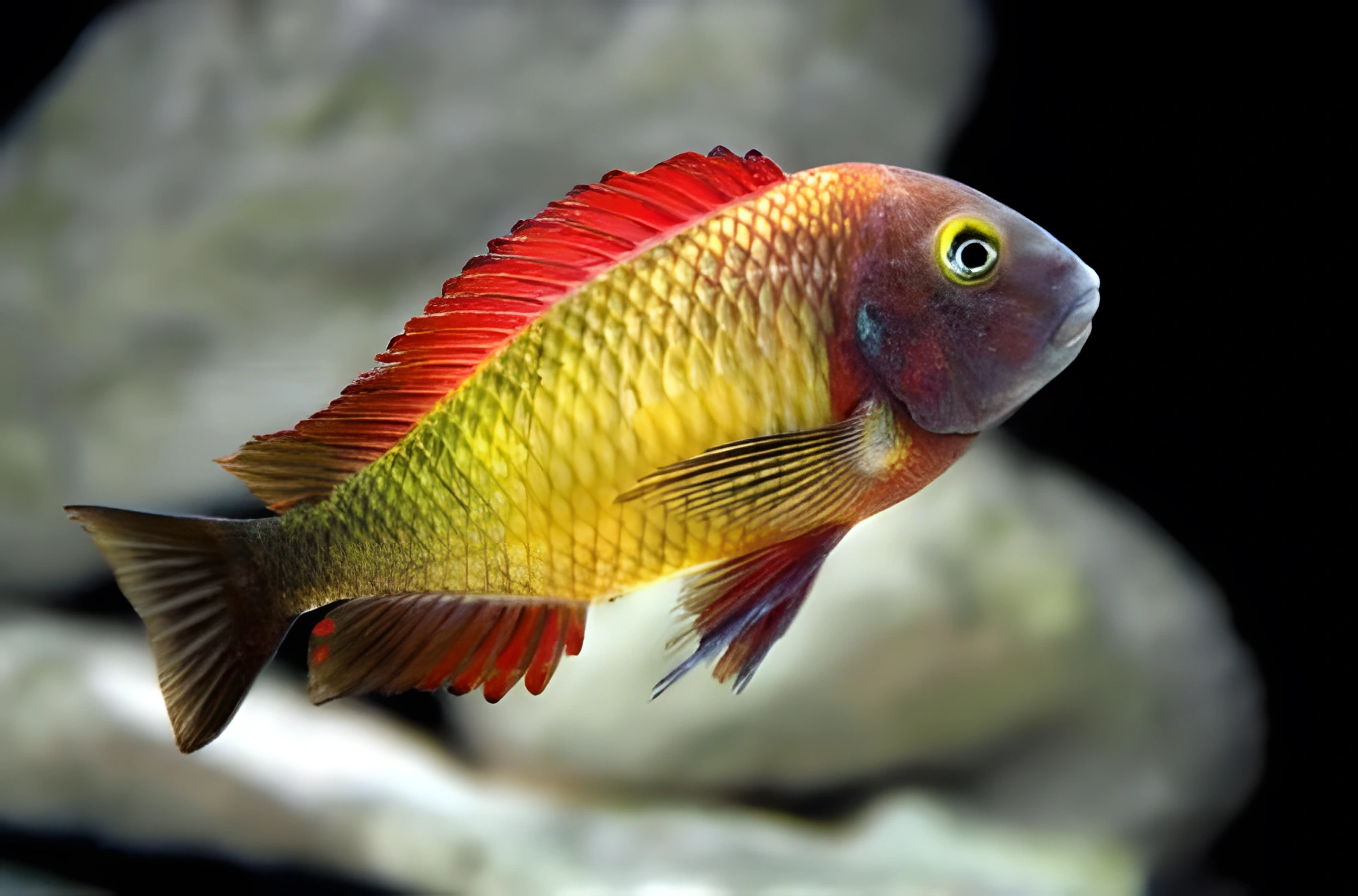
Tropheus moorii, known as the Tropheus Moorii or Blunt-nosed Cichlid, belongs to the family Cichlidae. This species is endemic to East Africa's Lake Tanganyika, preferring to inhabit shallow waters among rocky shorelines. Undoubtedly, it is popular and relatively easy to keep, but it possesses one significant drawback: pronounced aggression towards members of its own species, which often limits the presence of more than one such fish in a home aquarium.
- Required aquarium volume
- 100 L
- Size in aquarium
- 14 cm
- Temperature
- 23 – 27 °C
- Temperament
- Semi-peaceful (including aggression during spawning / intraspecific conflicts)
Parameters
Water pHSlightly alkaline (8) – Alkaline (9.5)
Water dHMedium hardness (10) – Very hard (25)
Water salinityno salt (freshwater)
Size in aquarium14 cm
Lifespan10 years
TemperamentSemi-peaceful (including aggression during spawning / intraspecific conflicts)
Toward small fishnot a predator
Required aquarium volume100 L
Lightingmoderate (regular)
Substratesandy (regular, light)
Water flowweak or moderate
FeedingMixed diet (meat + plant-based)
CareSolitary
Description
Adults reach approximately 14 cm in length. Sexual dimorphism is weakly expressed, making sex determination difficult. There are about 50 subspecies of the Blunt-nosed Cichlid, each distinguished by unique coloration and body patterns. The structure of these fish's mouths is shaped by their dietary preferences: it is positioned low, and the lips have rigid edges, ideally suited for scraping vegetation from rocks.
Habitat
Tropheus Moorii is endemic to Lake Tanganyika in East Africa. In nature, the fish primarily inhabit shallow areas along rocky shorelines at depths of 3 to 5 meters. Such biotopes are well-lit by sunlight, which promotes the active growth of algal growths on rocks, serving as the main food source. Rock formations also provide the fish with numerous natural shelters and crevices.
Behavior and Compatibility
Despite its reputation as being very aggressive, the Blunt-nosed Cichlid exhibits such behavior exclusively towards conspecifics, engaging in deadly fights for dominance. Towards other species, Tropheus Moorii is quite friendly and can successfully coexist with many popular aquarium fish that suit similar keeping conditions. This cichlid can be kept alone in a small aquarium, or in a group of 15–20 or more individuals, but only in a very large tank of 1000 liters or more, which will allow each individual to find its territory and significantly reduce the level of aggression.
Care and Maintenance
The minimum aquarium volume for a single specimen starts from 100 liters. The setup can be quite simple: sandy substrate and several large rocks or stones from which caves, grottoes, or other shelters can be created. Plants are not an essential element. Key attention should be paid to water parameters and cleanliness. These fish require high-quality, oxygen-rich water with elevated pH and hardness values. In addition to weekly 15–20% water changes, a productive filtration system is critically important, preferably with filter media capable of maintaining the required hydrochemical composition of the water.
Diet
In their natural habitat, the fish's diet consists of algae covering rocks and stones, as well as small invertebrates and crustaceans living within this vegetation. It is recommended to use specialized cichlid foods for Lake Tanganyika from various manufacturers, or universal foods with a high content of plant components for feeding in aquarium conditions.
Breeding and Reproduction
Breeding Tropheus involves two serious challenges that often prove unfeasible for amateur aquarists due to financial reasons. First, a very large aquarium of 1000 liters or more, equipped with sufficient hiding places, must be set up. Additionally, a group of 20–30 young individuals will need to be acquired, which will grow together, forming a community with its own hierarchy. During this process, many subdominant males are likely not to survive. Typically, only one alpha male remains to participate in spawning, and other male individuals, if they manage to survive, will keep their distance. Spawning occurs in open water: the female lays 5 to 15 eggs and immediately collects them in her mouth, preventing them from sinking to the bottom. She then approaches the male and ingests his milt, ensuring fertilization directly in her mouth. The eggs and hatched fry remain in the female's mouth for up to 4 weeks, after which they begin to swim independently. During this period, the female completely refuses food and can noticeably lose weight. If feeding before spawning was irregular or the diet insufficient, the female will likely release the fry prematurely or, in the worst case, may eat them. The male takes no part in protecting or caring for the offspring.
Diseases
Inappropriate keeping conditions and poor-quality food are the main causes of most diseases in Lake Tanganyika cichlids, often leading to ailments such as African bloat. Upon detecting the first symptoms, it is extremely important to check water parameters and ensure the absence of high concentrations of ammonia, nitrites, nitrates, and other dangerous substances. If necessary, all parameters should be normalized, and only then should treatment begin. More detailed information on symptoms and treatment methods is presented in the section “Diseases of Aquarium Fish.”
How to choose
When selecting specimens, attention should be paid to the fish's overall activity and the cleanliness of its skin, the absence of visible damage, ulcers, or signs of emaciation. It is important to note that Tropheus are extremely sensitive to changes in environmental conditions, so transport stress can provoke diseases. In the store, it is preferable to observe the group's behavior: healthy fish should exhibit species-typical territoriality and interest in food. Avoid purchasing fish with signs of bloating or atypically sluggish behavior.
Frequently asked questions
The essentials: size, tank volume, water parameters and care
How big does Tropheus Moorii get?
An adult reaches 14 cm in length. Plan the tank around the maximum size: the fish quickly outgrows a cramped setup.
What size aquarium does Tropheus Moorii need?
The minimum recommended volume is 100 L. A smaller tank speeds up nitrate build-up and raises stress levels.
What water parameters does Tropheus Moorii need?
Temperature 23–27 °C, pH 8–9.5, hardness 10–25 dGH. Stability matters more than exact values: sudden swings are harder on the fish than a small deviation from the ideal.
How long does Tropheus Moorii live?
Around 10 years when kept properly. Lifespan depends directly on tank volume, water quality and a varied diet.
Is Tropheus Moorii aggressive?
Temperament: semi-peaceful (including aggression during spawning / intraspecific conflicts). Keep this in mind when choosing tank mates.
How many Tropheus Moorii should be kept together?
Recommended setup: solitary. Ignoring this is a common cause of stress and disease.
What does Tropheus Moorii eat?
Diet type: mixed diet (meat + plant-based). Feed small portions that are finished within a couple of minutes — overfeeding does more harm than underfeeding.
What is the scientific name of Tropheus Moorii?
The scientific name of the species is Tropheus moorii, family Cichlids (Cichlidae). It also appears in the literature as: Tropheus moorei.