Temperature20 – 26 °C
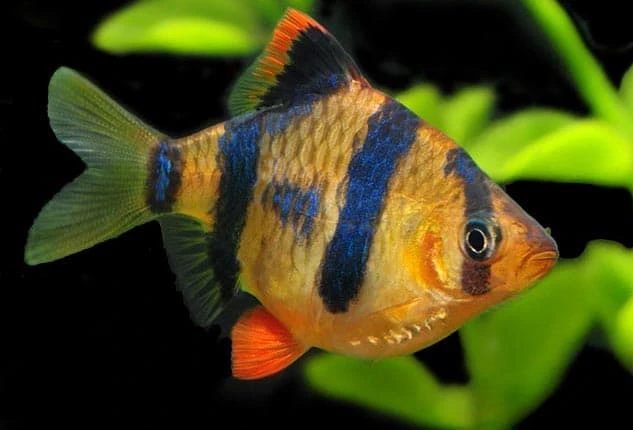
Other scientific names: Barbus tetrazona, Capoeta tetrazona, Puntius tetrazona, Systomus sumatranus, Systomus sumatrensis, Systomus tetrazona
The Sumatran Barb, or Tiger Barb, scientifically known as Puntigrus tetrazona, belongs to the family Cyprinidae. This aquarium fish is among the most familiar and widespread species. For many decades, its popularity has not waned, thanks to its striking appearance and general unpretentiousness in care.
The fish's rounded body features a high dorsal fin and a pointed head, giving it a streamlined silhouette. The main body coloration ranges from yellow to reddish, adorned with four vertical black stripes. These stripes are the basis for one of the species' names – Tiger Barb. The tail and fins often have reddish hues. Females appear larger, especially noticeable during preparation for spawning. Males, at this time, develop a pronounced red color on their heads, and their overall coloration becomes more intense.
The scientific description of this fish was first made in 1855, during the study of the flora and fauna of Southeast Asia, including the territories of modern Sumatra, Borneo, Thailand, and Cambodia. The home of the species is Sumatra: the type locality is Lahat in South Sumatra province, while records from Borneo are referred to congeners. Today, wild populations of these barbs are found in Singapore, Australia, the USA, and Colombia, and their spread to other continents is also highly probable. Barbs prefer to inhabit calm forest streams where the water is rich in oxygen. Typically, the bottom of such bodies of water consists of stones and sand. Dense thickets of aquatic vegetation serve as shelter and a food source for these fish, which includes small invertebrates and plant components – these can be insects and their larvae, crustaceans, diatoms, and various plankton.
This species is schooling, so it is recommended to keep Barbs in groups of at least 8–10 individuals. If kept alone, they may show aggression towards other aquarium inhabitants. This behavior is explained by the Barb's need for the company of its conspecifics; in its absence, the unspent energy intended for intraspecific communication is directed at tank mates. It is important to note that the Sumatran Barb tends to nip at the long fins or feelers of some fish species. Gouramis, Goldfish, and other species with flowing fins are at risk. Coexistence is possible with other barb species, as well as with other active species of comparable size. Smaller and less active fish may be in danger.
Keeping the Sumatran Barb is not associated with special difficulties, as this species is very undemanding. For a group of 5–6 individuals, the aquarium should have a minimum volume of 50–60 liters. Standard equipment includes a filter, lighting system, and heater. The filter not only cleans the water but also creates the necessary current, which helps maintain the fish's tone and positively affects the brightness of the males' coloration. The aquarium setup should mimic natural habitat conditions as much as possible. Dense thickets of vegetation along the perimeter of the aquarium walls provide fish with a sense of security while leaving free space for swimming in the central part. Sandy substrate is desirable. It is recommended to place natural snags, consisting of bogwood fragments, roots, or branches, on the bottom.
This is an omnivorous species. Their daily diet can consist of various dry, frozen, or live foods, such as daphnia, bloodworms, artemia, and others.
The Tiger Barb reaches sexual maturity as early as its second month of life, at a size of just 2–3 cm. Since parental care is absent in these fish, spawning is preferably organized in a separate breeding tank. The volume of such an aquarium should be at least 40 liters. As equipment, a simple airlift filter with a sponge as the filter material, as well as a heater, is sufficient. It is recommended to use a substrate of large pebbles, creating spaces between them where eggs can fall. Permissible water parameters for spawning include: GH level up to 10 (soft), pH around 6.5 (slightly acidic), temperature 24–26°C. As soon as you notice that the head of one or more males turns red, this signals the beginning of the spawning period. At this point, you should prepare the breeding tank and select a female with the most rounded abdomen. She is placed in the breeding tank first, and the male is added a day later. The courtship ritual is brief: the male will swim around the female with spread fins, trying to attract her attention. During spawning, the female releases 1–3 eggs at a time; their total number can reach 700. The male immediately fertilizes them. The eggs sink to the substrate, falling into crevices between particles, which makes them inaccessible to adult fish, who are capable of eating them. After spawning, the adult fish are returned to the main aquarium. Fry appear on the second day, and after 5 days, they begin to swim freely. They should be fed specialized micro-food or Artemia nauplii.
This species is exceptionally hardy. With proper aquarium conditions, health problems in fish usually do not occur.
When choosing Sumatran Barbs, pay attention to their overall activity and fin condition. Healthy individuals should be active, constantly moving, and actively interacting with each other in the school. Avoid purchasing fish that are isolated, appear sluggish, or show signs of damage to scales and fins. — choose individuals with clear, non-cloudy eyes and no white film or ulcers on the body — check the integrity of the fins, as nipped edges may indicate stress or disease in the aquarium — prefer fish with bright, contrasting coloration, which indicates their good health and proper keeping. It is important to consider that Sumatran Barbs are schooling fish, so it is recommended to purchase a group of 6–10 individuals at once. Buying single specimens or too small a group often leads to increased aggression and stress, which negatively affects the fish's health in the first days after moving to a new aquarium.
The essentials: size, tank volume, water parameters and care
An adult reaches 7 cm in length. Plan the tank around the maximum size: the fish quickly outgrows a cramped setup.
The recommended volume is 60 L. A smaller tank speeds up nitrate build-up and raises stress levels.
Temperature 20–26 °C, pH 6–8, hardness 5–20 dGH. Stability matters more than exact values: sudden swings are harder on the fish than a small deviation from the ideal.
Around 7 years when kept properly. Lifespan depends directly on tank volume, water quality and a varied diet.
Temperament: peaceful, but may bite fins. Keep this in mind when choosing tank mates.
Recommended setup: schooling (usually from 5–6 individuals and more). Ignoring this is a common cause of stress and disease.
Diet type: any (universal). Feed small portions that are finished within a couple of minutes — overfeeding does more harm than underfeeding.
The scientific name of the species is Puntigrus tetrazona, family Cyprinids (Cyprinidae). It also appears in the literature as: Barbus tetrazona, Capoeta tetrazona, Puntius tetrazona.
Matched by family, categories and overlapping keeping conditions
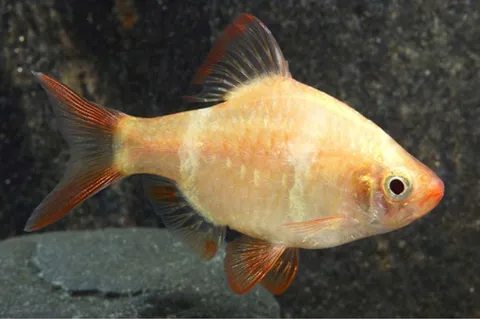
Puntigrus tetrazona
The scientific name Systomus tetrazona belongs to the Sumatra Barb (albino), a representative of the Cyprinidae family. This subspecies emerged as a result of selective breeding of the Sumatra Barb, acquiring a new body…
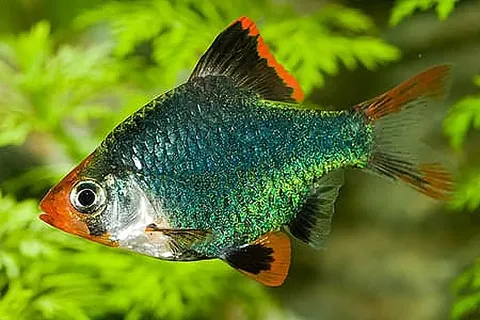
Puntigrus tetrazona
The Green Barb is a result of artificial selection, an improved form of the well-known Sumatra Barb (Puntigrus tetrazona). This energetic schooling fish has gained popularity among aquarists due to its vibrant…
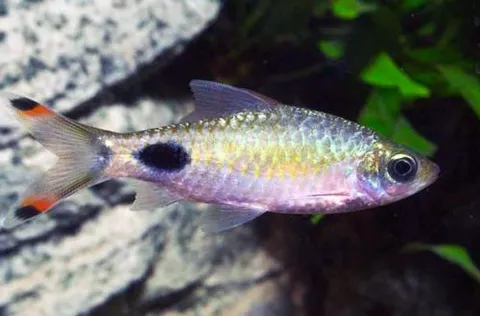
Puntius mahecola
The fish known as Mahecola Barb (scientific name Puntius mahecola) is classified within the family Cyprinidae. It is very popular in Asian countries, especially India, but outside of this region, in Europe and America,…

Kottelatia brittani
Kottelatia brittani, known as Brittan's Kottelatia, is a member of the Cyprinidae family. The fish is named after the Swiss ichthyologist Maurice Kottelat, as well as Martin Brittan, the monographer and reviser of the…