Temperature23 – 28 °C
Natural range
- Venezuela area
- Guyana area
- Suriname area
- French Guiana area
CharacinsConservation status: Least concern LC
Other scientific names: Poecilurichthys hemigrammus, Poecilurichthys unilineatus, Tetragonopterus unilineatus
Hemigrammus unilineatus, known as the Trinidad Tetra, belongs to the family Characidae. This fish is a relative of popular species such as the Glowlight Tetra, Pulcher, and Golden Tetra. Its coloration is less vibrant than that of its relatives, which is why the Trinidad Tetra is not as widely distributed. Nevertheless, it is quite undemanding to keep and, under certain conditions, can reproduce in a home aquarium.
- Required aquarium volume
- 70 L
- Size in aquarium
- 5 cm
- Temperature
- 23 – 28 °C
- Temperament
- Peaceful (regular)
Parameters
Water pHSlightly acidic (5.5) – Neutral (7.5)
Water dHVery soft (1) – Very hard (20)
Water salinityno salt (freshwater)
Size in aquarium5 cm
Lifespan5 years
TemperamentPeaceful (regular)
Toward small fishnot a predator
Required aquarium volume70 L
Lightingdimmed
Substrateany, but dark
Water flowweak
FeedingSmall / appropriate size / pieces
CareGroup (8–10 individuals)
Description
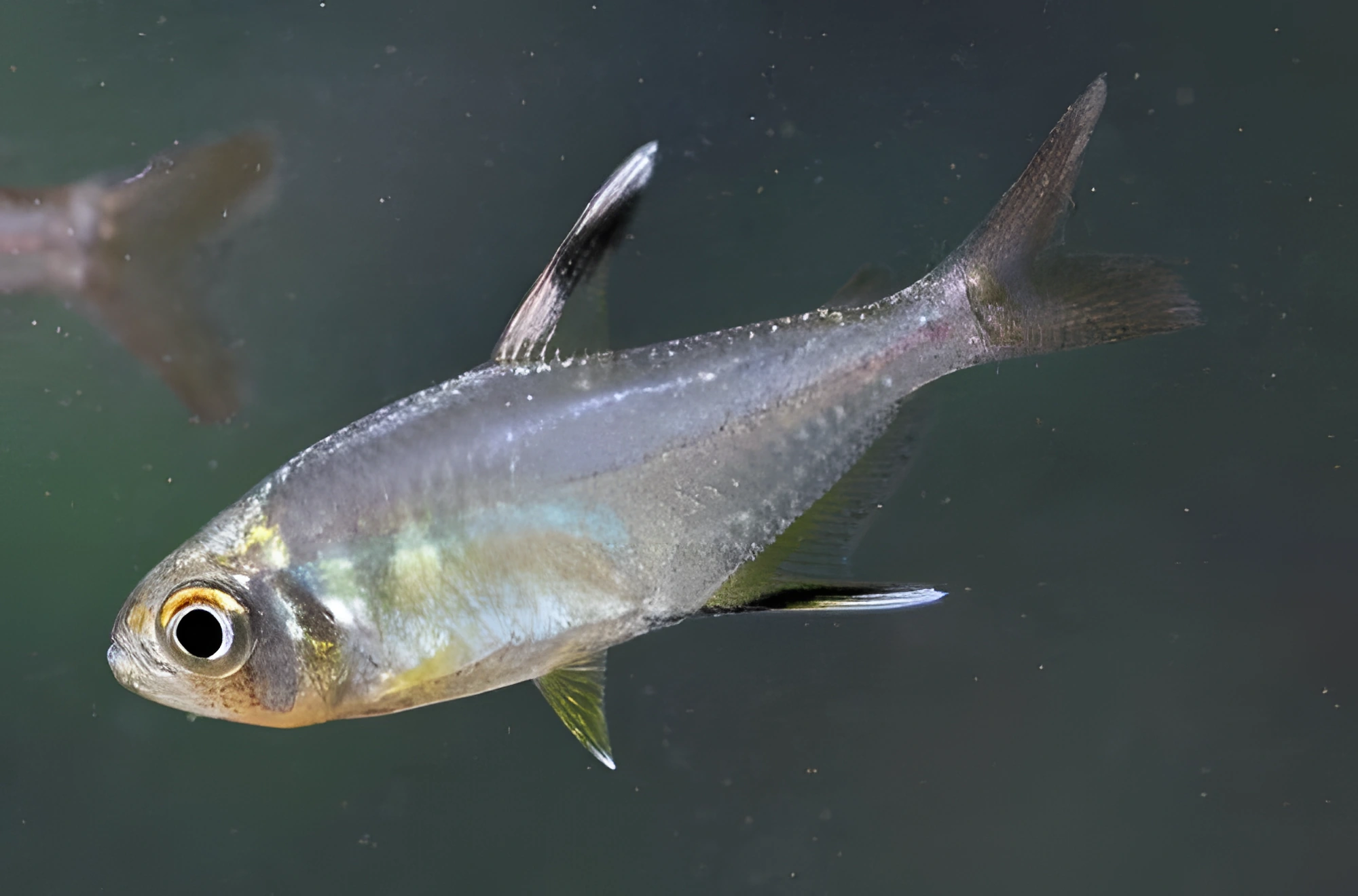
Adults reach approximately 5 cm (2 inches) in length. Under bright lighting, their coloration has a silvery hue. Their body coverings are almost transparent, allowing internal organs, such as the swim bladder, to be seen through them. Black markings are visible on the dorsal and anal fins, and the caudal fin is reddish. Sexual dimorphism in this species is weakly expressed; differences between males and females are minimal. However, some experienced specialists can determine the sex of the fish by the shape and size of the translucent swim bladder.
Habitat
The natural habitats of this fish are in South America, where it can be found in river systems flowing into the Atlantic Ocean, in the northern part of the continent. Its distribution range is quite wide and covers the territories of Venezuela, Guyana, Suriname, Eastern Guiana, northeastern Brazil, as well as the adjacent island of Trinidad and Tobago. The Trinidad Tetra inhabits various biotopes: these can be lakes, forest streams, backwaters, rivers, and tropical swamps, and it feels equally well in both clear flowing waters and more turbid and stagnant ones.
Behavior and Compatibility
It is recommended to purchase this species in a school of at least 8–10 individuals. Alone or in a small group, they can become either excessively timid or begin to show aggression towards other aquarium inhabitants – behavioral characteristics depend on the size of their tank mates. If the school is large enough, Trinidad Tetras will be an excellent addition to a freshwater community tank.
Care and Maintenance
For a school of 8–10 Trinidad Tetras, an aquarium of at least 70 liters (18.5 US gallons) is recommended. Since these fish inhabit a wide variety of biotopes in nature, the choice of specific aquarium decor is not critical for their keeping. It is important to provide enough open swimming spaces and avoid excessive overgrowth of the aquarium with live plants. The ability of these fish to adapt to a wide range of hydrochemical parameters allows the aquarist to choose the keeping conditions that will be easiest for them to maintain, based on their experience.
Diet
This fish is omnivorous and, in a home aquarium, readily accepts most common foods of appropriate size. The daily diet can consist of dry (flakes, granules), freeze-dried, frozen, or live foods, such as Artemia, bloodworms, Daphnia, and others.
Breeding and Reproduction
Provided a comfortable environment and adequate nutrition, spawning in these tetras occurs regularly. Unlike wild fish, there is no seasonal breeding in the aquarium. Fry can appear at any time, which creates certain difficulties for breeding in a community tank. The situation is exacerbated by the absence of parental instincts, as eating their own offspring is normal for them. If the spawning moment is missed, the entire brood can be quickly lost. To protect future offspring, dense thickets of fine-leaved plants are placed in the aquarium, where the emerging fry can find shelter, and after being discovered by the aquarist, they should be transferred to a separate tank. On our website, in the “Aquarium Plants” section, you can choose suitable plants for spawning. Tiny fry are initially fed microscopic foods, such as paramecia or special suspensions. As they grow, they will be able to accept larger foods, such as Artemia nauplii.
Diseases
A balanced aquarium biosystem and optimal keeping conditions serve as the best guarantee against various diseases. If you notice changes in the fish's behavior, color, or the appearance of unusual spots and other symptoms, the first step should be to check the water parameters, and only then should treatment begin. More detailed information on symptoms and treatment methods is presented in the "Aquarium Fish Diseases" section.
How to choose
When purchasing, choose active individuals that stay in a school and show interest in food. Avoid fish with signs of emaciation, damaged fins, white film on the body, or an unnaturally swollen abdomen. Since the Trinidad Tetra is a schooling species, it is recommended to acquire a group of 6–10 individuals at once to reduce stress during relocation and adaptation. In the store, pay attention to the keeping conditions: the water should be clear, without a strong odor, and tank mates should be peaceful, as stress from aggressive fish negatively affects the health of young individuals.
Frequently asked questions
The essentials: size, tank volume, water parameters and care
How big does Trinidad Tetra get?
An adult reaches 5 cm in length. Plan the tank around the maximum size: the fish quickly outgrows a cramped setup.
What size aquarium does Trinidad Tetra need?
The minimum recommended volume is 70 L. A smaller tank speeds up nitrate build-up and raises stress levels.
What water parameters does Trinidad Tetra need?
Temperature 23–28 °C, pH 5.5–7.5, hardness 1–20 dGH. Stability matters more than exact values: sudden swings are harder on the fish than a small deviation from the ideal.
How long does Trinidad Tetra live?
Around 5 years when kept properly. Lifespan depends directly on tank volume, water quality and a varied diet.
Is Trinidad Tetra aggressive?
Temperament: peaceful (regular). Keep this in mind when choosing tank mates.
How many Trinidad Tetra should be kept together?
Recommended setup: group (8–10 individuals). Ignoring this is a common cause of stress and disease.
What does Trinidad Tetra eat?
Diet type: small / appropriate size / pieces. Feed small portions that are finished within a couple of minutes — overfeeding does more harm than underfeeding.
What is the scientific name of Trinidad Tetra?
The scientific name of the species is Hemigrammus unilineatus, family Characidae. It also appears in the literature as: Poecilurichthys hemigrammus, Poecilurichthys unilineatus, Tetragonopterus unilineatus.