Temperature22 – 28 °C
Natural range
- Colombia area
- Venezuela area
- Trinidad area
CharacinsConservation status: Least concern LC
Other scientific names: Corynopoma veedonii, Nematopoma searlesii, Stevardia albipinnis, Stevardia aliata, Stevardia riisei
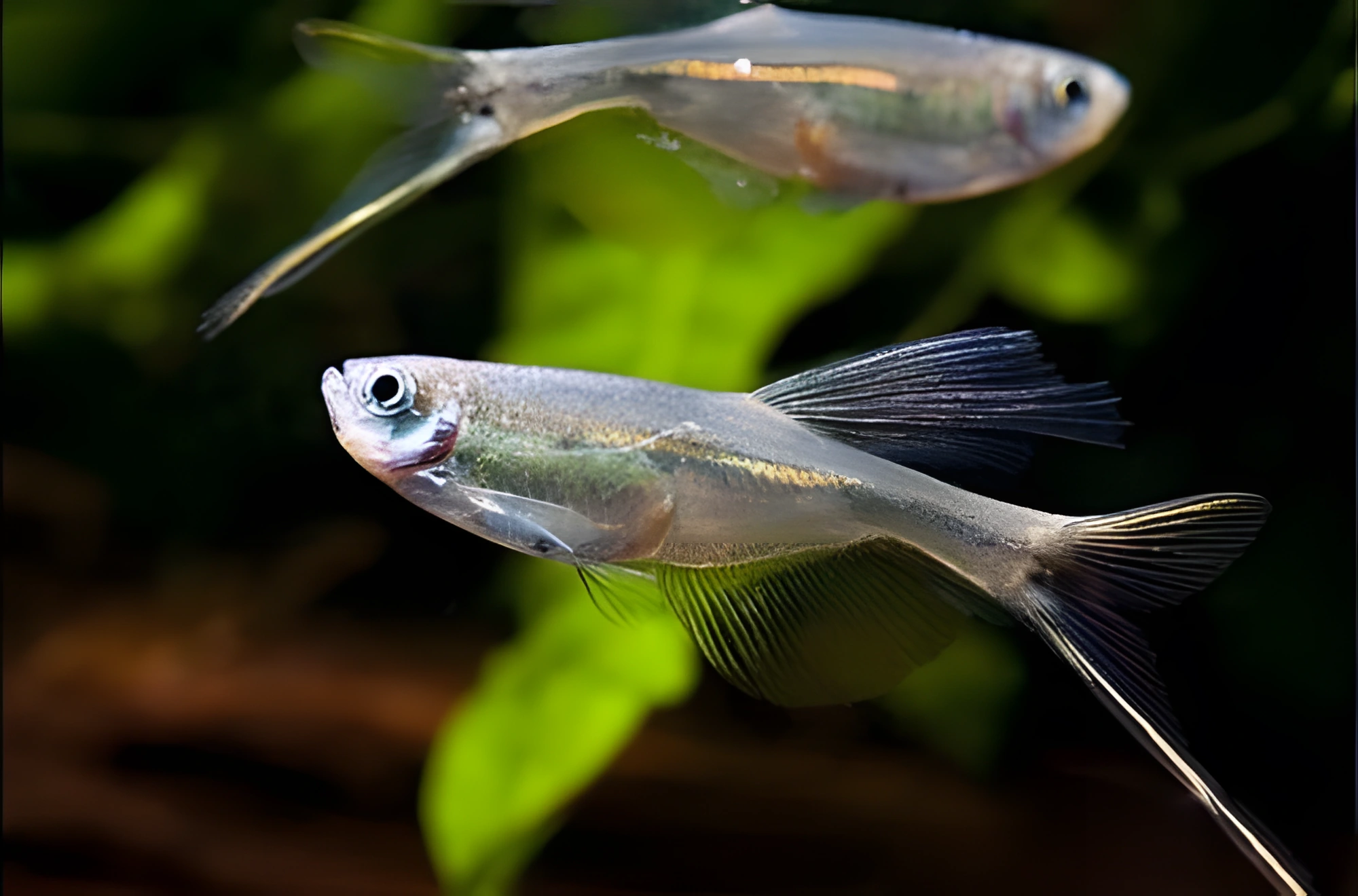
The Swordtail Characin, also known as the Dragon Fish, has the scientific name Swordtail characin (formerly Corynopoma riisei) and belongs to the family Characidae. This fish is remarkable in every respect. Although its coloration is not particularly vibrant, its original appearance, as well as its surprising breeding method and courtship behavior, make this species extremely interesting for any experienced aquarist.
- Required aquarium volume
- 90 L
- Size in aquarium
- 5 – 7 cm
- Temperature
- 22 – 28 °C
- Temperament
- Peaceful, calm/shy/inactive
Parameters
Water pHSlightly acidic (6) – Neutral (7)
Water dHVery soft (1) – Hard (15)
Water salinityno salt (freshwater)
Size in aquarium5 – 7 cm
Lifespan4 years
TemperamentPeaceful, calm/shy/inactive
Toward small fishnot a predator
Required aquarium volume90 L
Lightingdimmed
Substratesandy (regular, light)
Water flowweak or moderate
FeedingFloating (any)
CareMedium group (6–8 individuals)
Description
Adults reach a length of up to 6 cm, with a silvery body and transparent fins. Males can be unmistakably identified by two filamentous appendages, one on each gill cover, and by the elongated lower ray of the caudal fin. These appendages and the tail contain special glands that secrete pheromones, attracting females during the breeding season. Additionally, the fins have small hooks; with their help, the male holds the female during mating, as internal fertilization is characteristic of this species.
Habitat
This species originates from South America, specifically from the territories of modern Colombia and Venezuela, as well as the island of Trinidad. It inhabits coastal rivers and streams, preferring clean fresh water in areas with calm currents.
Behavior and Compatibility
These fish are peaceful towards other species, but within their own group, males may engage in skirmishes for the attention of females. Fortunately, this rarely leads to injuries but keeps the males in constant tone. It is highly recommended to keep them in groups of 6 or more individuals, as solitary keeping makes the fish lethargic and depressed. They get along well with most other species of similar size and peaceful disposition that can thrive in similar conditions. These are usually other characins, as well as Corydoras catfish or South American cichlids.
Care and Maintenance
Most of the time, these fish spend near the water surface, showing little interest in what happens in the lower layers. Therefore, when setting up the aquarium, it is important to provide ample open swimming spaces near the surface. The lower tier can be arranged according to personal preferences, capabilities, and the needs of other potential inhabitants. It is highly recommended to use several floating plants and create dense thickets of rooted species. The bottom should preferably be covered with a sandy substrate, adding many snags, branches, or tree roots, as well as fallen leaves. This biotope is typical for small rivers flowing under the canopy of a tropical forest. Optimal water conditions are characterized by a slightly acidic pH with low carbonate hardness, and the water temperature ranges from 22 to 28°C. Often, the water acquires a slight brownish tint (like tea) due to the decomposition of organic matter such as leaves and branches. A similar effect can be achieved by using peat filter materials in the filtration system, which also contribute to water acidification. In addition to the filter, the minimum equipment set includes a heater, aerator, and lighting system. The Swordtail Characin tolerates even weak currents poorly and prefers subdued, diffused lighting, so the equipment should be adjusted accordingly. Aquarium care includes weekly partial water changes (15–20% of the total volume), as well as regular cleaning of the substrate from waste products and the glass from algae. If natural, rather than decorative, leaves are used, they should be replaced every 2–3 weeks.
Diet
The upward-oriented mouth structure of the Swordtail Characin indicates its ability to feed from the water surface. In its natural habitat, the fish's diet consists of small invertebrates, as well as insects and their larvae. In a home aquarium, it will readily accept frozen or live foods such as bloodworms, daphnia, brine shrimp, as well as various flakes, granules, and freeze-dried foods, the main component of which is protein. These fish feed exclusively in the upper layers of the water; anything below, at the bottom, will be ignored.
Breeding and Reproduction
This species is distinguished by both unique courtship behavior and a special method of reproduction, where fertilization of eggs occurs inside the female's body, allowing spawning to proceed even in the absence of males. Various sources (specialized literature, internet resources, etc.) provide rather contradictory descriptions of the Dragon Fish breeding process. However, it can be concluded that these fish do not have strict requirements, and obtaining offspring is quite possible in home conditions. The stimulus for the start of the breeding season is an increase in the proportion of frozen or live foods in the daily diet, as well as maintaining the following water parameters: pH 6.0–7.0, dGH 1–5 at a temperature of 26–28°C. After some time, the fish's behavior will change. The males' gill appendages noticeably increase, and they twitch them intensely, which attracts females so much that they may even nip at them. If you observe such behavior for several days, it almost certainly means that the eggs have already been fertilized. Females can retain the eggs for several weeks, awaiting suitable conditions for spawning. Spawning is preferably carried out in a separate tank to protect the fry from adult fish, which will gladly feast on them if given the opportunity. A spawning aquarium of about 20 liters will be quite sufficient. It is necessary to place dense thickets of fine-leaved plants around the entire perimeter of the bottom. Lighting should be subdued, and a simple sponge air-lift filter can be used for filtration and aeration. Females are placed in the spawning aquarium, and after some time (this process can take up to a week), the appearance of fry should be expected. From this moment, the young mother is returned, and the fry are left to develop independently. It is worth noting that the number of fry in Dragon Fish is significantly lower than in other characins, which is associated with a more efficient method of reproduction and, consequently, higher offspring survival.
Diseases
With a balanced aquarium ecosystem and proper care, the likelihood of diseases is minimized. Therefore, if the first signs of illness appear, the first step should be to check the keeping conditions, and only then proceed with treatment. More detailed information on symptoms and treatment methods can be found in the "Diseases of Aquarium Fish" section.
How to choose
When purchasing, choose active individuals that stay in a school and exhibit natural behavior. Avoid fish with damaged fins, signs of emaciation, or an unnatural coating on the body. Since males have specific gill outgrowths, check the integrity of these structures, as their damage can negatively affect the fish's ability to reproduce. It is advisable to acquire a group of 6 or more individuals, as solitary keeping leads to stress and reduced immunity. Before purchasing, ensure there are no fish in the store's aquarium with obvious signs of disease, as this species is sensitive to water quality and transport conditions.
Frequently asked questions
The essentials: size, tank volume, water parameters and care
How big does Swordtail Characin get?
An adult reaches 5–7 cm in length. Plan the tank around the maximum size: the fish quickly outgrows a cramped setup.
What size aquarium does Swordtail Characin need?
The minimum recommended volume is 90 L. A smaller tank speeds up nitrate build-up and raises stress levels.
What water parameters does Swordtail Characin need?
Temperature 22–28 °C, pH 6–7, hardness 1–15 dGH. Stability matters more than exact values: sudden swings are harder on the fish than a small deviation from the ideal.
How long does Swordtail Characin live?
Around 4 years when kept properly. Lifespan depends directly on tank volume, water quality and a varied diet.
Is Swordtail Characin aggressive?
Temperament: peaceful, calm/shy/inactive. Keep this in mind when choosing tank mates.
How many Swordtail Characin should be kept together?
Recommended setup: medium group (6–8 individuals). Ignoring this is a common cause of stress and disease.
What does Swordtail Characin eat?
Diet type: floating (any). Feed small portions that are finished within a couple of minutes — overfeeding does more harm than underfeeding.
What is the scientific name of Swordtail Characin?
The scientific name of the species is Corynopoma riisei (Swordtail characin), family Characidae. It also appears in the literature as: Corynopoma veedonii, Nematopoma searlesii, Stevardia albipinnis.