Temperature20 – 28 °C
Natural range
- Loreto Region
- Peru area
CharacinsConservation status: Data deficient DD
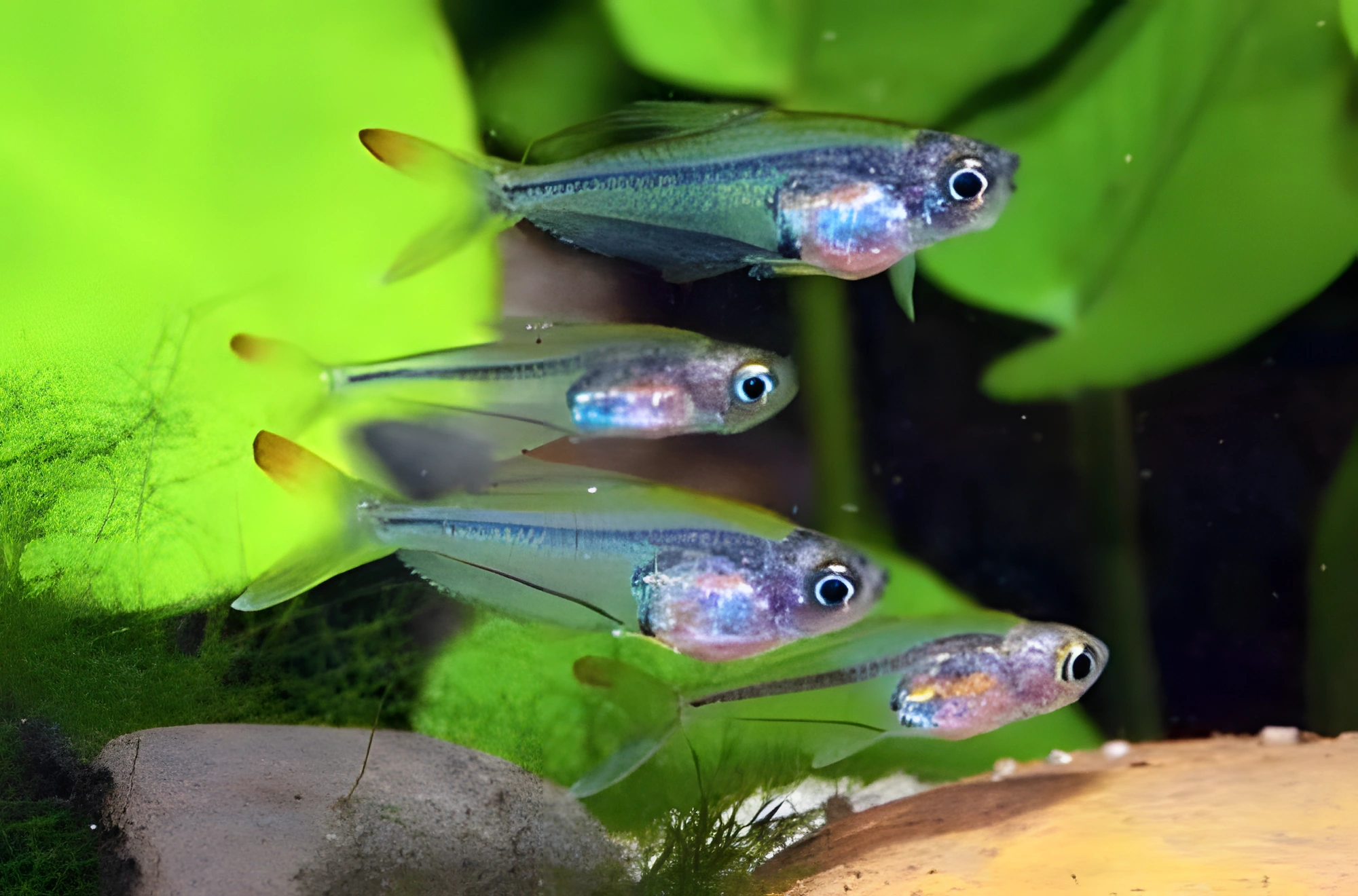
The Hummingbird Tetra, scientifically known as Trochilocharax ornatus, is a member of the Characidae family. This species undoubtedly lives up to its name, as it is among the most miniature aquarium fish. However, its keeping requires certain efforts, and breeding can be associated with some difficulties. The very small size of the fish creates challenges when choosing suitable tankmates. For these reasons, the Hummingbird Tetra is not an optimal choice for beginner aquarists.
- Required aquarium volume
- 40 L
- Size in aquarium
- 1.7 – 2 cm
- Temperature
- 20 – 28 °C
- Temperament
- Peaceful (regular)
Parameters
Water pHAcidic (4) – Neutral (6.5)
Water dHVery soft (1) – Soft (5)
Water salinityno salt (freshwater)
Size in aquarium1.7 – 2 cm
Lifespan3 years
TemperamentPeaceful (regular)
Toward small fishnot a predator
Required aquarium volume40 L
Lightingdimmed or moderate
Substrateany (no restrictions)
Water flowmoderate
FeedingAny (universal)
CareGroup (8–10 individuals)
Description
Adults grow up to 17 mm, making them one of the smallest aquarium fish – their length does not even reach 2 cm. Sexual dimorphism is weakly expressed; males and females look very similar, with no noticeable external differences. The main body color is gray with a slight bluish tint. The fins are almost transparent, but the tip of the caudal fin is red, and the pelvic fins have a yellowish hue.
Habitat
Its natural habitat is in South America, in the upper tributaries of the Amazon River, in the Loreto region of Peru. These fish prefer to settle in small forest streams, channels, and minor river courses. In their natural environment, the bottom is often covered with sand, strewn with numerous snags and fallen leaves. The decomposition of organic matter releases tannins, giving the water a characteristic brownish tint.
Behavior and Compatibility
This is a peaceful schooling fish that needs to be kept in a group of 8–10 individuals. Great care should be taken when choosing tankmates, as the fish is so small that even moderately large fish can frighten it. In nature, they can hide from danger, but this is impossible in the confined space of an aquarium. In small aquariums, the Hummingbird Tetra is only compatible with fish of a similar size.
Care and Maintenance
For a school of 8–10 Hummingbird Tetras, an aquarium of 40 L or more is suitable. The aquarium decor can be anything, but using natural elements is considered most favorable. A sandy substrate, driftwood, and live plants will create conditions as close to natural as possible. Lighting should be subdued, so shade-loving plant species, mosses, and ferns are preferable. It is recommended to add dried leaves from certain trees to the aquarium: their decomposition will mimic natural processes, releasing tannins. This will not only give the water a characteristic chemical composition but also color it brown. In addition, decomposing leaves will serve as a valuable source of secondary food for fry – paramecium. Hummingbird Tetras need soft water with an acidic pH. It may be necessary to use filters with chemical filtration to acidify the water, as well as a reverse osmosis system to reduce general hardness. It is important to maintain stable water parameters, as the fish is sensitive to their fluctuations and the accumulation of organic waste.
Diet
Hummingbird Tetras successfully eat all common types of aquarium food. However, it should be noted that the offered food must be crushed into tiny particles, otherwise, the fish will not be able to swallow it. The daily diet can include dry, freeze-dried, live, or frozen foods.
Breeding and Reproduction
Under favorable conditions, such as a suitable habitat and quality nutrition, the fish often enter a spawning state, which makes their breeding not too difficult. However, the main difficulties arise when raising fry, which are extremely small and require microscopic food, such as paramecium.
Diseases
Specific diseases that affect only this particular fish species have not been identified. When kept in suitable conditions, including high water quality, a balanced diet, and peaceful tank mates, health issues usually do not arise. The most common cause of illness is a deterioration of living conditions, which weakens the immune system and makes the fish susceptible to infections that are always present in their environment. Upon noticing initial signs of sickness (such as lethargy, emaciation, refusal to eat, or clamped fins), it is crucial to immediately check the basic water parameters. Often, restoring acceptable living conditions will lead to self-recovery, but if the fish is too weak or has suffered visible damage, medicinal treatment may be required. For more details on symptoms and treatment methods, consult the section “Diseases of Aquarium Fish.”
How to choose
When purchasing Hummingbird Tetras, it is important to ensure there are no external injuries or signs of emaciation, as the fish are extremely sensitive to stress and water quality. Healthy individuals should be active, exhibit schooling behavior, and have clean, transparent fins without any film or spots. Due to their miniature size (up to 2 cm), it is crucial to assess the condition of the fins, especially in males, where they are elongated.
It is recommended to acquire a group of 8–10 individuals simultaneously, as solitary keeping or purchasing too few fish leads to severe stress and rapid loss of immunity. In the store, pay attention to the keeping conditions: the water should be clean, without excessive organic matter, and the fish should not appear lethargic or hide in the corners of the aquarium. Avoid purchasing individuals if aggressive or significantly larger tankmates are present in their aquarium, as they could cause injuries.
Frequently asked questions
The essentials: size, tank volume, water parameters and care
How big does Hummingbird Tetra get?
An adult reaches 1.7–2 cm in length. Plan the tank around the maximum size: the fish quickly outgrows a cramped setup.
What size aquarium does Hummingbird Tetra need?
The minimum recommended volume is 40 L. A smaller tank speeds up nitrate build-up and raises stress levels.
What water parameters does Hummingbird Tetra need?
Temperature 20–28 °C, pH 4–6.5, hardness 1–5 dGH. Stability matters more than exact values: sudden swings are harder on the fish than a small deviation from the ideal.
How long does Hummingbird Tetra live?
Around 3 years when kept properly. Lifespan depends directly on tank volume, water quality and a varied diet.
Is Hummingbird Tetra aggressive?
Temperament: peaceful (regular). Keep this in mind when choosing tank mates.
How many Hummingbird Tetra should be kept together?
Recommended setup: group (8–10 individuals). Ignoring this is a common cause of stress and disease.
What does Hummingbird Tetra eat?
Diet type: any (universal). Feed small portions that are finished within a couple of minutes — overfeeding does more harm than underfeeding.
What is the scientific name of Hummingbird Tetra?
The scientific name of the species is Trochilocharax ornatus, family Characidae.