Temperature24 – 28 °C
Natural range
- Guyana area
- Suriname area
- French Guiana area
- Peru area
CharacinsConservation status: Least concern LC
Other scientific names: Hemibrycon ocellifer, Tetragonopterus ocellifer
The Head-and-taillight Tetra, also known by its scientific name Hemigrammus ocellifer, belongs to the family Characidae. This freshwater tropical fish is very common, easy to keep and breed, and coexists well with many other species of similar size. It will be an excellent choice for a beginner aquarist.
- Required aquarium volume
- 70 L
- Size in aquarium
- 5 cm
- Temperature
- 24 – 28 °C
- Temperament
- Peaceful (regular)
Parameters
Water pHSlightly acidic (5.5) – Neutral (6.5)
Water dHSoft (5) – Very hard (20)
Water salinityno salt (freshwater)
Size in aquarium5 cm
Lifespan5 years
TemperamentPeaceful (regular)
Toward small fishnot a predator
Required aquarium volume70 L
Lightingdimmed
Substratecoarse sand / gravel / pebbles
Water flowweak
FeedingAny (universal)
CareGroup (8–10 individuals)
Description
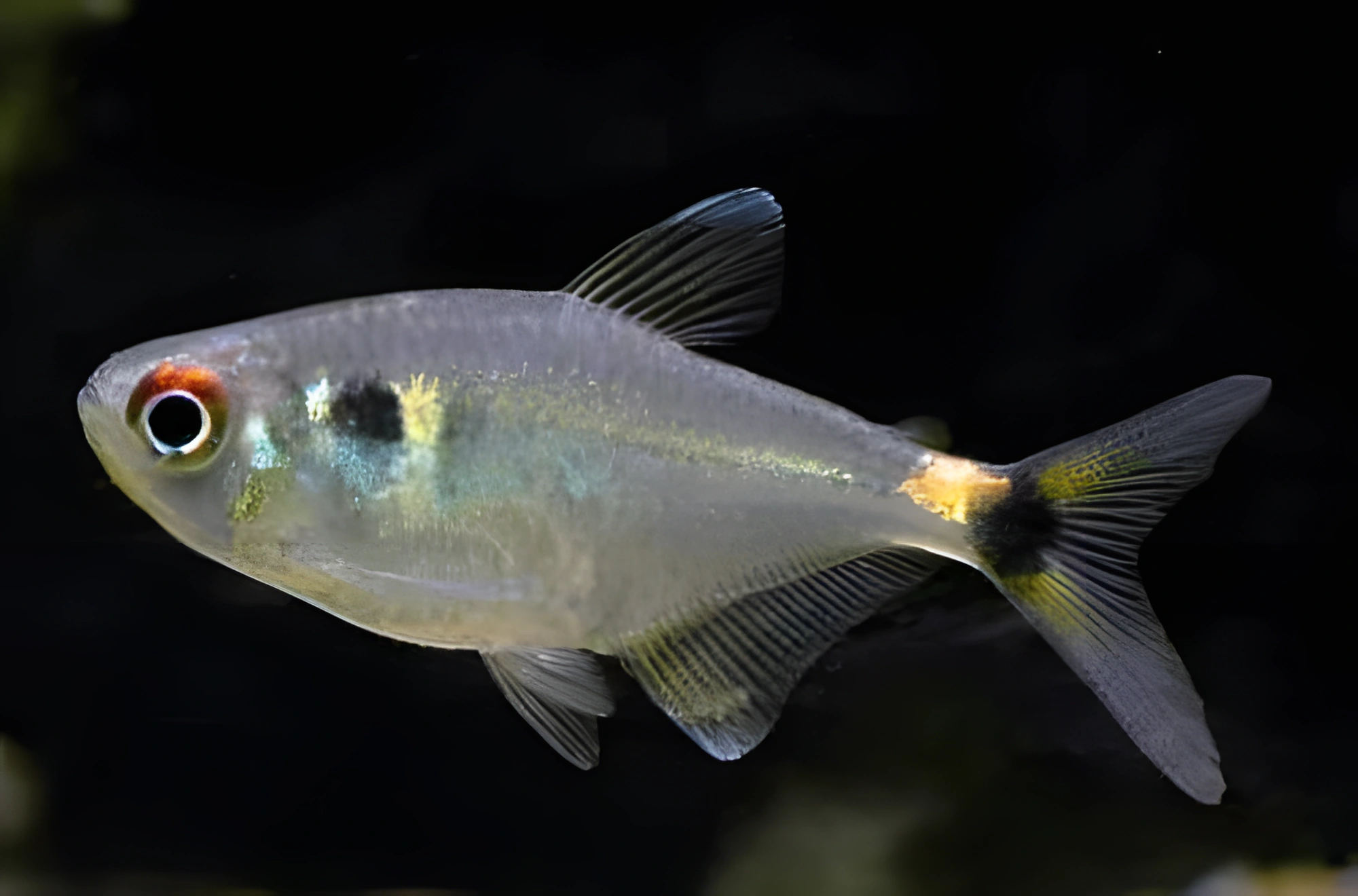
The length of an adult usually does not exceed 4.5 cm. The fish's body has a silvery coloration, and its fins are transparent. A characteristic feature, from which the species got its name, is the presence of red pigment in the upper part of the eye. Along the lateral line, a barely discernible yellowish stripe can be seen, framed by two large dark spots. The first of these is located immediately behind the gill cover, and the second is at the base of the caudal fin. Sexual dimorphism is weakly expressed; females are often larger than males and have a more rounded abdomen. A close relative of the Head-and-taillight Tetra, the Pulcher, exhibits a similar coloration, which often leads to confusion between them.
Habitat
These fish are ubiquitous in the tropical regions of South America, inhabiting the territories of modern-day Guyana, Suriname, French Guiana, Peru, and Brazil. Their natural habitat is numerous slow-flowing rivers and their tributaries that flow through humid rainforests. Nowadays, it is almost impossible to find a wild-caught Head-and-taillight Tetra for sale. Due to its popularity and unpretentiousness, this species is mass-bred for commercial purposes, primarily in Eastern Europe.
Behavior and Compatibility
The Glowlight Tetra is one of the best candidates for a community tank, as it coexists perfectly with peaceful fish of similar size, such as livebearers, danios, rasboras, other tetras, and Corydoras catfish. Obviously, due to their small size, keeping Glowlight Tetras with large fish can be risky. These fish should be kept in a school of at least 6 individuals; in this case, the rule "the more, the better" applies.
Care and Maintenance
This fish is extremely undemanding and can comfortably exist even in rather modest conditions. Nevertheless, to ensure the optimal well-being of your pets, it is recommended to create the most suitable environment for them. This will require a tank of at least 70 L, decorated with a sandy river substrate, several snags (both natural and decorative), and groups of rooted and floating plants. The aquarium equipment should be set up so that the lighting is subdued and the filters do not create a strong current. Water parameters should correspond to a slightly acidic pH value with low to medium hardness, and a temperature in the range of 24–28°C. Regular care includes weekly water changes of 10–15% of the volume and systematic cleaning of the substrate from organic debris, and the glass from algae.
Diet
Since the Glowlight Tetra has been cultivated in artificial aquarium conditions for many generations, it is perfectly adapted to consume all types of dry commercial foods, such as flakes or granules. To maintain good physical condition, it is recommended to offer the fish a varied diet, including live or frozen foods, such as bloodworms, daphnia, and artemia.
Breeding and Reproduction
Breeding these fish at home is not difficult; they can spawn even in a community tank. However, in such a case, the survival rate of the fry will be extremely low, as they will become prey not only for other aquarium inhabitants but also for their own parents. If you plan targeted breeding, it is recommended to prepare a separate aquarium of approximately 20–30 L. The decor is not critical; the main thing is to place several groups of dense, fine-leaved plants or mosses that can protect the eggs from being eaten. A fine-mesh net placed on the bottom or a layer of glass marbles will provide additional protection. A simple sponge air-lift filter and a heater will be sufficient for equipment. The lighting system can be neglected, as light from the room will be quite enough. A stimulating factor for spawning is a gradual change in water parameters until pH values are established within 5.5–6.5 with low carbonate hardness (dH 1–5). The temperature should be raised to 28°C, and a large amount of live food should be included in the daily diet. After some time, the females will become noticeably rounded, indicating the approaching breeding period. After this, the females and the most active males are transferred to a separate tank filled with water from the main aquarium. After spawning, the fish are returned. Fry will appear within 24–36 hours and will begin to swim freely after 3–4 days, from which point it is necessary to start feeding them specialized food for fry.
Diseases
A balanced aquarium system that provides suitable keeping conditions is the best prevention of any diseases in the Glowlight Tetra. Therefore, if you notice changes in behavior, fish color, or the appearance of unusual spots, first check the water parameters, and only then proceed with possible treatment.
How to choose
When purchasing, choose active individuals that stay in a school and exhibit natural mobility for the species. Avoid fish with signs of emaciation, scale damage, film on the body, or an unnaturally bloated abdomen. It is important to pay attention to the condition of the eyes – they should be clear, without cloudiness. In the store, the fish should look bright, with clearly defined glowing spots near the tail and gill covers; dull coloration may be a consequence of stress or poor health. It is recommended to purchase a group of 6–10 individuals at once, as solitary keeping in the store often leads to a depressed state and makes the fish more susceptible to diseases.
Frequently asked questions
The essentials: size, tank volume, water parameters and care
How big does Head-and-taillight Tetra get?
An adult reaches 5 cm in length. Plan the tank around the maximum size: the fish quickly outgrows a cramped setup.
What size aquarium does Head-and-taillight Tetra need?
The minimum recommended volume is 70 L. A smaller tank speeds up nitrate build-up and raises stress levels.
What water parameters does Head-and-taillight Tetra need?
Temperature 24–28 °C, pH 5.5–6.5, hardness 5–20 dGH. Stability matters more than exact values: sudden swings are harder on the fish than a small deviation from the ideal.
How long does Head-and-taillight Tetra live?
Around 5 years when kept properly. Lifespan depends directly on tank volume, water quality and a varied diet.
Is Head-and-taillight Tetra aggressive?
Temperament: peaceful (regular). Keep this in mind when choosing tank mates.
How many Head-and-taillight Tetra should be kept together?
Recommended setup: group (8–10 individuals). Ignoring this is a common cause of stress and disease.
What does Head-and-taillight Tetra eat?
Diet type: any (universal). Feed small portions that are finished within a couple of minutes — overfeeding does more harm than underfeeding.
What is the scientific name of Head-and-taillight Tetra?
The scientific name of the species is Hemigrammus ocellifer, family Characidae. It also appears in the literature as: Hemibrycon ocellifer, Tetragonopterus ocellifer.