Temperature22 – 28 °C
Natural range
- Paraguay area
- South America area
CharacinsConservation status: Least concern LC
Other scientific names: Megalamphodus megalopterus, Megalamphodus rogoaguae, Megalomphodus megalopterus
The Phantom Tetra, also known as the Black Phantom Tetra (Hyphessobrycon megalopterus), belongs to the family Characidae. For many years, this fish has maintained its popularity among aquarists, becoming one of the most common species. It is well-studied and successfully bred in home aquariums, making it an excellent choice for beginners.
- Required aquarium volume
- 80 L
- Size in aquarium
- 3 – 5 cm
- Temperature
- 22 – 28 °C
- Temperament
- Peaceful, active/mobile
Parameters
Water pHSlightly acidic (6) – Neutral (7.5)
Water dHVery soft (1) – Very hard (18)
Water salinityno salt (freshwater)
Size in aquarium3 – 5 cm
Lifespan6 years
TemperamentPeaceful, active/mobile
Toward small fishnot a predator
Required aquarium volume80 L
Lightingdimmed
Substratesandy (dark)
Water flowweak
FeedingSinking (meat / protein)
CareSchooling (usually from 5–6 individuals and more)
Description
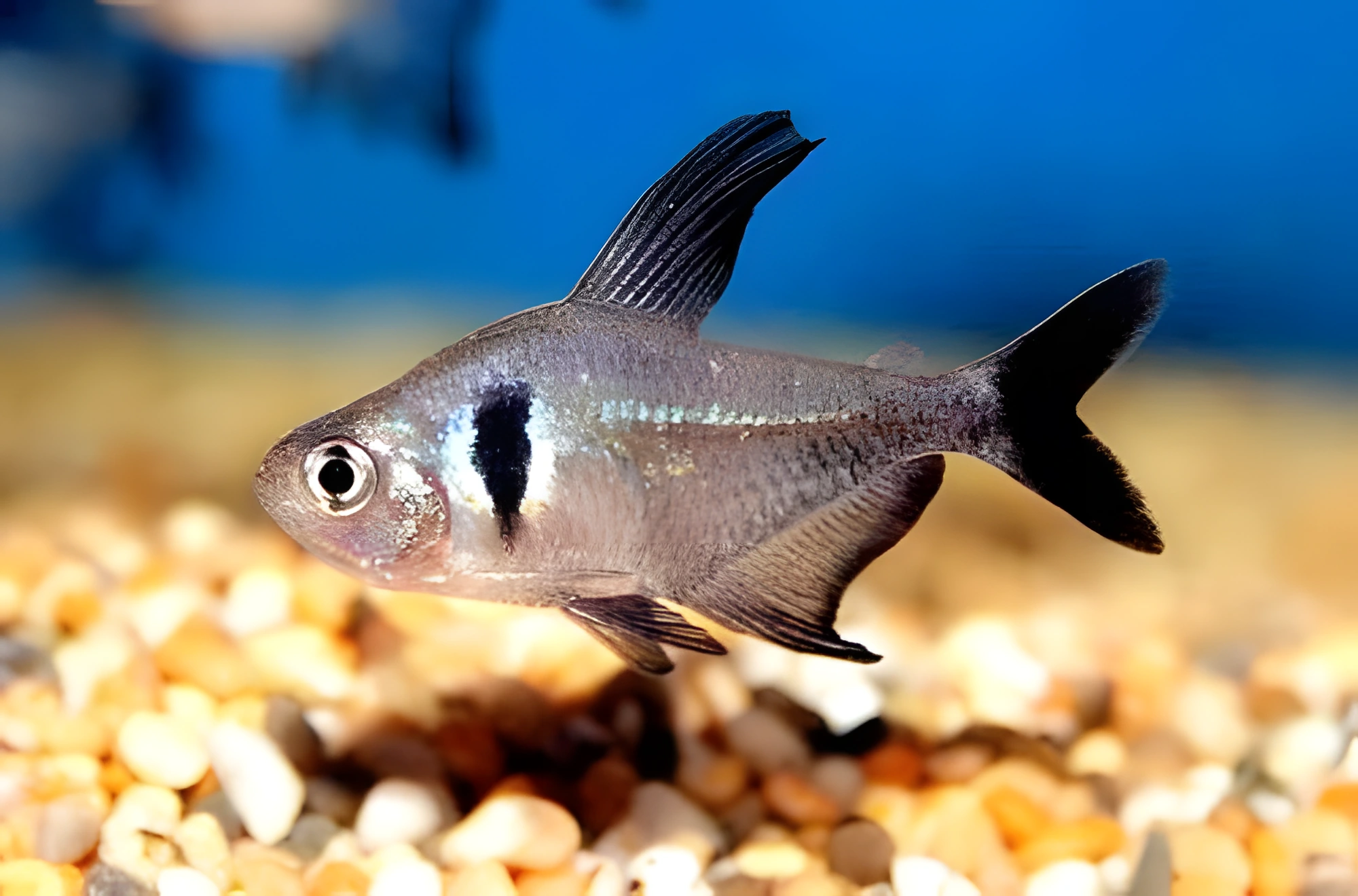
The body of the Phantom Tetra has the classic Tetra shape—it is somewhat oval and laterally compressed, with a noticeably large anal fin. A distinctive feature of this species is its large dorsal fin, which is even more pronounced in males. The fish's coloration is a smoky black tone with a silvery belly. The fins are light, but their edges are outlined in a dark color. Behind the gills, there is a large dark spot on the fish's body.
Females are distinguished by the more intense coloration of their adipose, pectoral, and anal fins. The male, in contrast, has a paler coloration but possesses a high dorsal fin.
Habitat
The Phantom Tetra was first described in 1915. This species was discovered in South America, specifically in Paraguay, and is now widely distributed in river systems across the continent. The natural habitat of the Black Phantom Tetra includes clear, transparent waters with abundant vegetation, as well as swampy areas. In the wild, their diet consists of worms, small crustaceans, and various insects.
Behavior and Compatibility
Phantom Tetras exhibit a peaceful nature and coexist easily with fish of similar temperament. It is recommended to keep them in groups of at least 6 individuals. Although males sometimes engage in 'skirmishes,' these are always displays of strength that cause no harm. These fish are quite cautious: an unexpected tap on the glass or a loud noise can cause them to panic, so care should be taken.
Care and Maintenance
It is important to ensure specific water parameters: it should be soft and slightly acidic. Maintaining the necessary pH level is most effectively achieved with filters equipped with peat as a filtering material, as this not only purifies but also acidifies the water. It is recommended to refresh about 25–30% of the water volume with fresh water every two weeks. These fish do not like bright light, so subdued lighting will be favorable. The aquarium setup should include two zones: an open swimming area and dense plant thickets along the back and side walls. Floating plants will additionally create shade. Dark river sand or fine gravel is suitable for the substrate. Various decorative wooden elements such as snags, branches, or roots can also be used. Adding dried leaves will tint the water a light brown, mimicking natural habitat conditions. Leaves should be replaced every two weeks, which can be conveniently combined with partial water changes.
Diet
The Black Phantom Tetra is an omnivorous fish and readily accepts both dry commercial foods and meaty ones. To ensure a balanced diet, in addition to granules and flakes, it is essential to include meaty products such as pieces of worms, bloodworms, or brine shrimp. Specialized Tetra foods containing freeze-dried meat additives are available on the market, significantly simplifying the feeding process for the aquarist.
Breeding and Reproduction
For successful breeding, it is recommended to use a separate spawning tank of at least 20 liters, filled three-quarters full. Its setup should include groups of low-growing plants, up to 4–5 cm, with open areas between elements like driftwood and roots. Water parameters: temperature no lower than 25°C, pH around 6.0, and soft water (dH – 4°). Equipment required includes a weak filter and a heater. Spawning can begin at any time; it is stimulated by intensive feeding with meaty or live foods for several weeks. During this period, males become more vibrant, and the females' bellies noticeably enlarge due to ripening eggs. When this occurs, the fish are transferred to the spawning tank. After a short courtship ritual, the female lays eggs, which the male then fertilizes. The entire process takes place over plant thickets, where the eggs subsequently settle. If there are several groups of plants in the aquarium, the pair may spawn in multiple areas. After spawning, the adult fish are returned to the main aquarium. In the spawning tank, after removing the parents, artificial lighting must be excluded; it can even be covered with a towel to minimize light access. This helps prevent fungal infection of the eggs, to which these fish are predisposed. The eggs should remain in darkness for about one to two days, during which time the fry will hatch. They should be fed powdered foods and brine shrimp nauplii.
Diseases
In aquariums where high water quality is maintained and regular care is provided, the likelihood of diseases is extremely low. More detailed information on symptoms and treatment methods can be found in the "Aquarium Fish Diseases" section.
How to choose
When purchasing, choose active individuals with clean fins and scales, free from visible damage, spots, or film. Avoid fish with signs of emaciation, sunken bellies, or unnatural behavior, such as constant swimming at the surface or listing to one side. Healthy Phantom Tetras in a store typically exhibit schooling behavior and show interest in food.
Keep in mind that in retail aquariums, the fish's coloration may be pale due to stress, but it should quickly recover in suitable home conditions. Inspect the gills: they should be symmetrical, without signs of inflammation or unnatural tissue growth. It is recommended to purchase a group of 6-10 individuals, as solitary keeping causes significant stress and timidity.
Frequently asked questions
The essentials: size, tank volume, water parameters and care
How big does Phantom Tetra get?
An adult reaches 3–5 cm in length. Plan the tank around the maximum size: the fish quickly outgrows a cramped setup.
What size aquarium does Phantom Tetra need?
The minimum recommended volume is 80 L. A smaller tank speeds up nitrate build-up and raises stress levels.
What water parameters does Phantom Tetra need?
Temperature 22–28 °C, pH 6–7.5, hardness 1–18 dGH. Stability matters more than exact values: sudden swings are harder on the fish than a small deviation from the ideal.
How long does Phantom Tetra live?
Around 6 years when kept properly. Lifespan depends directly on tank volume, water quality and a varied diet.
Is Phantom Tetra aggressive?
Temperament: peaceful, active/mobile. Keep this in mind when choosing tank mates.
How many Phantom Tetra should be kept together?
Recommended setup: schooling (usually from 5–6 individuals and more). Ignoring this is a common cause of stress and disease.
What does Phantom Tetra eat?
Diet type: sinking (meat / protein). Feed small portions that are finished within a couple of minutes — overfeeding does more harm than underfeeding.
What is the scientific name of Phantom Tetra?
The scientific name of the species is Hyphessobrycon megalopterus, family Characidae. It also appears in the literature as: Megalamphodus megalopterus, Megalamphodus rogoaguae, Megalomphodus megalopterus.