Temperature23 – 27 °C
Natural range
- Democratic Republic of the Congo area
CharacinsConservation status: Least concern LC
Other scientific names: Micralestes breuseghemi, Phenacogrammus breuseghemi
Breuseghem's Tetra, scientifically known as Bathyaethiops breuseghemi, is a member of the family Alestidae, or African Tetras. Its homeland is the African continent, where it is found in the lower reaches of the Congo River, in the territory of the modern Democratic Republic of Congo. These fish favor river sections characterized by abundant aquatic vegetation and silty substrates.
- Required aquarium volume
- 140 L
- Size in aquarium
- 7 cm
- Temperature
- 23 – 27 °C
- Temperament
- Peaceful, active/mobile
Parameters
Water pHSlightly acidic (6) – Neutral (7.2)
Water dHVery soft (3) – Medium hardness (10)
Water salinityno salt (freshwater)
Size in aquarium7 cm
Lifespan5 years
TemperamentPeaceful, active/mobile
Toward small fishnot a predator
Required aquarium volume140 L
Lightingdimmed
Substrateany, but dark
Water flowweak
FeedingAny (universal)
CareSmall group (5–6 individuals)
Description
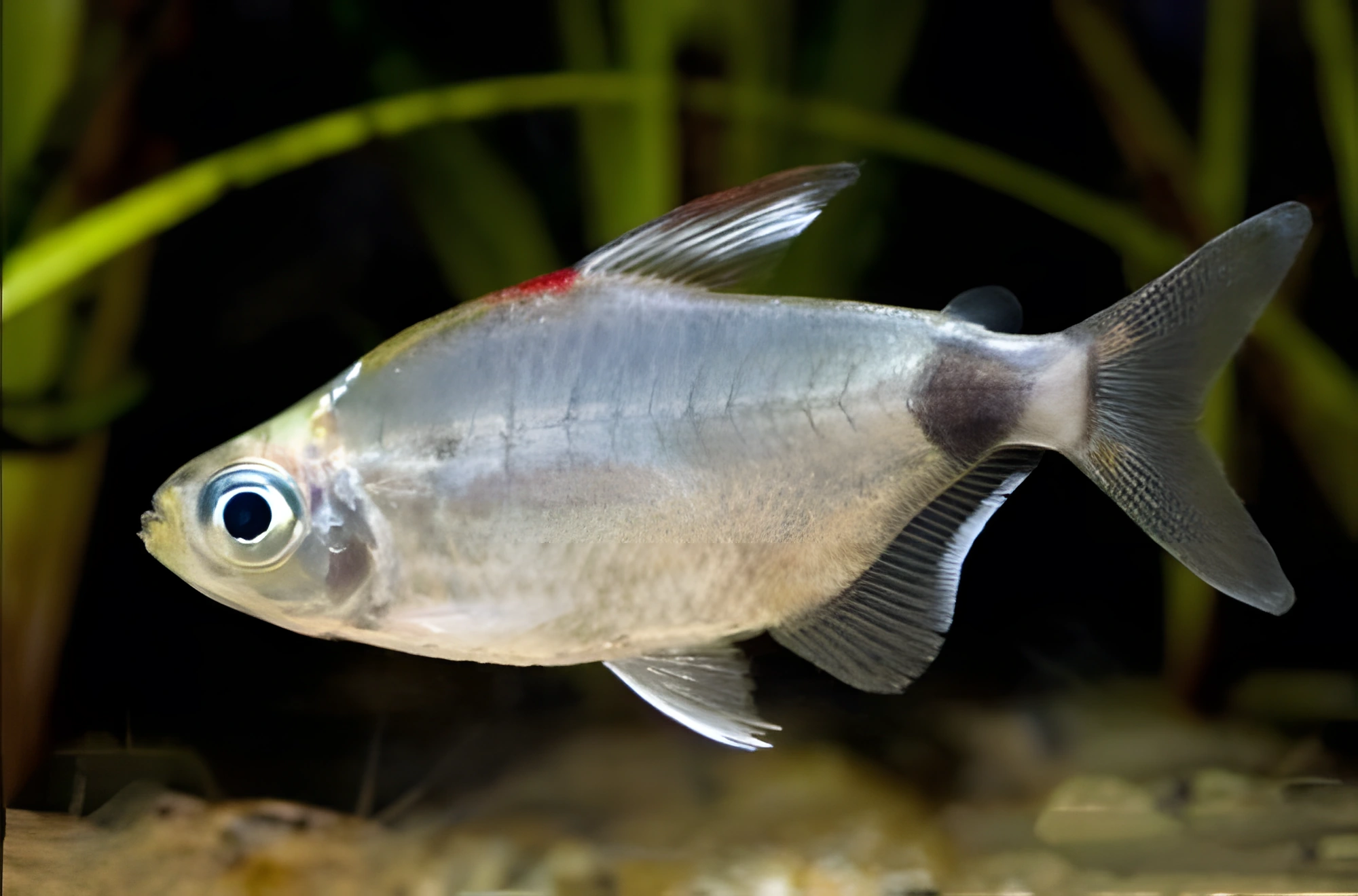
These fish reach a length of about 7 cm when fully grown. Characteristic features of their appearance include a high body and a rather large head, as well as short, translucent fins. The main coloration of Breuseghem's Tetra is silvery, adorned with a distinctive large dark spot located on the caudal peduncle. On the back, near the dorsal fin, red or orange hues can sometimes be observed. Sexual dimorphism in these fish is very weakly expressed, making it almost impossible to distinguish males from females. It is worth noting that a similar body coloration is also characteristic of a related species, the Altus Tetra, which often leads to confusion between them.
Habitat
The species inhabits river basins in Central and West Africa, primarily within the Democratic Republic of Congo. It is found in tributaries of the Congo River, such as the Lulua and Bomu. It prefers bodies of water with soft, slightly acidic water, typical of tropical forest rivers, where it often stays among dense vegetation and snags, which provide shelter [aquaportail.com], [practicalfishkeeping.co.uk].
Behavior and Compatibility
This peaceful fish prefers to be in a group of its own kind, making it an excellent choice for schooling. Good compatibility is observed with African tetras and cichlids inhabiting the same region, as well as with other small fish of similar size and temperament.
Care and Maintenance
For a comfortable existence of a group of 5–6 Breuseghem's Tetras, an aquarium with a volume of at least 140 L will be required. The aquarium decor should include an abundance of aquatic plants, such as Anubias and Bolbitis, as well as snags and a soft sandy substrate. It is also recommended to place leaves and bark from certain trees on the bottom of the aquarium; their decomposition will contribute to changes in the water's chemical composition, enriching it with tannins and other substances, thereby recreating conditions close to their natural habitat. More details can be found in the article “What tree leaves can be used in an aquarium”. For their long-term keeping, it is important to provide warm, slightly acidic water with low general and carbonate hardness. Maintaining high water quality, meaning minimal pollution levels, directly depends on regular aquarium maintenance and the reliable operation of the filtration system. If Breuseghem's Tetra was bred in aquarium conditions rather than caught in the wild, it is likely already well-accustomed to popular dry foods. To ensure a complete diet, it can be supplemented with live or frozen foods.
Diet
Fish raised in aquarium conditions, rather than collected from the wild, are usually well-adapted to dry foods. The daily diet can be enriched with live or frozen foods. Breuseghem's Tetra is a peaceful fish that enjoys living in a school. It coexists well with African tetras and cichlids from the same regions, as well as with other small fish of similar size and temperament.
Breeding and Reproduction
Breeding in aquarium conditions is not sufficiently studied. Like other members of the Alestidae family, these fish are egg-layers. To stimulate spawning, specific conditions are required: soft, slightly acidic water and the presence of fine-leaved plants or a substrate for egg deposition. Adult individuals may show a tendency to eat their eggs, so it is recommended to remove the parents after spawning is complete [aquaportail.com], [laguiadelacuario.es].
Diseases
The species does not have specific breed-related diseases, but it shows increased sensitivity to water quality and transport conditions. During the adaptation period after import, fish are susceptible to stress and weakened immunity, which can lead to bacterial infections or fungal infestations. Prevention includes mandatory quarantine for at least one week, maintaining stable hydrochemical parameters, and avoiding sharp temperature fluctuations [aquaportail.com], [practicalfishkeeping.co.uk].
How to choose
When selecting specimens, attention should be paid to the cleanliness of the skin, the absence of fin damage, and active behavior. Healthy fish should show interest in food and stay in a school. It is important to ensure that the fish have passed the adaptation period with the seller, as recently imported specimens are often under severe stress. Care should be taken to avoid confusion with the closely related species Bathyaethiops caudomaculatus: males of Bathyaethiops breuseghemi usually have a characteristic orange-red marking on the dorsal fin, and the spot on the caudal peduncle has a more rounded shape [aquaportail.com], [practicalfishkeeping.co.uk].
Frequently asked questions
The essentials: size, tank volume, water parameters and care
How big does Breuseghem's Tetra get?
An adult reaches 7 cm in length. Plan the tank around the maximum size: the fish quickly outgrows a cramped setup.
What size aquarium does Breuseghem's Tetra need?
The minimum recommended volume is 140 L. A smaller tank speeds up nitrate build-up and raises stress levels.
What water parameters does Breuseghem's Tetra need?
Temperature 23–27 °C, pH 6–7.2, hardness 3–10 dGH. Stability matters more than exact values: sudden swings are harder on the fish than a small deviation from the ideal.
How long does Breuseghem's Tetra live?
Around 5 years when kept properly. Lifespan depends directly on tank volume, water quality and a varied diet.
Is Breuseghem's Tetra aggressive?
Temperament: peaceful, active/mobile. Keep this in mind when choosing tank mates.
How many Breuseghem's Tetra should be kept together?
Recommended setup: small group (5–6 individuals). Ignoring this is a common cause of stress and disease.
What does Breuseghem's Tetra eat?
Diet type: any (universal). Feed small portions that are finished within a couple of minutes — overfeeding does more harm than underfeeding.
What is the scientific name of Breuseghem's Tetra?
The scientific name of the species is Bathyaethiops breuseghemi, family African Tetras (Alestidae). It also appears in the literature as: Micralestes breuseghemi, Phenacogrammus breuseghemi.