Temperature23 – 27 °C
Natural range
- Congo River Basin
- Central African Republic area
- Republic of the Congo area
- Democratic Republic of the Congo area
CharacinsConservation status: Least concern LC
Other scientific names: Alestopetersius altus, Alestopetersius nummifer, Alestopetersius rochefoucauldi, Bathyaethiops altus, Bathyaethiops nummifer, Hemigrammalestes altus
The Alestes Tetra (Brachypetersius altus), a member of the Alestidae family (African Tetras), is native to the waters of West Africa. It can be found in the lower Congo River basin, as well as in numerous tributaries within the territories of Congo and the Democratic Republic of Congo. These fish inhabit sections of rivers with slow currents, preferring backwaters rich in dense aquatic vegetation and silty substrates abundant in fallen organic matter. The water in such areas typically takes on a brownish hue and can be slightly turbid due to suspended organic particles.
- Required aquarium volume
- 120 L
- Size in aquarium
- 6 cm
- Temperature
- 23 – 27 °C
- Temperament
- Peaceful, active/mobile
Parameters
Water pHSlightly acidic (6) – Neutral (7.2)
Water dHVery soft (3) – Medium hardness (10)
Water salinityno salt (freshwater)
Size in aquarium6 cm
Lifespan5 years
TemperamentPeaceful, active/mobile
Toward small fishnot a predator
Required aquarium volume120 L
Lightingdimmed
Substrateany, but dark
Water flowweak
FeedingAny (universal)
CareSmall group (5–6 individuals)
Description
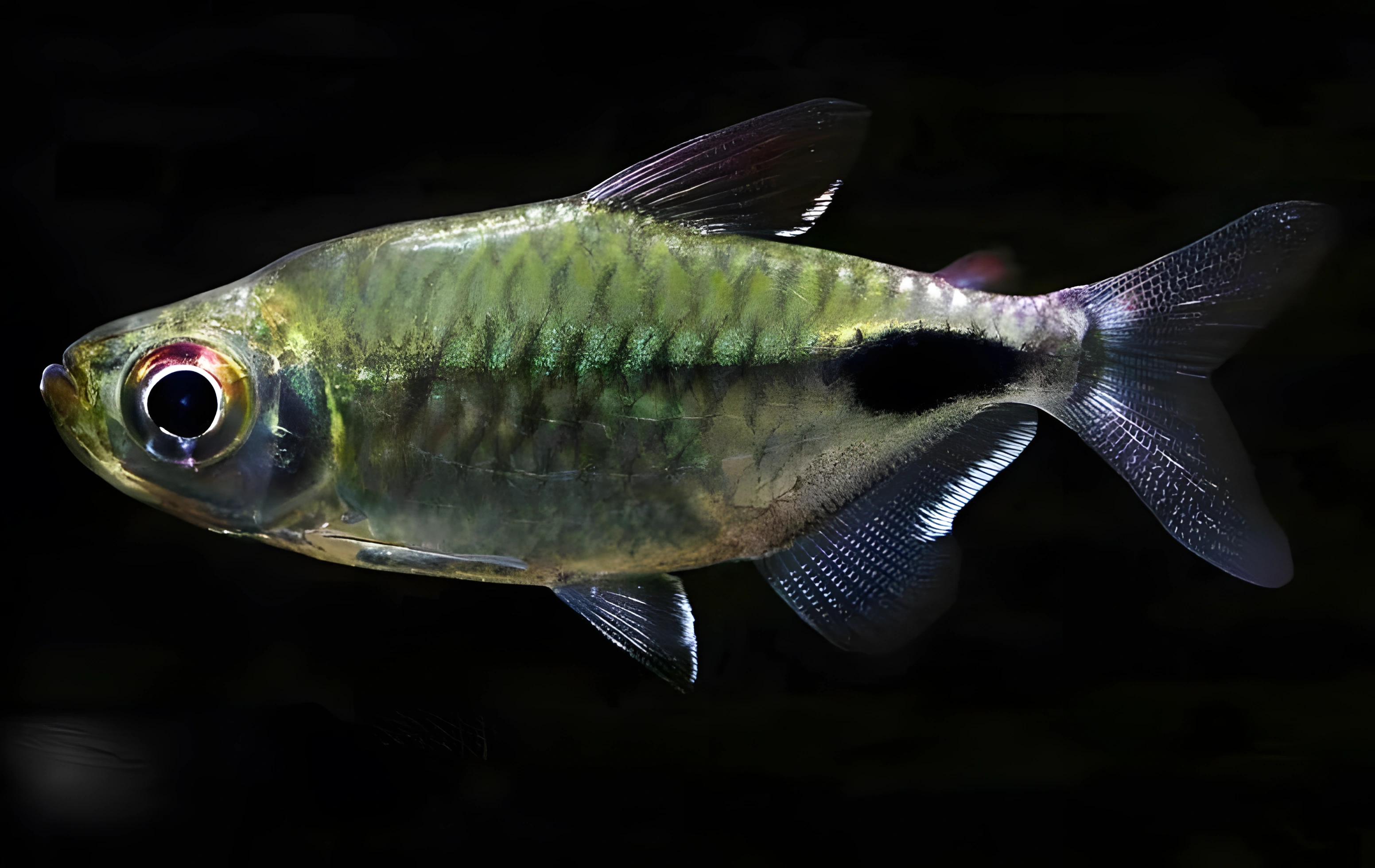
Adults of this fish species reach approximately 6 cm in length. Their body is characterized by a high shape, a large head, and big eyes, which help them navigate and find food effectively in murky water and low light conditions. Their coloration is silvery with noticeable greenish iridescence. The fins are translucent, with reddish tints in places and a characteristic white edge. A large black spot on the caudal peduncle is noteworthy. A similar spot at the base of the tail is also present in the closely related species, Brycinus nurse, which sometimes causes confusion due to the similar body shape.
Habitat
The species inhabits the Congo River basin in the Central African Republic, the Republic of Congo, and the Democratic Republic of Congo. The fish live in tropical freshwater bodies with slow currents. In their natural environment, they prefer areas with soft water, rich in organic debris, and abundant coastal vegetation.
Behavior and Compatibility
These fish prefer to be in a group with their conspecifics or closely related species, so it is advisable to acquire them in a school of 5–6 individuals. They are peaceful and get along well with many other aquarium fish of comparable size.
Care and Maintenance
For a school of 5–6 individuals, the optimal aquarium volume starts from 120 liters. For decor, it is recommended to use dark substrate, as well as thickets of shade-loving plants, such as Anubias. Snags and other elements that create shelters are welcome. Lighting should be subdued, and additional shading can be provided by floating plants. To recreate the natural chemical composition of the water, leaves and bark of certain trees are placed at the bottom of the aquarium, which release tannins when decomposing, staining the water brown. More detailed information on this can be found in the article "Which tree leaves can be used in an aquarium." It is very important to maintain a stable hydrochemical composition of the water, not exceeding the recommended pH and dH values. In addition, high water quality is critically important, which implies low levels of pollutants and nitrogen cycle products. This requires uninterrupted operation of the filtration system and weekly aquarium maintenance, including partial water changes and removal of organic waste – food remnants and excrement.
Diet
Alestes Tetras raised in captivity are usually already accustomed by breeders to popular dry foods, which eliminates problems with their nutrition. Their daily diet can consist of dry flakes, granules, supplemented with live or frozen food. These fish exhibit a peaceful character and successfully coexist with many fish species of similar size. It is preferable to keep them in the company of conspecifics or closely related species, so it is recommended to acquire a group of 5–6 individuals.
Breeding and Reproduction
Breeding in aquarium conditions is not well studied. Spawning is paired or communal, egg-laying. Soft and slightly acidic water is required to stimulate the process. Eggs are laid among fine-leaved plants. The fish do not show parental care for their offspring and are prone to eating eggs, so the parents should be removed immediately after spawning.
Diseases
No specific diseases characteristic only of this species have been identified. If water parameters are not met and living conditions are poor, the fish are susceptible to common infectious and parasitic diseases, such as ichthyophthiriasis or bacterial skin lesions. Prevention involves maintaining stable water quality, regular water changes, and providing a complete diet.
How to choose
When purchasing, choose active individuals with clean fins and no visible body damage. Healthy fish have the species-specific sheen of scales and a distinct dark spot in the caudal region. It is recommended to avoid purchasing fish with signs of lethargy, damaged gill covers, or an unnaturally bloated abdomen, which may indicate hidden diseases.
Frequently asked questions
The essentials: size, tank volume, water parameters and care
How big does Alestes Tetra get?
An adult reaches 6 cm in length. Plan the tank around the maximum size: the fish quickly outgrows a cramped setup.
What size aquarium does Alestes Tetra need?
The minimum recommended volume is 120 L. A smaller tank speeds up nitrate build-up and raises stress levels.
What water parameters does Alestes Tetra need?
Temperature 23–27 °C, pH 6–7.2, hardness 3–10 dGH. Stability matters more than exact values: sudden swings are harder on the fish than a small deviation from the ideal.
How long does Alestes Tetra live?
Around 5 years when kept properly. Lifespan depends directly on tank volume, water quality and a varied diet.
Is Alestes Tetra aggressive?
Temperament: peaceful, active/mobile. Keep this in mind when choosing tank mates.
How many Alestes Tetra should be kept together?
Recommended setup: small group (5–6 individuals). Ignoring this is a common cause of stress and disease.
What does Alestes Tetra eat?
Diet type: any (universal). Feed small portions that are finished within a couple of minutes — overfeeding does more harm than underfeeding.
What is the scientific name of Alestes Tetra?
The scientific name of the species is Brachypetersius altus, family African Tetras (Alestidae). It also appears in the literature as: Alestopetersius altus, Alestopetersius nummifer, Alestopetersius rochefoucauldi.