Temperature24 – 25 °C
Natural range
- Guatemala area
- Central America area
CichlidsConservation status: Least concern LC
Other scientific names: Chuco godmanni, Cichlasoma godmanni, Heros godmanni, Vieja godmanni
The scientific name Theraps godmanni indicates that Theraps godmanni belongs to the family Cichlidae, or Cichlids. This fish species originally inhabits Central America, and its natural range is limited to the river systems of Guatemala, located on the Atlantic slope. Notably, these fish prefer fast-flowing mountain rivers where the water remains relatively cool.
- Required aquarium volume
- 150 L
- Size in aquarium
- 25 cm
- Temperature
- 24 – 25 °C
- Temperament
- Semi-peaceful (including aggression during spawning / intraspecific conflicts)
Parameters
Water pHNeutral (7) – Slightly alkaline (7.6)
Water dHMedium hardness (10) – Very hard (20)
Water salinityno salt (freshwater)
Size in aquarium25 cm
Lifespan10 years
TemperamentSemi-peaceful (including aggression during spawning / intraspecific conflicts)
Toward small fishnot a predator
Required aquarium volume150 L
Lightingmoderate (regular)
Substraterocky (rock formations, boulders, etc.)
Water flowstrong
FeedingPlant-based with meat additives
CarePair (male/female)
Description
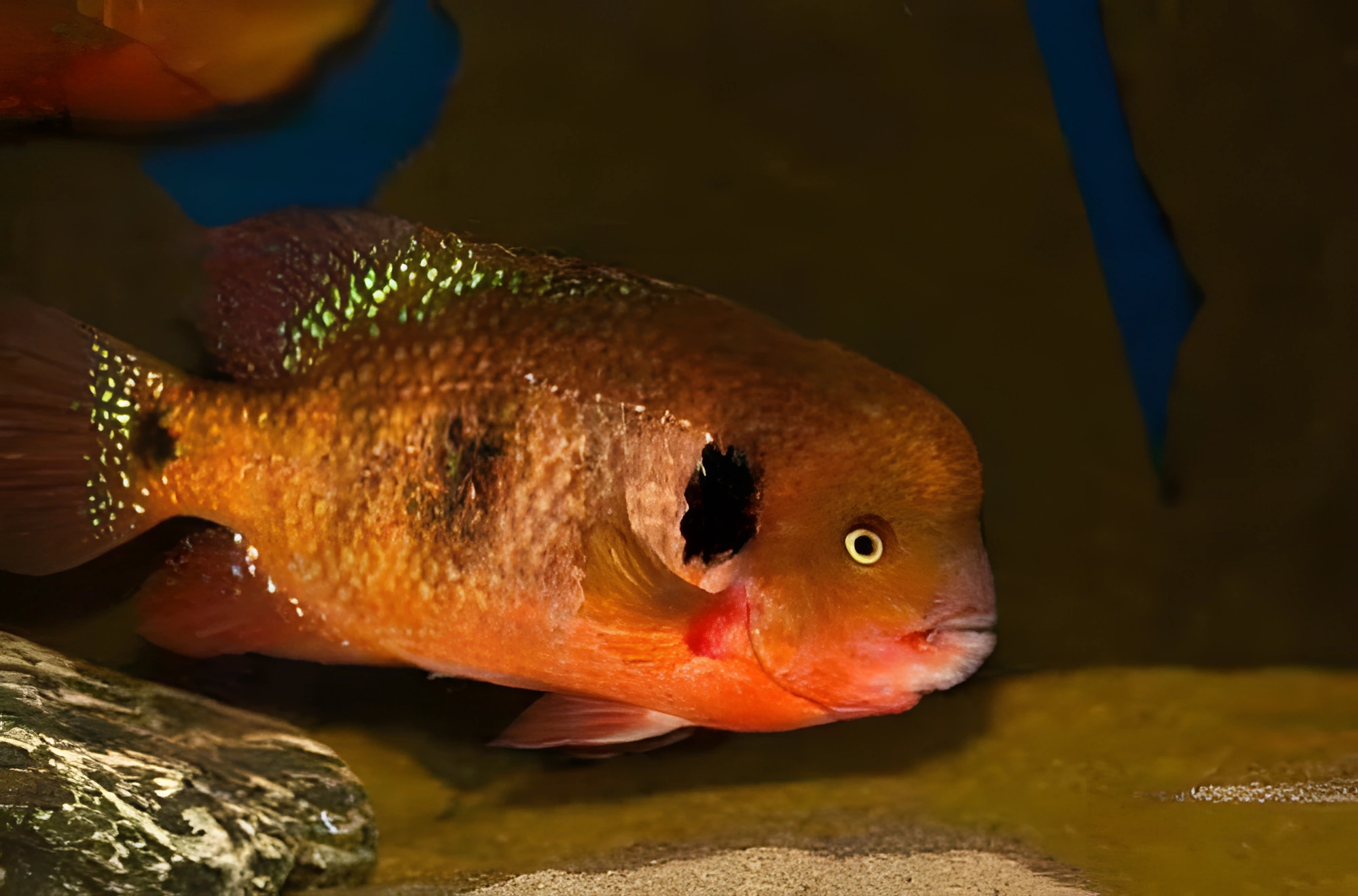
In the wild, these fish can reach 30 cm in length, but in aquariums, they typically grow up to 25 cm. The fish's body is distinguished by its height and is slightly compressed laterally. Its caudal peduncle is elongated and terminates in a small tail. The dorsal and anal fins appear enlarged and are distinctly shifted towards the tail. Females are larger than males, but their coloration is less pronounced. Females predominantly exhibit light beige and gray tones, and their scales may have a blue sheen. Males, although smaller, have more saturated coloration, which becomes particularly vibrant during the breeding season, acquiring a deep red hue with a turquoise shimmer on their scales. With age, the fish develops a characteristic feature—a so-called "nuchal hump," which is a bump on the forehead. A characteristic feature of the body pattern is a large, irregularly shaped black spot located immediately behind the head. Sometimes, pale dark vertical markings can be observed in the caudal part of the body.
Habitat
The species inhabits Central America, being endemic to the Polochic River basin in Guatemala. In nature, it prefers tropical freshwater bodies with flowing water. The fish primarily live a benthic lifestyle, adhering to areas with stony or sandy bottoms, where they find shelter among rocks and snags.
Behavior and Compatibility
This species is characterized by territorial and aggressive behavior. During the breeding season, their hostility significantly increases. Theraps godmanni actively protect their offspring and are capable of injuring other fish that inadvertently come too close. In the confined space of home aquariums, they are poorly compatible with other species. Only conspecifics can be considered as tank mates, provided that each individual has the opportunity to establish its own territory.
Care and Maintenance
For keeping a single fish, a tank volume of at least 150 liters is required, while for two individuals, more than 350 liters are needed. It is important to ensure that each adult fish has the opportunity to occupy an individual area on the aquarium bottom. The decor should mimic a mountain riverbed; the composition should be based on large stones and boulders, and snags can also be used. Live plants are usually not planted, as they can be uprooted, damaged, or eaten. It is recommended to create several shelters in the form of artificial caves or stone grottoes where neighboring fish can hide from each other. Thus, these shelters will serve as the centers of their territories and should be located at some distance from each other, in different parts of the aquarium. The imitation of a strong current can be provided by a powerful filtration system or a separate pump. The first option is preferable, as the filter performs a dual function: water purification and current creation. Keeping conditions can be more or less strict regarding hydrochemical parameters, depending on whether the fish was obtained from the wild or from a breeder. Before purchasing, it is extremely important to clarify the keeping specifics with the supplier or seller and to accurately recreate the water chemistry in your aquarium.
Diet
These fish readily accept most common foods, whether dry, frozen, or live. However, it is extremely important to regularly include plant-based foods in their diet, such as blanched vegetables (e.g., peas, spinach, Brussels sprouts) and spirulina flakes.
Breeding and Reproduction
Breeding requires a spacious aquarium, as the fish exhibit strong territoriality. Spawning occurs on flat stones or in depressions dug in the substrate. The pair actively cares for their offspring, guarding the clutch and fry from any threats. Frequent water changes and maintaining the temperature at the upper end of the acceptable range serve as a stimulus for spawning.
Diseases
The species has a strong immune system provided that water purity is maintained and there are no high concentrations of nitrogenous compounds. They are sensitive to sharp fluctuations in environmental parameters, which can provoke stress and reduce resistance to infections. Prevention includes regular filtration, aeration, and weekly partial water changes.
How to choose
When selecting individuals, attention should be paid to the cleanliness of the skin and fins, the absence of spots, ulcers, or film. A healthy fish shows activity, natural coloration, and an adequate reaction to external stimuli. Avoid purchasing specimens with signs of emaciation, sunken bellies, or unnatural behavior, such as prolonged hovering in a corner of the aquarium.
Frequently asked questions
The essentials: size, tank volume, water parameters and care
How big does Theraps godmanni get?
An adult reaches 25 cm in length. Plan the tank around the maximum size: the fish quickly outgrows a cramped setup.
What size aquarium does Theraps godmanni need?
The minimum recommended volume is 150 L. A smaller tank speeds up nitrate build-up and raises stress levels.
What water parameters does Theraps godmanni need?
Temperature 24–25 °C, pH 7–7.6, hardness 10–20 dGH. Stability matters more than exact values: sudden swings are harder on the fish than a small deviation from the ideal.
How long does Theraps godmanni live?
Around 10 years when kept properly. Lifespan depends directly on tank volume, water quality and a varied diet.
Is Theraps godmanni aggressive?
Temperament: semi-peaceful (including aggression during spawning / intraspecific conflicts). Keep this in mind when choosing tank mates.
How many Theraps godmanni should be kept together?
Recommended setup: pair (male/female). Ignoring this is a common cause of stress and disease.
What does Theraps godmanni eat?
Diet type: plant-based with meat additives. Feed small portions that are finished within a couple of minutes — overfeeding does more harm than underfeeding.
What is the scientific name of Theraps godmanni?
The scientific name of the species is Theraps godmanni, family Cichlids (Cichlidae). It also appears in the literature as: Chuco godmanni, Cichlasoma godmanni, Heros godmanni.