Temperature20 – 26 °C
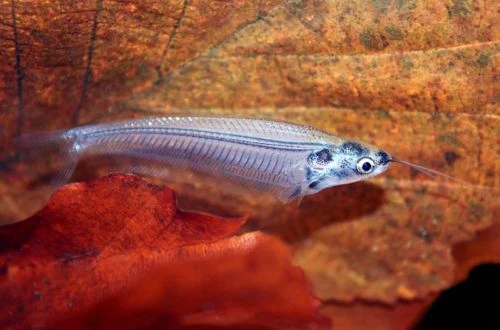
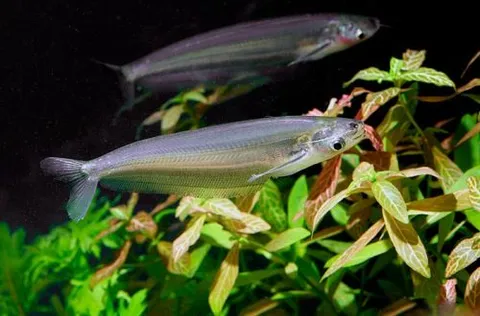
Kryptopterus vitreolus, known as the glass catfish, belongs to the family Siluridae. It stands out among catfishes for its remarkably transparent body, through which the fish's skeleton can be observed. This unusual evolutionary adaptation, combined with its ease of care and peaceful nature, has earned this species widespread popularity among aquarium enthusiasts worldwide.
The glass catfish has an elongated and tall body, with an unusually long anal fin that extends from the head to the very tail. Its main distinguishing feature is its transparent body, through which the spine and ribs are clearly visible. Near the mouth on its head are two sensitive, long, antenna-like barbels.
Its natural habitat is in the river systems of Southeast Asia, primarily in modern-day Thailand. Specifically, these fish are found in rivers that flow into the Gulf of Thailand. Due to potential confusion within the species, a precise definition of its habitat range requires further research. The catfish prefers to live in still or slow-moving waters, which are often quite murky.
These catfish thrive best in a shoal of at least 6 individuals. Their behavior is calm and peaceful, one might even say modest. It is advisable to avoid cohabitation with active or aggressive species, as well as those significantly larger than them. Other peaceful and small fish typical of Southeast Asia get along wonderfully with glass catfish.
A group of several fish will feel comfortable in an aquarium of 100 liters or more. The decor should include many rooted and floating plants; the latter create additional shading, which is beneficial for these fish. The choice of substrate depends on the needs of the plants and is not critical for the catfish, as they prefer to stay in the middle or upper water layers. Water parameters should be as close as possible to their natural habitat, meaning the water should be soft (in terms of dGH) and slightly acidic (pH). Adding a few dry fallen leaves can give the water a characteristic “tea” tint due to the release of tannins, mimicking the conditions of slow-flowing swamps or marshy river sections in the tropics. More detailed information on dH and pH parameters can be found in the “Hydrochemical Composition of Water” section. The minimum equipment set includes a heater, an aerator, a filter (preferably one that does not create a strong current), and a lighting system set for subdued light. Aquarium care for glass catfish includes daily feeding, regular cleaning of the substrate from organic waste (food remnants, excrement), and weekly water changes of 15–20%. The frequency of changes depends on the number of inhabitants and the efficiency of the filtration system.
In their natural habitat, the glass catfish acts as a small predator, whose diet consists of zooplankton and various invertebrates. If kept in a home aquarium, the fish will happily consume all types of dry foods, be it flakes or pellets. These should be supplemented with live or frozen meaty foods, such as bloodworms, daphnia, grindal worms, and brine shrimp. It is important to ensure a varied diet! Feeding is recommended 2–3 times a day, offering an amount of food that the fish can consume within 5 minutes.
No cases of successful breeding of glass catfish in home aquarium conditions have been recorded; at least, the author has not found such information. These fish are supplied to retail and wholesale networks by breeders from Asia, where they are bred on specialized fish farms organized directly in their natural environment.
Catfish are very sensitive to water quality and composition; any changes in parameters or deterioration of conditions immediately affect their well-being. This increases the fish's susceptibility to infections and can lead to various diseases. In a biologically balanced aquarium with suitable conditions, health problems usually do not arise.
When purchasing, choose only active individuals that stay in a shoal and show no signs of emaciation. Avoid fish with cloudy eyes, damaged fins, or visible spots on their transparent bodies, as glass catfish are extremely sensitive to transport conditions and stress. At the store, be sure to ask how long the fish have been imported and prefer individuals that have already undergone an adaptation period in the aquarium. Given that the species is often sourced from the wild, it is important to ensure the absence of parasites and signs of bacterial infections that may appear in the first few days after relocation. Remember that quarantine for new individuals is a mandatory condition before introducing them to the main aquarium.
The essentials: size, tank volume, water parameters and care
An adult reaches 5–6.5 cm in length. Plan the tank around the maximum size: the fish quickly outgrows a cramped setup.
The recommended volume is 100 L. A smaller tank speeds up nitrate build-up and raises stress levels.
Temperature 20–26 °C, pH 4–7, hardness 1–10 dGH. Stability matters more than exact values: sudden swings are harder on the fish than a small deviation from the ideal.
Around 7 years when kept properly. Lifespan depends directly on tank volume, water quality and a varied diet.
Temperament: peaceful (regular). Keep this in mind when choosing tank mates.
Recommended setup: medium group (6–8 individuals). Ignoring this is a common cause of stress and disease.
Diet type: any (universal). Feed small portions that are finished within a couple of minutes — overfeeding does more harm than underfeeding.
The scientific name of the species is Kryptopterus vitreolus, family Sheatfishes (Siluridae).
Matched by family, categories and overlapping keeping conditions
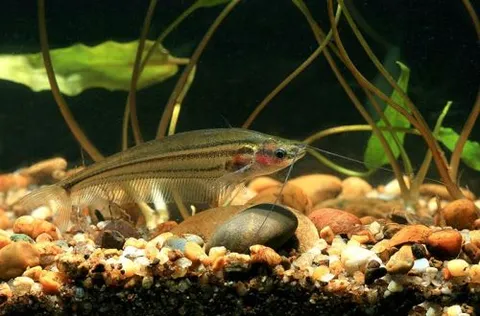
Kryptopterus macrocephalus
The Spotted Glass Catfish, also known as the False Glass Catfish under its scientific name Kryptopterus macrocephalus, belongs to the family Siluridae. This fish is peaceful but at the same time carnivorous. It is quite…
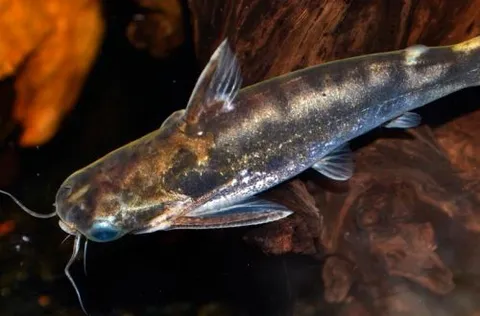
Centromochlus macracanthus
Centromochlus (Centromochlus macracanthus) is a representative of the Auchenipteridae family that is not frequently encountered in the aquarium hobby. This may be due to its modest appearance and predominantly nocturnal…
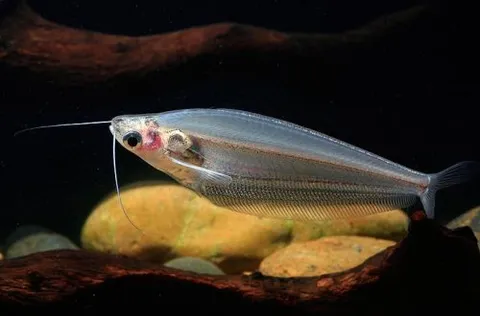
Kryptopterus bicirrhis
Kryptopterus bicirrhis, known as the Two-barbel Indian Glass Catfish, belongs to the family Siluridae (Catfishes). It is not commonly found in aquariums, although the name "glass catfish" is sometimes mistakenly applied…
Kryptopterus geminus
Kryptopterus geminus, known as the Glass Catfish Twin, is a representative of the family Siluridae (Catfishes). Its name "twin" is due to its close relationship with another, quite popular species – the Ghost Glass…