Temperature20 – 30 °C
Natural range
- India area
- Pakistan area
- Southeast Asia area
UnusualConservation status: Least concern LC
Other scientific names: Ambassis alta, Ambassis barlovi, Ambassis notatus, Ambassis ranga, Chanda ranga, Parambassis notatus
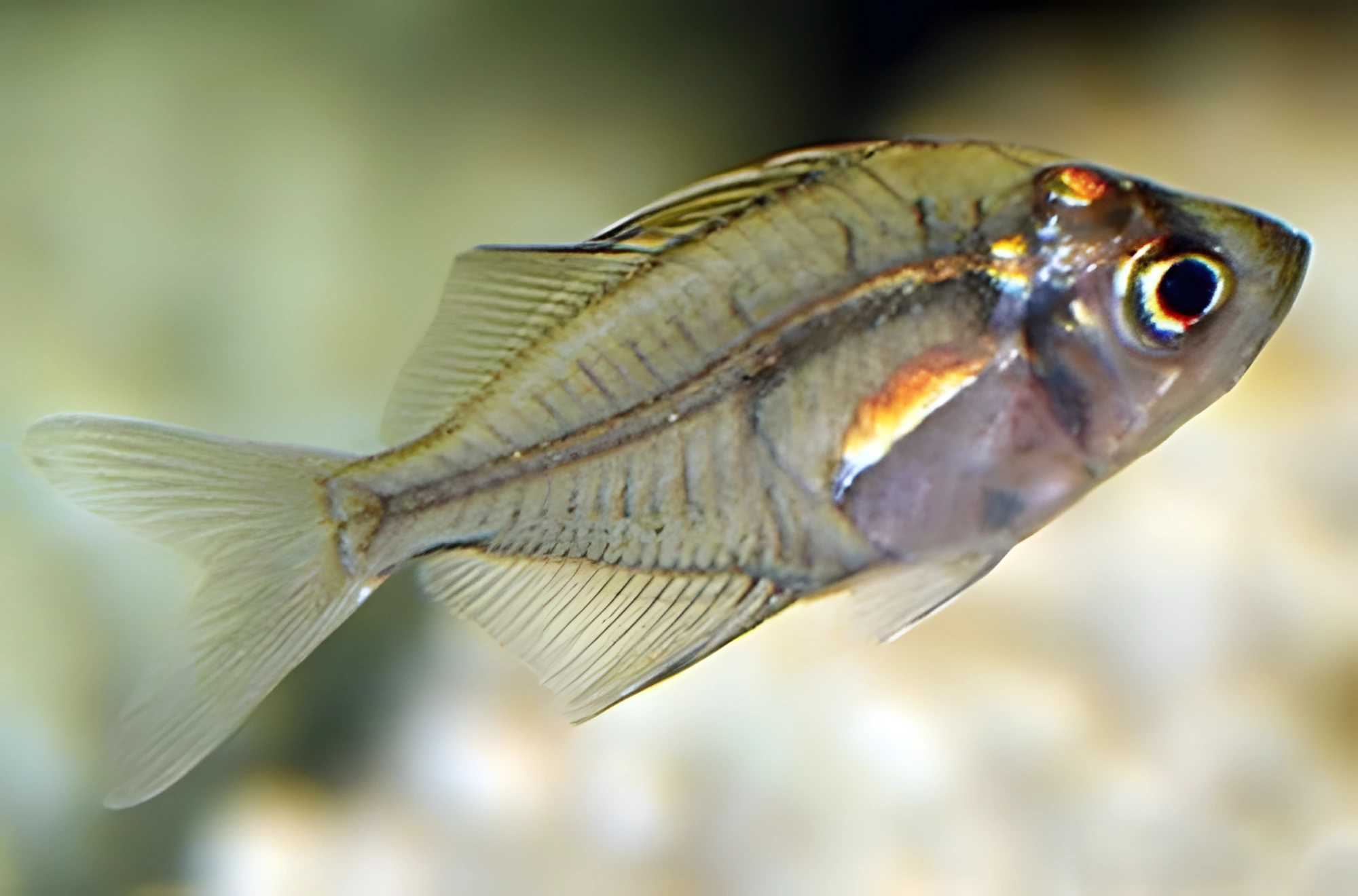
The Indian Glassfish, scientifically known as Parambassis ranga, belongs to the family Ambassidae. It is quite well-known among aquarists, though not widely distributed. Its popularity is partly due to the fact that in Asia, these glassfish are often artificially colored using methods that are considered barbaric and strongly condemned in Europe and America. Without such artificial "cosmetics," the fish appears less remarkable. There is also a perception that it is difficult to keep due to high mortality rates. However, this problem is often a consequence of such coloring. In reality, uncolored glassfish are hardy and undemanding, coexisting well with other fish and quite suitable even for beginner aquarists.
- Required aquarium volume
- 80 L
- Size in aquarium
- 8 cm
- Temperature
- 20 – 30 °C
- Temperament
- Peaceful (regular)
Parameters
Water pHNeutral (6.5) – Slightly alkaline (8)
Water dHMedium hardness (8) – Very hard (20)
Water salinityvery low (up to ~3 g/L)
Size in aquarium8 cm
Lifespan5 years
TemperamentPeaceful (regular)
Toward small fishnot a predator
Required aquarium volume80 L
Lightingdimmed
Substrateany, but dark
Water flowweak
FeedingAny (universal)
CareMedium group (6–8 individuals)
Description
Adults of this species reach approximately 8 cm in length. Males can be distinguished from females by the blue edging on their dorsal and anal fins, as well as the predominance of yellow hues in their coloration. The differences become particularly noticeable during the spawning period, when their colors intensify. One of the most characteristic features of the Indian Glassfish is its semi-transparent body. The fish's internal organs are clearly visible through its skin.
The practice of artificially coloring Indian Glassfish is widespread in Asia: dyes are injected into the fish's body using tools resembling tattooing machines. This procedure causes enormous harm to the fish's health, and most of them die within a few months. Despite their popularity in some Asian countries, the import of such colored fish is strictly prohibited in Europe and America, as it violates the principles of animal welfare laws.
Habitat
The natural habitat of these fish is Southeast Asia, including India and Pakistan. They can be found in a wide variety of freshwater bodies: rivers, streams, lakes, and swamps. They particularly prefer areas with dense aquatic vegetation where the current is slow or the water is stagnant.
Behavior and Compatibility
The Indian Glassfish is a peaceful and shy species, preferring to live in schools of 6 or more individuals. During the breeding season, males may become territorial, but such behavior generally does not lead to serious skirmishes or injuries. They coexist well with non-aggressive fish of comparable size. Other fish originating from the Southeast Asian region make excellent companions.
Care and Maintenance
For the comfortable keeping of a small school of these fish, an aquarium of at least 80 liters is necessary. For decoration, it is preferable to use a dark substrate, various snags, and an abundance of both rooted and floating plants. The latter, among other things, create additional shading under subdued lighting. The key to successful keeping is maintaining high water quality with optimal parameters. This is achieved by installing an effective filtration system and regularly performing essential procedures such as cleaning the aquarium of organic waste and weekly partial water changes with fresh water. When choosing a filter, it is advisable to opt for a model that does not create excessive current, as it is the primary source of water movement in the aquarium.
Diet
These fish are undemanding in their diet and readily accept most common dry, frozen, and live foods of appropriate size. For example, an excellent combination is achieved by feeding flakes mixed with bloodworms or brine shrimp.
Breeding and Reproduction
Breeding these fish is not particularly difficult and does not require special conditions. However, raising the fry to adulthood may not be so easy. In a favorable environment and with the onset of the breeding season, the fish form temporary pairs. As noted, a sign of impending spawning in males is more intense coloration. The pair lays eggs among plants, with a clutch potentially containing up to 200 eggs. Parental instincts in these fish are weakly expressed, so immediately after spawning, they may eat their offspring. To preserve the clutch, it should be carefully transferred to a separate tank with identical water parameters. The eggs are very susceptible to fungal infections. A weak solution of Methylene blue is often used to combat this problem, but its application requires caution. More detailed information on combating this ailment can be found on the page "Fungal growth on fish eggs." The fry hatch the very next day but only begin to swim actively after 3–4 days. In the first few days, they feed on the remnants of their yolk sac, after which they switch to microscopic foods, such as brine shrimp nauplii.
Diseases
If the fish has its natural color and has not been artificially colored, health problems usually do not arise. Most diseases are a consequence of improper care, which weakens the fish's immune system and makes it vulnerable to various infections. Detailed information on symptoms and treatment methods is presented in the section "Diseases of Aquarium Fish."
How to choose
When choosing glassfish, avoid individuals with artificial coloring, as the dye injection procedure is extremely traumatic and significantly shortens the fish's lifespan. Healthy specimens should have a natural transparent appearance, be active, and show interest in food. It is important to carefully inspect the fish for any damage, ulcers, or signs of infectious diseases, to which weakened, colored individuals are particularly susceptible.
Before purchasing, it is recommended to ask the seller about the water parameters in which the fish are kept to ensure their smooth adaptation to the conditions of a home aquarium. Since glassfish are schooling fish, they should be purchased in a group of at least 6 individuals. In the store, it is advisable to observe the fish's behavior: healthy glassfish stay in a school, show no signs of apathy, and actively swim in the water column.
Frequently asked questions
The essentials: size, tank volume, water parameters and care
How big does Glassfish get?
An adult reaches 8 cm in length. Plan the tank around the maximum size: the fish quickly outgrows a cramped setup.
What size aquarium does Glassfish need?
The minimum recommended volume is 80 L. A smaller tank speeds up nitrate build-up and raises stress levels.
What water parameters does Glassfish need?
Temperature 20–30 °C, pH 6.5–8, hardness 8–20 dGH. Stability matters more than exact values: sudden swings are harder on the fish than a small deviation from the ideal.
How long does Glassfish live?
Around 5 years when kept properly. Lifespan depends directly on tank volume, water quality and a varied diet.
Is Glassfish aggressive?
Temperament: peaceful (regular). Keep this in mind when choosing tank mates.
How many Glassfish should be kept together?
Recommended setup: medium group (6–8 individuals). Ignoring this is a common cause of stress and disease.
What does Glassfish eat?
Diet type: any (universal). Feed small portions that are finished within a couple of minutes — overfeeding does more harm than underfeeding.
What is the scientific name of Glassfish?
The scientific name of the species is Parambassis ranga, family Asian Glassfish (Ambassidae). It also appears in the literature as: Ambassis alta, Ambassis barlovi, Ambassis notatus.