Temperature18 – 24 °C
Natural range
- Ganges River Basin
- Northern India area
- Nepal area
- Bangladesh area
CyprinidsConservation status: Least concern LC
Other scientific names: Barbus gelius, Cyprinus gelius, Puntius gelius, Systomus gelius
The Sun Barb, also known as the Golden Dwarf Barb (Pethia gelius), belongs to the Cyprinidae family. This species is known for its unpretentiousness and ease of care, but it requires special attention to the protein component of its diet. Its exceptional peacefulness and calmness are notable, which is not often found among barbs, although for such a miniature fish, this is quite natural behavior.
- Required aquarium volume
- 60 L
- Size in aquarium
- 4 cm
- Temperature
- 18 – 24 °C
- Temperament
- Peaceful, calm/shy/inactive
Parameters
Water pHSlightly acidic (6) – Neutral (7)
Water dHVery soft (1) – Medium hardness (10)
Water salinityno salt (freshwater)
Size in aquarium4 cm
Lifespan5 years
TemperamentPeaceful, calm/shy/inactive
Toward small fishnot a predator
Required aquarium volume60 L
Lightingdimmed or moderate
Substrategravel (dark)
Water flowweak
FeedingHigh protein (predominantly meat)
CareGroup (8–10 individuals)
Description
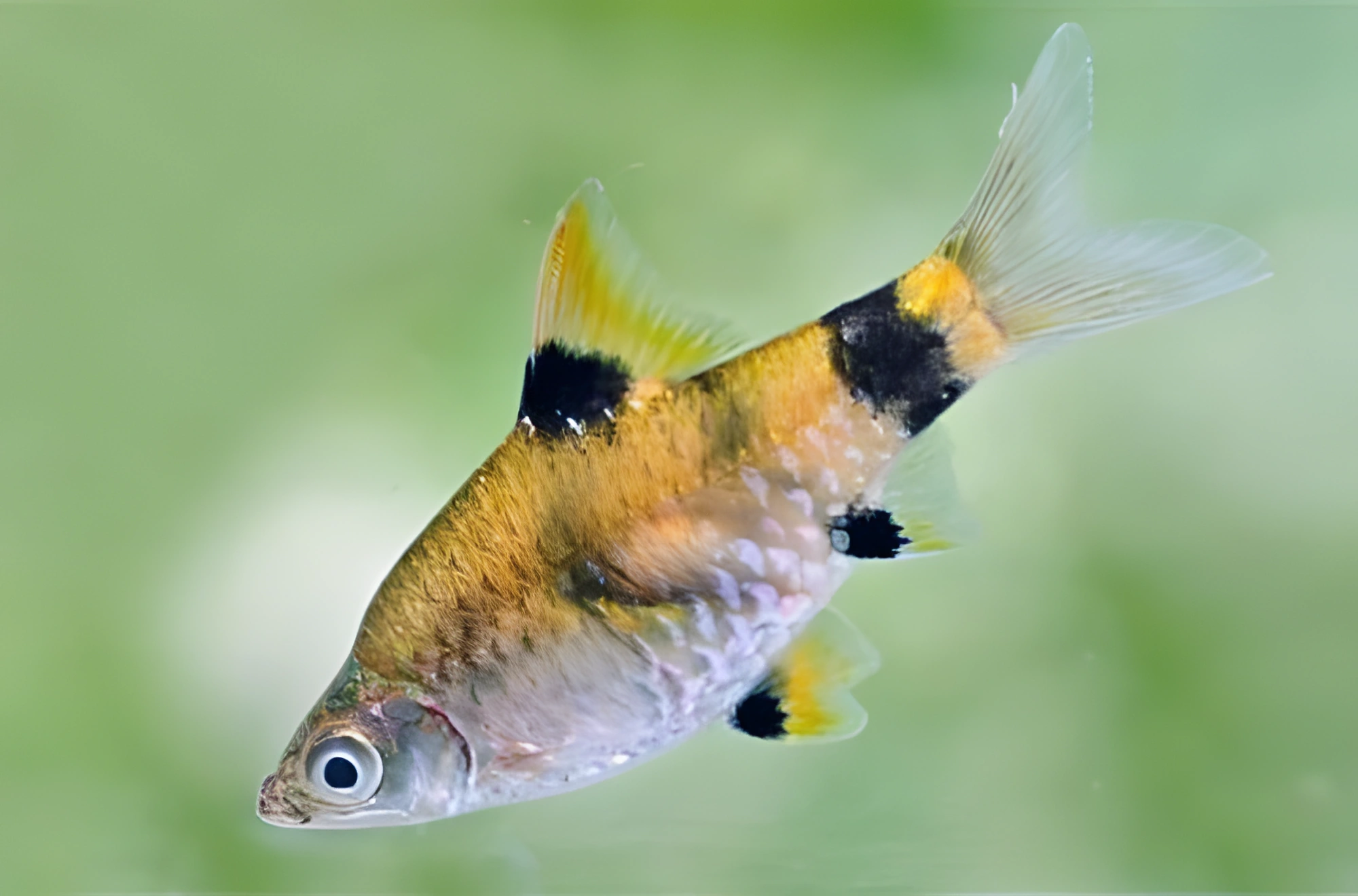
These fish rarely reach a length of more than 4 cm in adulthood. Females usually appear slightly larger, while males are distinguished by a more elegant physique. Their main coloration has a pleasant yellowish tint, complemented by several dark markings located on the dorsal and anal fins, as well as at the base of the caudal fin.
Habitat
The natural habitat of this species covers the Ganges River basin. It can be found in water bodies of northern India, Nepal, and Bangladesh. The Sun Barb prefers small rivers and streams with slow currents, where the water is often cloudy and the substrate is silty, with rich riparian vegetation.
Behavior and Compatibility
This peaceful and somewhat timid fish feels ideal in a school, so it should be kept in a group of at least 8–10 individuals. In a group, the Barb feels protected, which helps to reveal the full brightness of its coloration and manifest natural behavior. Due to their modest size, neighbors for them are chosen from fish of similar size and temperament, such as characins or cyprinids. Coexistence with freshwater shrimp is also possible.
Care and Maintenance
For keeping a school of Sun Barbs, an aquarium of at least 60 L is recommended. In the setup, it is important to use a soft substrate, as well as various snags, branches, or tree roots. Rooted and floating plants will not only create a natural environment but also provide necessary shading, diffusing the light. In nature, this barb prefers water bodies with weak currents, so when choosing a filtration system for the aquarium, attention should be paid to models that combine high performance with minimal water movement. Other necessary equipment includes a heater, an aerator, and a lighting system. Ideal water conditions are characterized by a slightly acidic reaction (pH) and low carbonate hardness. More detailed information on pH and dGH parameters can be found in the corresponding section “Hydrochemical composition of water.” Regular aquarium care includes weekly replacement of 10–15% of the water with fresh, as well as cleaning the substrate from waste products and the glass from organic film.
Diet
The diet of the Sun Barb can include all types of dry, frozen, and live foods. For optimal nutrition, it is recommended that protein-rich food forms the basis, with flakes and pellets serving only as a supplement. Fish should be fed 2–3 times a day, offering an amount of food that will be eaten within 5 minutes. It is important to promptly remove all uneaten leftovers to prevent water pollution in the aquarium.
Breeding and Reproduction
The Sun Barb belongs to the egg-laying species: females attach eggs to the underside of plant leaves, and males then fertilize them. However, parental instincts in these fish are poorly developed, and after spawning, they may well eat their eggs or newly hatched fry. The ability to reproduce is maintained throughout the year without special intervention from the aquarist, but due to the reasons mentioned, the survival rate of offspring in a community tank will be extremely low. To increase the chances of fry survival and protect them from adult fish, it is recommended to breed them in a separate spawning tank. The setup of the spawning tank can be minimalistic, with just a few plants, such as Ludwigia repens or Ludwigia palustris, whose leaves are perfect for attaching eggs. For this species, a spawning tank of about 20 L, filled halfway, is usually used. Equipment will include an aerator, a heater, and a simple sponge air-driven filter with low power to prevent accidental suction of eggs and fry. Spawning occurs under dim lighting, so a light source is not needed at the initial stage. The beginning of the breeding period can be determined by noticeably rounded females and active attention from males. By this time, a separate tank must be prepared, filled with water from the community tank, then several females and the brightest males should be transferred there. After that, all that remains is to wait. The end of spawning is easily determined by the females — they will become noticeably slimmer. After this, the fish should be returned to the community tank. Fry will appear after 24–36 hours, and will begin to swim freely after another 3–4 days. Young should be fed specialized microscopic food.
Diseases
Balanced nutrition and maintaining optimal living conditions are the best prevention of diseases in freshwater fish. If the first signs of an ailment appear, such as a change in coloration or behavior, it is first necessary to check the water parameters and quality, adjust them to normal if necessary, and only then proceed with treatment. More detailed information on symptoms and treatment methods is presented in the section “Diseases of Aquarium Fish”.
How to choose
When choosing Sun Barbs, preference should be given to active individuals that stay in a school and exhibit natural behavior. Avoid purchasing fish with signs of emaciation, fin damage, film on the body, or atypical spots. Since this species is quite timid, fish in the store may appear pale due to stress, but their coloration should become brighter when comfortable conditions are created. It is recommended to acquire a group of 8–10 individuals at once, as solitary keeping causes severe stress in barbs and makes them susceptible to diseases.
Frequently asked questions
The essentials: size, tank volume, water parameters and care
How big does Sun Barb get?
An adult reaches 4 cm in length. Plan the tank around the maximum size: the fish quickly outgrows a cramped setup.
What size aquarium does Sun Barb need?
The minimum recommended volume is 60 L. A smaller tank speeds up nitrate build-up and raises stress levels.
What water parameters does Sun Barb need?
Temperature 18–24 °C, pH 6–7, hardness 1–10 dGH. Stability matters more than exact values: sudden swings are harder on the fish than a small deviation from the ideal.
How long does Sun Barb live?
Around 5 years when kept properly. Lifespan depends directly on tank volume, water quality and a varied diet.
Is Sun Barb aggressive?
Temperament: peaceful, calm/shy/inactive. Keep this in mind when choosing tank mates.
How many Sun Barb should be kept together?
Recommended setup: group (8–10 individuals). Ignoring this is a common cause of stress and disease.
What does Sun Barb eat?
Diet type: high protein (predominantly meat). Feed small portions that are finished within a couple of minutes — overfeeding does more harm than underfeeding.
What is the scientific name of Sun Barb?
The scientific name of the species is Pethia gelius, family Cyprinids (Cyprinidae). It also appears in the literature as: Barbus gelius, Cyprinus gelius, Puntius gelius.