Temperature16 – 28 °C
Natural range
- Mexico area
- Sierra Madre Occidental area
LivebearersConservation status: Endangered EN
Other scientific names: Characodon bilineatus, Goodea bilineata, Neotoca bilineata
The Twostripe Skiffia (Skiffia bilineata), a representative of the Goodeidae family, is an excellent choice for beginner aquarists. It is easy to care for and highly compatible with other aquarium inhabitants.
- Required aquarium volume
- 40 L
- Size in aquarium
- 4 – 5 cm
- Temperature
- 16 – 28 °C
- Temperament
- Peaceful (regular)
Parameters
Water pHNeutral (6.5) – Slightly alkaline (8.5)
Water dHHard (12) – Very hard (25)
Water salinityvery low (up to ~3 g/L)
Size in aquarium4 – 5 cm
Lifespan3 years
TemperamentPeaceful (regular)
Toward small fishnot a predator
Required aquarium volume40 L
Lightingany
Substrateany (no restrictions)
Water flownone or stagnant (no flow)
FeedingAny (universal)
CareMixed (solitary / pair / group)
Description
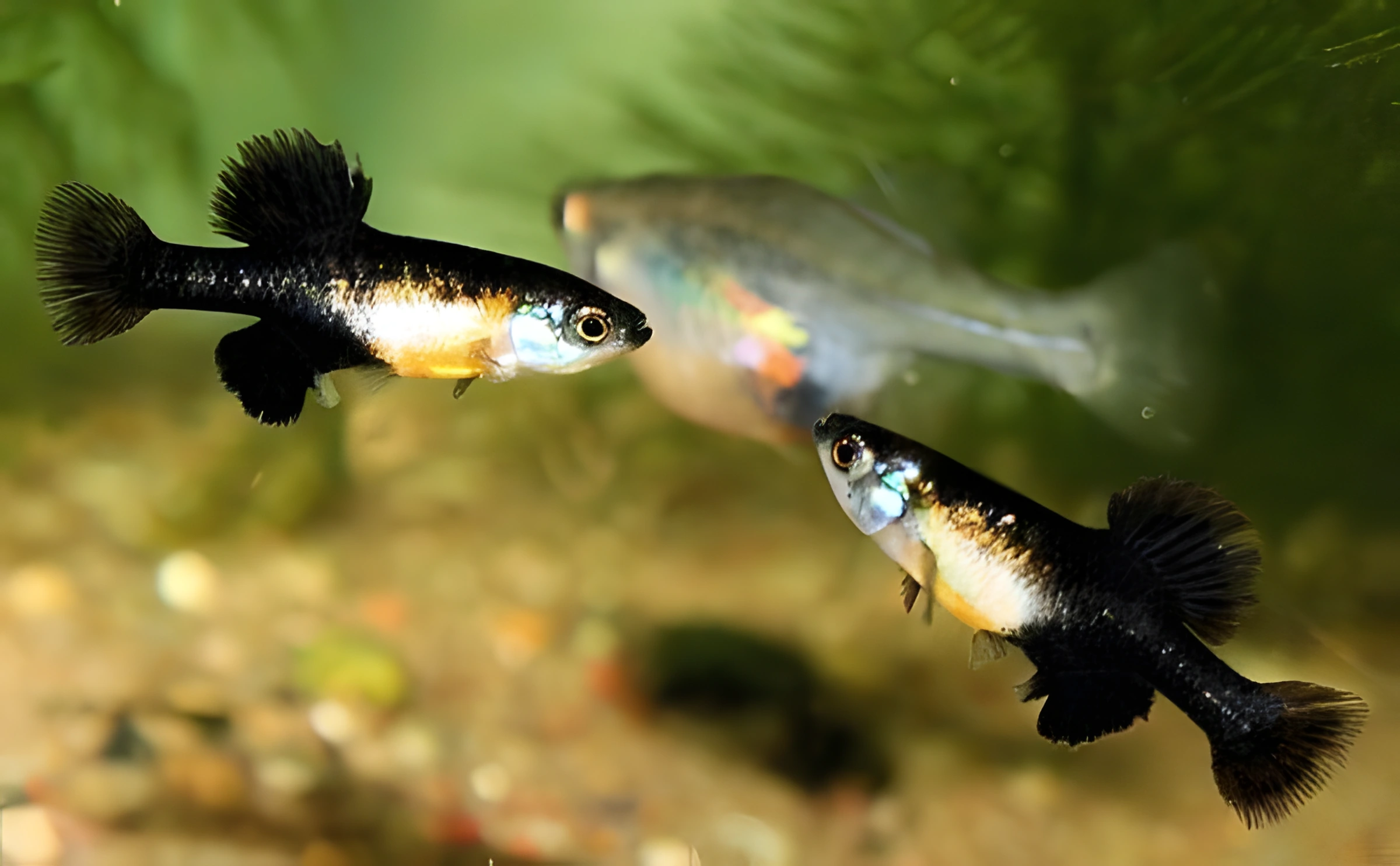
Males reach approximately 4 cm in length, with a predominantly black coloration and a golden belly. Females are noticeably larger, growing up to 5 cm and appearing more robust. Their bodies are grey, and their bellies are silvery.
Habitat
The natural habitat of this species extends across Mexico, where the fish inhabits numerous river systems. These rivers originate in the Sierra Madre mountain ranges and flow into the Pacific Ocean. Skiffia bilineata prefers lowland areas with moderate currents. It favors shallow, slightly turbid biotopes densely overgrown with aquatic vegetation.
Behavior and Compatibility
This is a peaceful and sociable fish; only males may show some unfriendliness towards each other. However, in a large group, aggressive displays are significantly mitigated. Skiffia bilineata is highly compatible with most other species of comparable size.
Care and Maintenance
For a small group of 3–4 individuals, an aquarium of 40 liters or more will suffice. Any decorations can be used, but it is advisable to provide an abundance of aquatic plants to offer hiding places for the fish. Keeping Skiffia bilineata is straightforward; this species is considered undemanding and hardy. During the warm season (in temperate climate zones), these fish can even live in outdoor ponds. The temperature regime in their natural habitats in plateaus and coastal areas is unstable, so the fish feel better and breed more readily in unheated aquariums. The hydrochemical composition of the water is also not critical, provided that pH and dGH values change smoothly, without sharp fluctuations. They can tolerate brackish water with a salt concentration of about 5 grams per liter.
Diet
In natural conditions, their diet consists of algae, plant detritus, and small invertebrates—whatever the fish can swallow. Such omnivorousness simplifies feeding in the aquarium, allowing the use of almost any popular food of suitable size: dry, frozen, or live. Aqvium flake food for aquarium fish is specially formulated for aquarium fish. Our new product has already become a bestseller on Ozon, receiving a 4.9 rating. It is suitable for most aquarium fish, and the raw materials for its production comply with new European standards (EU 2018/848). The food contains vitamins A, C, D3, E, and Omega 3-6. It can be purchased on Ozon.
Breeding and Reproduction
Females carry up to 20 large fry, which are approximately 1 cm long upon birth. To protect the young from adult fish, it is best to provide dense thickets of fine-leaved plants. For guaranteed preservation of offspring, it is recommended to move the fry to a separate aquarium. The young can be fed with regular food.
Diseases
Unsuitable keeping conditions are the main cause of most diseases in aquarium fish. If a hardy fish like Skiffia bilineata shows signs of illness, it most likely indicates significant deterioration in its habitat. Usually, restoring comfortable conditions promotes recovery. However, if symptoms persist, medical treatment will be required. More detailed information on symptoms and treatment methods is available in the “Aquarium Fish Diseases” section.
How to choose
When selecting individuals, preference should be given to active fish with clean skin without visible damage, white coatings, or ulcers. It is important to pay attention to the condition of the fins: they should be spread out, without signs of damage or clamping. Avoid buying fish that stay at the water surface, breathe heavily, or display apathetic behavior, as this may indicate hidden diseases or the effects of transport stress. It is best to purchase a group of 6 or more individuals, as this species has a pronounced schooling instinct and becomes overly timid when alone.
Frequently asked questions
The essentials: size, tank volume, water parameters and care
How big does Twostripe Skiffia get?
An adult reaches 4–5 cm in length. Plan the tank around the maximum size: the fish quickly outgrows a cramped setup.
What size aquarium does Twostripe Skiffia need?
The minimum recommended volume is 40 L. A smaller tank speeds up nitrate build-up and raises stress levels.
What water parameters does Twostripe Skiffia need?
Temperature 16–28 °C, pH 6.5–8.5, hardness 12–25 dGH. Stability matters more than exact values: sudden swings are harder on the fish than a small deviation from the ideal.
How long does Twostripe Skiffia live?
Around 3 years when kept properly. Lifespan depends directly on tank volume, water quality and a varied diet.
Is Twostripe Skiffia aggressive?
Temperament: peaceful (regular). Keep this in mind when choosing tank mates.
How many Twostripe Skiffia should be kept together?
Recommended setup: mixed (solitary / pair / group). Ignoring this is a common cause of stress and disease.
What does Twostripe Skiffia eat?
Diet type: any (universal). Feed small portions that are finished within a couple of minutes — overfeeding does more harm than underfeeding.
What is the scientific name of Twostripe Skiffia?
The scientific name of the species is Skiffia bilineata, family Goodeidae. It also appears in the literature as: Characodon bilineatus, Goodea bilineata, Neotoca bilineata.