Temperature24 – 30 °C
Natural range
- Amazonas State
- Brazil area
CichlidsConservation status: Least concern LC
Other scientific names: Plataxoides leopoldi
Leopold's Angelfish, or Pterophyllum leopoldi by its scientific name, belongs to the Cichlidae family. European researchers named it in honor of the Belgian King Leopold III.
- Required aquarium volume
- 150 L
- Size in aquarium
- 5 cm
- Temperature
- 24 – 30 °C
- Temperament
- Semi-peaceful (including aggression during spawning / intraspecific conflicts)
Parameters
Water pHNeutral (6.5) – Neutral (7.2)
Water dHSoft (5) – Hard (15)
Water salinityno salt (freshwater)
Size in aquarium5 cm
Lifespan8 years
TemperamentSemi-peaceful (including aggression during spawning / intraspecific conflicts)
Toward small fishnot a predator
Required aquarium volume150 L
Lightingdimmed
Substrateany (no restrictions)
Water flowweak
FeedingSinking (any)
CareMedium group (6–8 individuals)
Description
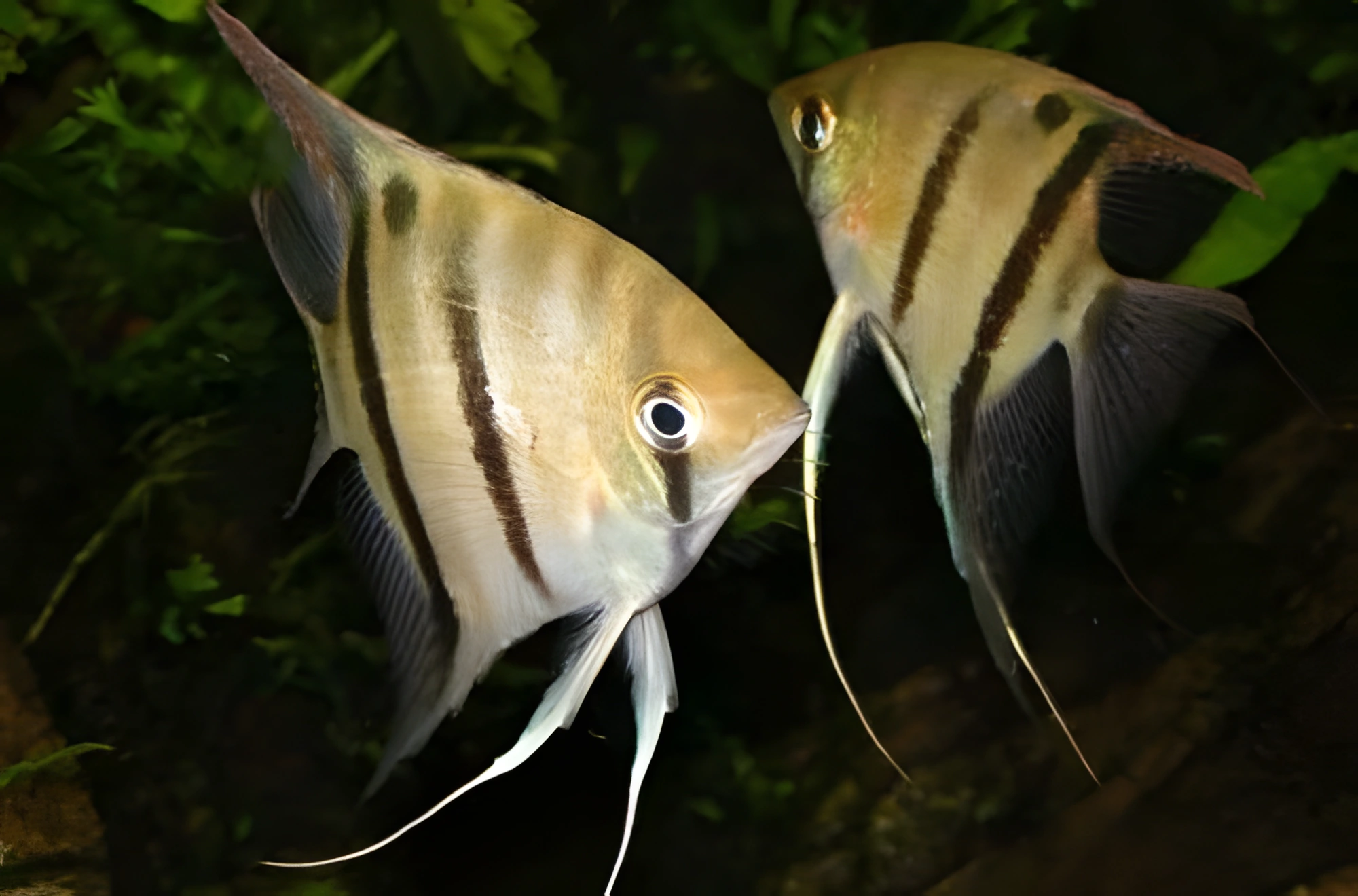
Among all representatives of its genus, this fish is the most miniature. Adult Leopold's Angelfish grow to approximately 5 cm in length. The body has the classic angelfish outline – it is tall, strongly flattened laterally, rhomboid, with a pointed head. The dorsal, anal, and caudal fins are impressively sized and resemble a triangle. The main coloration is silvery, adorned with vertical dark stripes. A distinctive feature of the species is a small black spot located on the back, beneath the dorsal fin.
Habitat
The natural habitats of this fish are in South America. Its distribution range is limited to the central part of the Amazon River basin, which roughly corresponds to the territory of the Amazonas state. Here, in the heart of the Amazonian rainforests, it chooses river sections with slow currents, where the water has a characteristic brown tint and is quite turbid.
Behavior and Compatibility
This species is characterized by a relatively peaceful and calm disposition. They get along well with other fish of comparable size. However, smaller aquarium inhabitants can sometimes become targets of the angelfish's attention. During spawning, the fish actively protect their clutch site, chasing away other inhabitants. They prefer to live in groups of 6 to 8 individuals, although keeping them in pairs is also quite common. In some cases, Leopold's Angelfish itself can be vulnerable to overly active species, such as barbs, which can damage their long, filamentous pectoral fins. All predatory species also pose a potential threat.
Care and Maintenance
For a stable school of 6–8 fish, the recommended aquarium volume starts from 150 liters, with the tank height being no less than 40 cm. In terms of decor, preference should be given to vertical elements resembling submerged tree roots, snags, or underwater plant stems. Overly dense plant thickets are undesirable. This thermophilic species requires a constant temperature of no less than 26°C, with 29–30°C considered most comfortable. In warm water, oxygen quickly dissipates, and organic matter actively decomposes. To maintain optimal living conditions, it is necessary to ensure the uninterrupted operation of filtration and aeration systems, and the aquarist will have to perform weekly partial water changes and remove accumulated waste. It is important to maintain stable pH and dGH parameters both for long-term keeping and during maintenance. Angelfish have long been popular aquarium inhabitants and have successfully adapted to artificial environments over many generations. Thanks to this, dry foods are a familiar source of nutrition for them. The feeding process is simple: just choose a suitable product (the assortment is very wide) and follow the instructions on the package.
Diet
Angelfish have long gained popularity among aquarists and have successfully lived in artificial environments for many generations. That's why dry foods are quite natural for them. Feeding is not difficult: just choose a suitable product – and the modern market offers a wide selection – and follow the instructions on the package. The fish form a stable monogamous pair, which, under favorable conditions, regularly produces offspring. Pair formation occurs only within the school. As they mature, the male and female choose a partner and stay with them for a long time. In an optimal environment and with a balanced diet, angelfish lay hundreds of eggs, securely attaching them to broad plant leaves, such as Cryptocoryne or Echinodorus. Their parental instincts are well-developed, thanks to which the clutch is relatively safe under the supervision of the adult fish. However, if spawning occurs in a community tank, the eggs and newly hatched fry may become prey for more active neighbors. In high-temperature aquariums, fungal problems on the eggs often arise. To prevent this, as well as to protect against predators, it is recommended to move the plants with the clutch and the parents to a separate tank. It is best to perform this transfer long before the spawning moment. The incubation period is only 2 days, after which the fry feed on their yolk sac for another week, and then begin to actively swim in search of food. They should be fed specialized fry foods.
Breeding and Reproduction
The fish form a strong monogamous pair, which, under favorable conditions, is capable of regularly producing offspring. Pair formation is only possible within a school. As they mature, the male and female choose a partner and remain faithful for a long time. In a suitable environment and with a balanced diet, angelfish can lay up to several hundred eggs, attaching them to broad plant leaves, such as Cryptocoryne or Echinodorus. Thanks to well-developed parental instincts, the clutch is under the reliable protection of the adult fish. However, if spawning occurs in a community tank, there is a risk that the eggs and newly hatched fry may be eaten by more active neighbors. Another common problem in very warm aquariums is the appearance of fungus on the eggs. To prevent diseases and protect against predation by other fish, it is recommended to transfer the plants with the clutch and the adult fish to a separate tank. It is advisable to perform this transfer long before spawning begins. The incubation period lasts 2 days, after which the fry will feed on the yolk sac reserves for another week, and then begin to swim freely in search of food. They should be fed specialized fry foods.
Diseases
Leopold's Angelfish is sensitive to water quality and microflora composition, which makes it susceptible to typical cichlid diseases if keeping conditions are violated. The main risks are associated with bacterial infections affecting fins and skin, as well as parasitic infestations, especially in wild-caught individuals. Prevention includes strict adherence to environmental parameters, regular water changes, and mandatory quarantine for new fish to prevent the introduction of pathogens into the aquarium.
How to choose
When choosing, attention should be paid to the fish's activity and the condition of its fins, which should be intact and without signs of erosion or film. A healthy individual has clear eyes, a plump body without a sunken belly, and shows natural curiosity rather than apathy. Avoid buying fish with visible spots, ulcers, or unnaturally clamped fins, as this often indicates stress, emaciation, or hidden infections that arose during transportation or keeping in the store.
Frequently asked questions
The essentials: size, tank volume, water parameters and care
How big does Leopold's Angelfish get?
An adult reaches 5 cm in length. Plan the tank around the maximum size: the fish quickly outgrows a cramped setup.
What size aquarium does Leopold's Angelfish need?
The minimum recommended volume is 150 L. A smaller tank speeds up nitrate build-up and raises stress levels.
What water parameters does Leopold's Angelfish need?
Temperature 24–30 °C, pH 6.5–7.2, hardness 5–15 dGH. Stability matters more than exact values: sudden swings are harder on the fish than a small deviation from the ideal.
How long does Leopold's Angelfish live?
Around 8 years when kept properly. Lifespan depends directly on tank volume, water quality and a varied diet.
Is Leopold's Angelfish aggressive?
Temperament: semi-peaceful (including aggression during spawning / intraspecific conflicts). Keep this in mind when choosing tank mates.
How many Leopold's Angelfish should be kept together?
Recommended setup: medium group (6–8 individuals). Ignoring this is a common cause of stress and disease.
What does Leopold's Angelfish eat?
Diet type: sinking (any). Feed small portions that are finished within a couple of minutes — overfeeding does more harm than underfeeding.
What is the scientific name of Leopold's Angelfish?
The scientific name of the species is Pterophyllum leopoldi, family Cichlids (Cichlidae). It also appears in the literature as: Plataxoides leopoldi.