Temperature24 – 28 °C
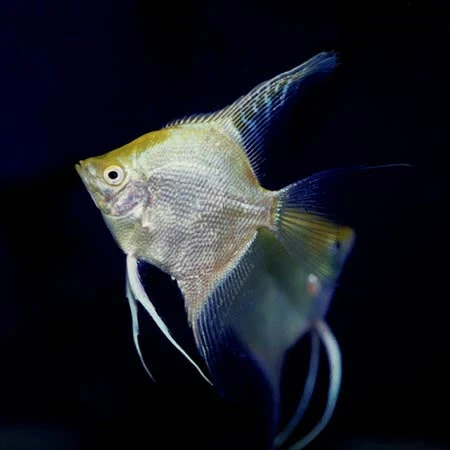
Other scientific names: Platax scalaris, Plataxoides dumerilii, Pterophillum eimekei, Pterophyllum dumerilii, Pterophyllum eimekei, Zeus scalaris
Pterophyllum scalare, more commonly known as the angelfish, belongs to the family Cichlidae. This fish captivates with its grace and unique body shape, which sets it apart from other aquarium inhabitants. Its peculiar body contours are even reflected in its Latin scientific name, which can be roughly translated as "Winged Leaf."
A characteristic feature is its high, strongly flattened body, complemented by elongated anal and dorsal fins, giving the fish a rhomboid silhouette. The pectoral fins are thread-like and significantly long. Since the species Pterophyllum scalare has been actively used in selective breeding, the artificially bred forms exhibit a wide variety of colors, from solid to complex combinations of several hues.
The angelfish was first discovered by European researchers in 1823 during their study of the biological diversity of South America. Its range extends through the Amazon basin and a number of other river systems, covering Brazil, Peru, Colombia, Guyana, Suriname and French Guiana. These fish prefer slow-moving backwaters, swamps, and flooded river valleys with abundant aquatic vegetation. Their diet consists of small fish and invertebrates.
This species exhibits quite aggressive behavior, especially intensifying during spawning periods when the fish become territorial. It is not recommended to keep them with fish that are smaller than or equal in size. Only large, peaceful species are suitable as tankmates, provided they are kept in a spacious aquarium of at least 300 liters. A species-specific aquarium is considered the most favorable.
These fish are considered relatively undemanding, provided that the required water parameters are maintained and 15–20% of the water volume is changed weekly. Optimal aquarium equipment includes a filter, aerator, heater, and a lighting system with subdued light. Since angelfish inhabit waters with weak currents, water movement in the aquarium should be minimized. Dense plant thickets, arranged in groups around the perimeter of the aquarium, leaving the central part free for swimming, are welcome in the decor. Various wooden elements, such as snags, branches, and roots, can be used for shelters. The choice of substrate is not critical for the fish and is determined more by the needs of the aquarium plants.
The angelfish diet can include all types of dry, frozen, and live foods. It is important to ensure dietary variety, always including high-protein components such as bloodworms or mosquito larvae, and not forgetting plant-based supplements. Specialized foods designed specifically for angelfish, containing all necessary trace elements and freeze-dried protein products, are available in pet stores. Feeding is recommended two or three times a day. It is crucial to remove all uneaten food to prevent water spoilage and avoid overfeeding.
Due to difficulties in determining sex, the optimal approach is to acquire a group of 4–8 individuals. Angelfish begin to breed at 6 to 12 months of age, depending on environmental conditions. A change in water parameters stimulates spawning: the pH value should be around 6.5 (slightly acidic environment), and dH around 5 (soft water). The diet during this period should be enriched with protein-rich foods. Over time, the fish form pairs and begin to occupy a separate area of the aquarium, establishing their territory. Sometimes, males may emit characteristic clicking sounds during mating. Females lay up to 1000 eggs on plant leaves, which are then fertilized. The parents vigilantly guard their offspring, attacking anyone who approaches their territory. However, as a result of many years of selective breeding, parental instincts may be lost, in which case the fry risk being eaten by their own parents. In such a situation, plants with eggs should be transferred to a separate spawning aquarium with similar conditions. The hatched fry should be fed specialized micro-food.
Angelfish are predisposed to various diseases, among which ichthyophthiriasis is particularly common. Health problems usually arise from a disruption or deterioration of water quality, when its parameters do not meet optimal indicators.
When selecting angelfish, attention should be paid to their appearance and behavior in the aquarium. Healthy fish should be active, have clean, undamaged fins without signs of rot or white coating. It is important that the body is even, without depressions, and the eyes are clear and transparent. Avoid individuals that appear emaciated, have an unnaturally bloated abdomen, or constantly stay at the water surface, gasping for air. Since angelfish are schooling fish, it is recommended to acquire a group of 4–6 young individuals so that they can form pairs independently in the future. When purchasing, ask the seller what the fish were fed, as an abrupt change in diet can cause stress. Be sure to inspect the aquarium in the store: the presence of sick or dead fish in it is a serious reason to refuse the purchase, as infections spread quickly in such systems.
The essentials: size, tank volume, water parameters and care
An adult reaches 15 cm in length. Plan the tank around the maximum size: the fish quickly outgrows a cramped setup.
The recommended volume is 200 L. A smaller tank speeds up nitrate build-up and raises stress levels.
Temperature 24–28 °C, pH 6–7, hardness 5–10 dGH. Stability matters more than exact values: sudden swings are harder on the fish than a small deviation from the ideal.
Around 15 years when kept properly. Lifespan depends directly on tank volume, water quality and a varied diet.
Temperament: semi-peaceful (dangerous to smaller ones). Not a predatory species, but small fish that fit in its mouth will eventually be eaten.
Recommended setup: schooling (usually from 5–6 individuals and more). Ignoring this is a common cause of stress and disease.
Diet type: meat / protein (live, frozen, fresh). Feed small portions that are finished within a couple of minutes — overfeeding does more harm than underfeeding.
The scientific name of the species is Pterophyllum scalare, family Cichlids (Cichlidae). It also appears in the literature as: Platax scalaris, Plataxoides dumerilii, Pterophillum eimekei.
Matched by family, categories and overlapping keeping conditions
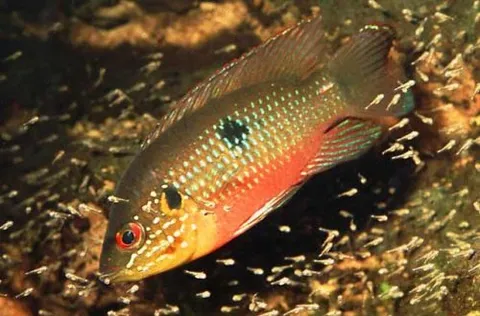
Rubricatochromis bimaculatus
Rubricatochromis bimaculatus, or the Jewel Cichlid, belongs to the family Cichlidae. This fish possesses a bright, attractive appearance, however, its temperament can create difficulties for other aquarium inhabitants.…
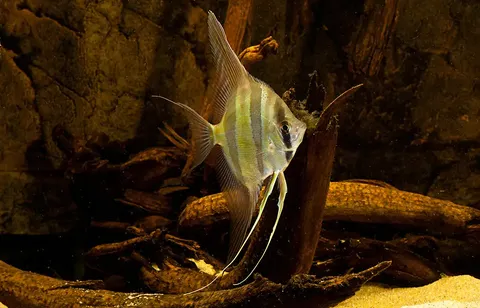
Pterophyllum altum
Pterophyllum altum, known as the Altum Angelfish or High-bodied Angelfish, belongs to the Cichlidae family. This species is the largest among angelfish, reaching lengths of 18 cm or more. Despite their size, these fish…
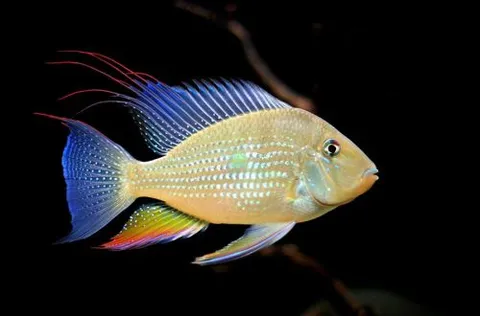
Acarichthys heckelii
Acarichthys heckelii, known as Heckel's Acara or Threadfin Acara, belongs to the Cichlidae family. This vibrant and attractive fish is relatively easy to keep, standing out with its unusual behavior during the breeding…
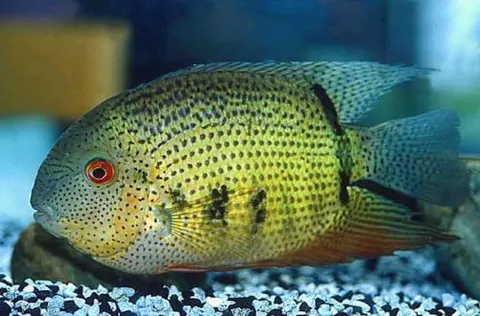
Heros notatus
The Cichlasoma Severum Notatus, scientifically known as Heros notatus, is a member of the Cichlidae family. This large and beautiful fish possesses a range of qualities highly valued by hobbyists: it is hardy, easy to…