Temperature17 – 28 °C
Natural range
- Trinidad and Tobago area
- Barbados area
- Venezuela area
- Central America area
LivebearersConservation status: Least concern LC
Other scientific names: Acanthophacelus guppii, Acanthophacelus reticulatus, Girardinus guppii, Girardinus reticulatus, Haridichthys reticulatus, Heterandria guppyi
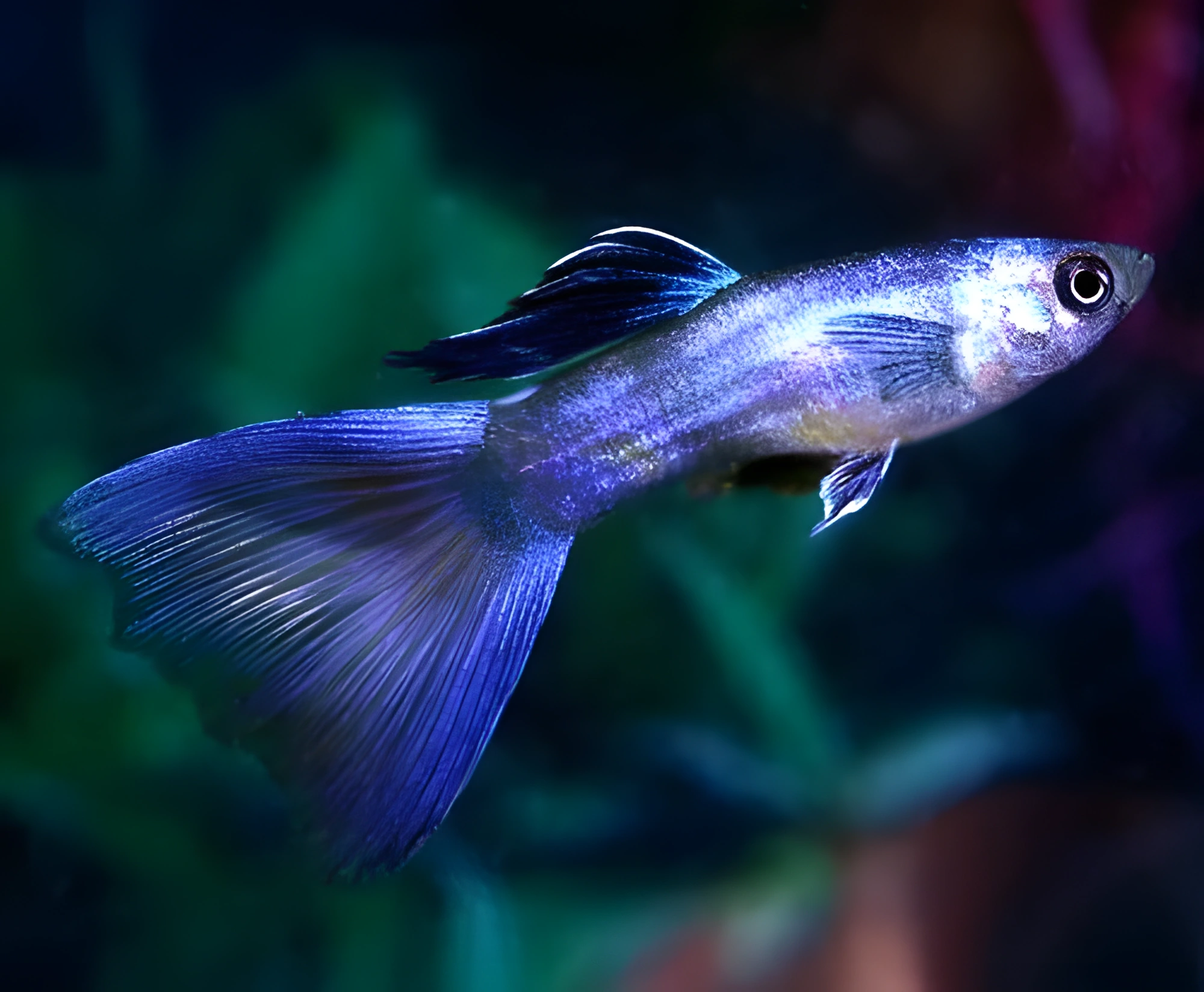
Blue Guppies, known scientifically as Poecilia reticulata (Blue variety), belong to the Poeciliidae family. This name is a generalization and encompasses various breeds where blue is the dominant color. It is mainly applied to European standard Moscow Guppies, which are characterized by a solid bluish coloration. In other breeds, blueness is only present in elements of the pattern or combined with other shades (e.g., black or green); thus, only certain body parts, such as the tail and fins, may be blue.
- Required aquarium volume
- 40 L
- Size in aquarium
- 3 – 6 cm
- Temperature
- 17 – 28 °C
- Temperament
- Peaceful (regular)
Parameters
Water pHNeutral (7) – Slightly alkaline (8.5)
Water dHMedium hardness (10) – Very hard (30)
Water salinitylow (3–5 g/L)
Size in aquarium3 – 6 cm
Lifespan3 years
TemperamentPeaceful (regular)
Toward small fishnot a predator
Required aquarium volume40 L
Lightingweak (low)
Substrateany (no restrictions)
Water flowweak or moderate
FeedingAny (universal)
CareMixed (solitary / pair / group)
Description
Blue guppies are a selective color variation of the species Poecilia reticulata. These are small, livebearing fish with elongated bodies. Males reach 3 cm in length, are distinguished by their bright coloration and developed fins, while females grow up to 6 cm and have more modest coloring. The name unites many selective breeds where blue color dominates the body or fin coloration. Sexual dimorphism is pronounced: in males, the anal fin is transformed into a gonopodium, while females are larger and have a rounded belly.
Habitat
In nature, the wild species Poecilia reticulata inhabits water bodies in Central and South America, including the islands of Trinidad and Tobago, Barbados, and Venezuela. The fish are found in a wide variety of biotopes: from fast mountain streams to stagnant swamps and canals, including areas with brackish water. Selective forms, such as blue guppies, do not live in their natural environment and are the result of many years of breeders' work.
Behavior and Compatibility
These are peaceful and active fish, suitable for keeping in community tanks with other calm species. They are social and prefer to be in a group. Intraspecific conflicts are practically absent. It is recommended to maintain a female-to-male ratio of 2:1 or 3:1 to reduce the level of harassment of females by males. It is undesirable to keep them with fish prone to fin nipping, such as some types of barbs.
Care and Maintenance
Comfortable long-term keeping of Guppies is ensured in a spacious aquarium environment with clean, warm water, a balanced diet, and peaceful, calm tankmates. Thanks to their modest size, these fish feel quite comfortable even in small tanks. They can often be found in so-called nano-aquariums, with volumes of only 10–20 liters, and sometimes even less. Nature has endowed Guppies with unpretentiousness, allowing them to adapt to a wide range of hydrochemical parameters, including brackish water. Temperature conditions also do not play a critical role. In certain situations, if the aquarium is located in a living area, Guppies can live in unheated tanks (without the use of a heater). Regarding nutrition: many manufacturers offer specialized product lines specifically for this fish species. Such foods can serve as the basis of their daily diet. If desired, the diet can be enriched with frozen and live foods, such as Artemia, bloodworms, Daphnia, and other invertebrates. Aqvium Flake Food for Aquarium Fish Check out our new product, a bestseller on Ozon with a 4.9 rating. Flake food is suitable for most aquarium fish. The raw materials are manufactured according to new European Union standards (EU 2018/848). Contains vitamins A, C, D3, E and Omega 3-6 Buy on Ozon Behavior and Compatibility: Guppies are known for their peaceful nature, which makes them excellent tankmates for many species of tropical fish. Conflicts within their own species do not arise. More detailed information on compatible species can be found in a separate article.
Diet
Guppies are omnivorous. In the aquarium, they accept all types of food: high-quality dry flakes, granules, as well as frozen and live products such as Artemia, Daphnia, or bloodworms. To maintain vibrant coloration and health, a varied diet is recommended. Feeding should be done 1–2 times a day in small portions that the fish can consume in a couple of minutes, avoiding overfeeding, to which the species is prone.
Breeding and Reproduction
Guppies are livebearing fish. Reproduction occurs easily, often without the aquarist's intervention. Gestation lasts about 4–5 weeks. The female gives birth to fully formed fry capable of independent feeding. Since adult fish are prone to cannibalism, it is recommended to use heavily planted aquariums or move the pregnant female to a separate tank for the survival of the offspring. Fry are fed Artemia nauplii or specialized micro-foods 3–4 times a day.
Diseases
The species is susceptible to diseases typical of aquarium fish, including fungal, bacterial, and parasitic infections. Symptoms may include lethargy, loss of appetite, fin clamping, changes in coloration, or atypical behavior. Water purity and the absence of sudden fluctuations in temperature and pH are the main preventative factors. They are sensitive to the accumulation of ammonia, nitrites, and nitrates, so regular water changes are essential.
How to choose
When selecting fish, attention should be paid to their activity and the condition of their fins: they should be spread out, without signs of damage or film. Healthy specimens should show interest in food and not have sunken bellies. Avoid purchasing fish that appear apathetic, stay at the surface, or have visible spots on their bodies. It is recommended to acquire specimens from reputable sources where quarantine conditions are observed.
Frequently asked questions
The essentials: size, tank volume, water parameters and care
How big does Blue Guppies get?
An adult reaches 3–6 cm in length. Plan the tank around the maximum size: the fish quickly outgrows a cramped setup.
What size aquarium does Blue Guppies need?
The minimum recommended volume is 40 L. A smaller tank speeds up nitrate build-up and raises stress levels.
What water parameters does Blue Guppies need?
Temperature 17–28 °C, pH 7–8.5, hardness 10–30 dGH. Stability matters more than exact values: sudden swings are harder on the fish than a small deviation from the ideal.
How long does Blue Guppies live?
Around 3 years when kept properly. Lifespan depends directly on tank volume, water quality and a varied diet.
Is Blue Guppies aggressive?
Temperament: peaceful (regular). Keep this in mind when choosing tank mates.
How many Blue Guppies should be kept together?
Recommended setup: mixed (solitary / pair / group). Ignoring this is a common cause of stress and disease.
What does Blue Guppies eat?
Diet type: any (universal). Feed small portions that are finished within a couple of minutes — overfeeding does more harm than underfeeding.
What is the scientific name of Blue Guppies?
The scientific name of the species is Poecilia reticulata (разновидность Blue), family Poeciliidae. It also appears in the literature as: Acanthophacelus guppii, Acanthophacelus reticulatus, Girardinus guppii.