Temperature20 – 26 °C
Natural range
- Eastern Australia area
- Australia area
RainbowfishConservation status: Least concern LC
Other scientific names: Atherina signata, Atherinosoma jamesonii, Pseudomugil signafer, Pseudomugil signata
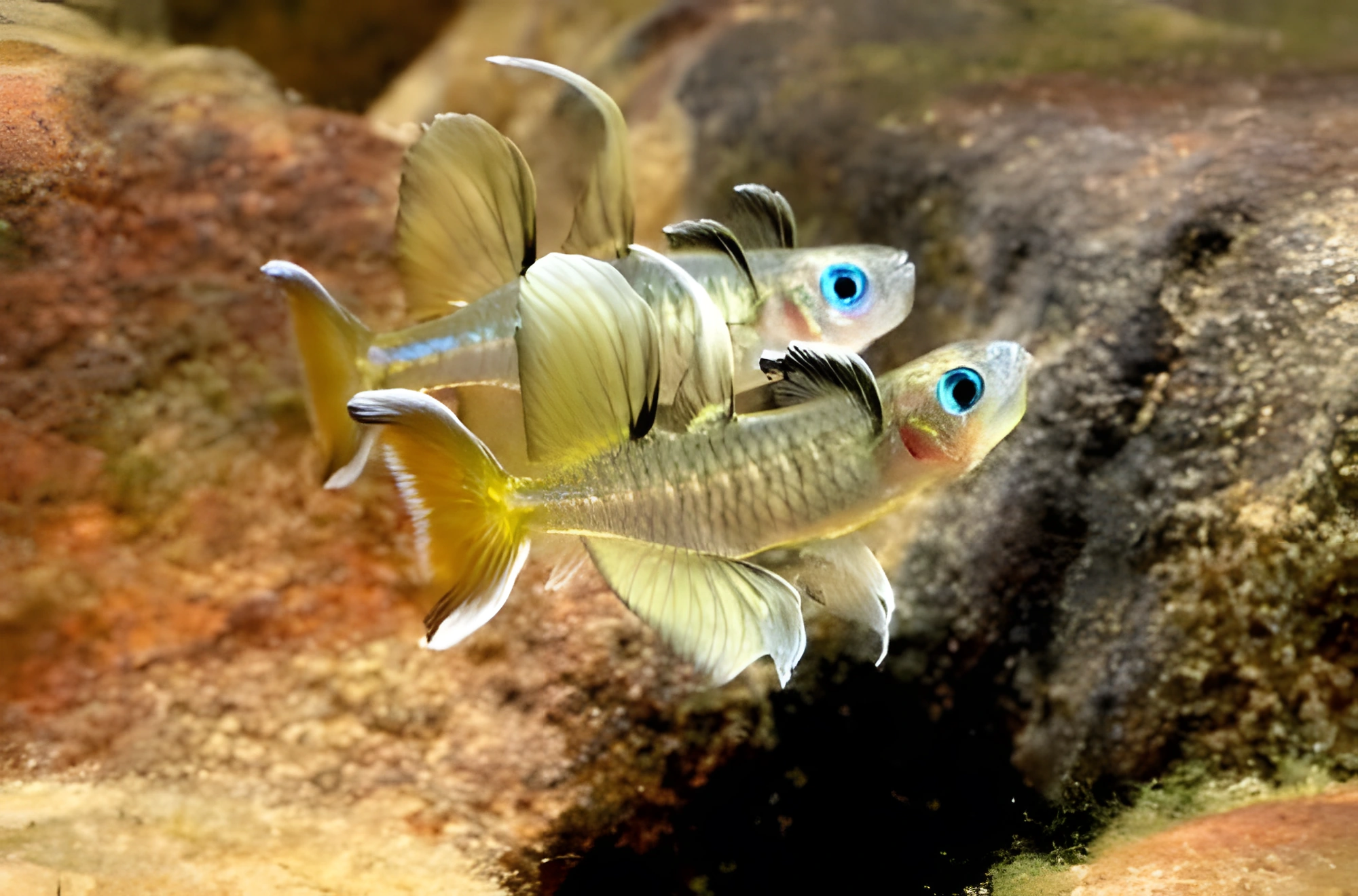
Pseudomugil signifer, or the Australian blue-eye (scientific name Pseudomugil signifer), is a member of the family Pseudomugilidae. This remarkable fish is captivating not only for its unusual appearance but also for its astonishing ability to adapt to a wide variety of habitats. Its undemanding nature, ease of care, and compatibility with other peaceful species make it an excellent choice for a community tank.
- Required aquarium volume
- 60 L
- Size in aquarium
- 7 cm
- Temperature
- 20 – 26 °C
- Temperament
- Peaceful (regular)
Parameters
Water pHSlightly acidic (6) – Slightly alkaline (8)
Water dHSoft (5) – Very hard (22)
Water salinitywide range (from ~1 to ~20 g/L)
Size in aquarium7 cm
Lifespan3 years
TemperamentPeaceful (regular)
Toward small fishnot a predator
Required aquarium volume60 L
Lightingmoderate (regular)
Substrateany (no restrictions)
Water flowweak
FeedingAny (universal)
CareGroup (8–10 individuals)
Description
Adults range in size from 3 to 7 cm. It is worth noting that fish can vary significantly in size depending on their region of origin: for example, in the north of the continent, the Australian blue-eye is larger and has more elongated fins compared to specimens from southern regions. The fish's body has a yellowish tint with a silvery sheen on its head. A distinctive feature of this species, reflected in its name, is its blue iridescent eyes.
Habitat
The native habitat of these fish is the eastern coast of Australia and nearby island territories. This species has successfully adapted to a wide variety of natural biotopes. They can be found in swampy areas, clear freshwater lakes and streams, as well as in brackish waters, mangrove thickets, and salt marshes.
Behavior and Compatibility
Most representatives of this species are peaceful and calm fish, coexisting well in a community tank with tankmates of similar size and temperament, such as characins, cyprinids, catfish, and others. Schooling is recommended, with the group size being no less than 8–10 individuals. It is important to note that males of northern blue-eye varieties can be quite aggressive towards each other, especially during spawning, engaging in fierce skirmishes. Weaker individuals sometimes even die from injuries sustained.
Care and Maintenance
The optimal aquarium volume for a small school of blue-eyes from southern regions starts from 60 liters; 'northerners' will require a larger volume due to their greater size. The decor can include areas with dense vegetation, interspersed with open spaces for free swimming. Several natural or artificial snags will also add to the aesthetics. If the Australian blue-eye is raised in an aquarium or on a farm, rather than caught from the wild, there will be no problems with its keeping. It will be sufficient to recreate water conditions similar to those in which it was previously kept. Thanks to its high adaptability, when maintaining the aquarium, living conditions can be gradually changed in the desired direction to optimize maintenance costs. Keeping in brackish water is permissible at a concentration of up to 10–15 g of salt per 1 liter.
Diet
Since feeding occurs at the surface and in the water column, the use of sinking foods is undesirable. If possible, the diet should be enriched with live foods, such as small bloodworms, Artemia, and Daphnia.
Breeding and Reproduction
In natural conditions, the breeding season lasts from October to December; however, in a home aquarium, with stable parameters, it can begin at any time of the year. The fish use adhesive threads to attach their eggs to the surface of fine-leaved plants or mosses; artificial vegetation can also serve as a suitable alternative. Spawning continues for several days, during which the female lays several batches of eggs, which can be fertilized by multiple males. The incubation period lasts from 10 to 21 days, depending on the temperature regime. Parental instincts are not developed in these fish, and adults often eat both their own eggs and fry. In an aquarium with lush vegetation, there is a chance of a small percentage of offspring surviving. If the goal is to save all offspring, the eggs can be carefully moved to a separate tank with identical water conditions, where the fry will subsequently be raised. Specialized powdered foods and/or Artemia nauplii are used for feeding.
Diseases
Health problems in these fish arise only in the presence of injuries or keeping in unsuitable conditions, which leads to a weakening of the immune system and the subsequent occurrence of various diseases. At the first signs of illness, it is necessary first to check the water parameters for exceeding permissible values or the presence of toxic substances (such as nitrites, nitrates, ammonia). If deviations are found, all indicators should be normalized, and then treatment should begin. More detailed information on symptoms and treatment methods is available in the "Diseases of Aquarium Fish" section.
How to choose
When purchasing, choose active, lively individuals with clean fins and no visible damage or film on their bodies. Avoid fish with signs of lethargy, rapid breathing, or unnaturally clamped fins, as these may indicate stress or hidden diseases. Given that the species has wide geographical variability, ask the seller about the origin of the batch, as northern and southern populations may differ in size and intensity of coloration.
Before purchasing, ensure that the fish are kept in conditions close to those recommended for the species and show no signs of emaciation. Since Pseudomugil signifer is a schooling species, it is recommended to acquire a group of 8–10 individuals at once to minimize stress during adaptation to a new aquarium. If possible, observe the fish's behavior in the store: healthy individuals should show curiosity and natural social activity.
Frequently asked questions
The essentials: size, tank volume, water parameters and care
How big does Australian Blue-eye get?
An adult reaches 7 cm in length. Plan the tank around the maximum size: the fish quickly outgrows a cramped setup.
What size aquarium does Australian Blue-eye need?
The minimum recommended volume is 60 L. A smaller tank speeds up nitrate build-up and raises stress levels.
What water parameters does Australian Blue-eye need?
Temperature 20–26 °C, pH 6–8, hardness 5–22 dGH. Stability matters more than exact values: sudden swings are harder on the fish than a small deviation from the ideal.
How long does Australian Blue-eye live?
Around 3 years when kept properly. Lifespan depends directly on tank volume, water quality and a varied diet.
Is Australian Blue-eye aggressive?
Temperament: peaceful (regular). Keep this in mind when choosing tank mates.
How many Australian Blue-eye should be kept together?
Recommended setup: group (8–10 individuals). Ignoring this is a common cause of stress and disease.
What does Australian Blue-eye eat?
Diet type: any (universal). Feed small portions that are finished within a couple of minutes — overfeeding does more harm than underfeeding.
What is the scientific name of Australian Blue-eye?
The scientific name of the species is Pseudomugil signifer, family Pseudomugilidae. It also appears in the literature as: Atherina signata, Atherinosoma jamesonii, Pseudomugil signafer.