Temperature23 – 28 °C
Natural range
- Mekong River Basin
- Chao Phraya River Basin
- Mae Klong River Basin
- Thailand area
UnusualConservation status: Least concern LC
Other scientific names: Mastacembelus siamensis, Rhynchobdella aculeata
The Siamese spiny eel, scientifically known as Macrognathus siamensis, belongs to the family Mastacembelidae, or spiny eels, and is classified as an eel. It can be found in the wild in Southeast Asia, particularly in the vast basins of the Chao Phraya and Mekong rivers, located in modern-day Thailand. It prefers shallow river areas with soft substrate, often burying itself and leaving only its head exposed.
- Required aquarium volume
- 150 L
- Size in aquarium
- 30 cm
- Temperature
- 23 – 28 °C
- Temperament
- Semi-peaceful (including aggression during spawning / intraspecific conflicts)
Parameters
Water pHSlightly acidic (6) – Slightly alkaline (8)
Water dHSoft (6) – Very hard (25)
Water salinityno salt (freshwater)
Size in aquarium30 cm
Lifespan10 years
TemperamentSemi-peaceful (including aggression during spawning / intraspecific conflicts)
Toward small fishnot a predator
Required aquarium volume150 L
Lightingdimmed
Substratesandy (regular, light)
Water flowmoderate
FeedingHigh protein (predominantly meat)
CareBoth solitary and in group (flexible)
Description
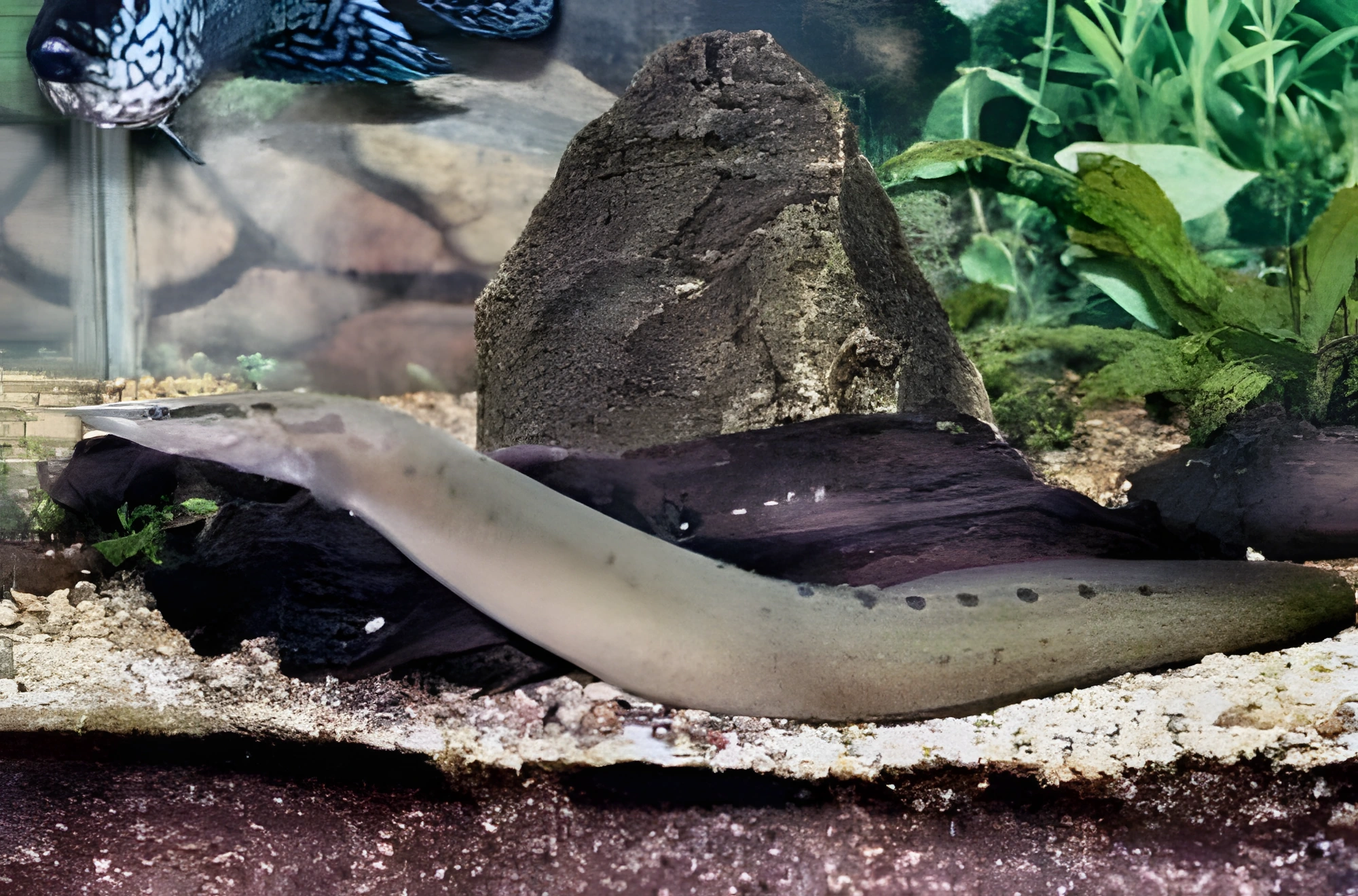
Adults of this species can reach a length of up to 30 cm. A distinctive feature of the fish is its elongated, snake-like body with a pointed head. The dorsal and anal fins are located closer to the caudal part, merging with it into a single unit. The body coloration is usually light brown, adorned with a beige stripe that runs along the entire body from the head to the base of the tail. Along the edge of the dorsal fin, 3 to 6 round black spots can be seen; for this feature, the species is sometimes called the Peacock Eel. Outwardly, it resembles its closest relative, the Spiny Eel, which inhabits similar natural conditions.
Habitat
The Siamese spiny eel inhabits the Mekong, Chao Phraya, and Meklong river basins in Thailand, Cambodia, Laos, and Vietnam. It prefers bodies of water with slow currents or stagnant water, such as swamps, canals, and flooded forest areas. In nature, it stays in areas with soft sandy or silty bottoms, where it spends the daylight hours buried in the substrate.
Behavior and Compatibility
This species leads a secretive, nocturnal lifestyle and is characterized by its shyness. When keeping them, it is necessary to avoid cohabitation with overly active or territorial species. For example, when choosing fish from the Loach and Catfish families, caution should be exercised, with the exception of peaceful Corydoras. The spiny eel coexists well with most peaceful species of comparable size. However, it is worth remembering that small fish that can fit into the mouth of a Siamese spiny eel will likely become its prey.
Care and Maintenance
For keeping 2–3 eels, the optimal aquarium volume starts from 150 liters. Since they are bottom dwellers, the main task in aquascaping is to pay attention to the lower layer. It is recommended to use a soft substrate consisting of sand or fine gravel, and also to provide several secluded spots, such as caves and grottoes. Lighting should be subdued, and floating plants will serve as an additional source of shade. Since the Siamese spiny eel likes to burrow into the substrate, rooted plants are usually uprooted. For the long-term health of the fish, it is important to provide water of soft to medium hardness with a pH from slightly acidic to neutral, and to maintain a high level of dissolved oxygen. Additional aeration is welcome. Aquarium maintenance is standard: weekly partial water changes with fresh water and removal of accumulated organic debris, such as food and excrement. In its natural environment, the spiny eel's diet consists of insect larvae, small crustaceans, and worms, and it may catch fry or small fish if the opportunity arises. In a home aquarium, the diet should be based on high-protein foods: earthworms, large bloodworms, and pieces of shrimp meat. It is best to feed them shortly before turning off the main lighting, as the eel is active at night.
Diet
In its natural environment, the spiny eel's diet consists of insect larvae, small crustaceans, and worms, and it may catch fry or small fish if the opportunity arises. In a home aquarium, the diet should be based on high-protein foods: earthworms, large bloodworms, and pieces of shrimp meat. It is best to feed them shortly before turning off the main lighting, as the eel is active at night. Creating a suitable habitat is crucial, as unsatisfactory conditions will inevitably affect the fish's health. The Siamese spiny eel is sensitive to temperature, so the water should not be colder than the recommended values. Unlike most scaled fish, the skin of eels is relatively delicate and can be easily damaged by tools during aquarium maintenance. More detailed information on symptoms and treatment methods is available in the "Diseases of Aquarium Fish" section.
Breeding and Reproduction
Natural reproduction in aquarium conditions is practically nonexistent. In professional farms, hormonal injections are used to stimulate spawning. The process involves active pursuit of the female by the male, after which the eggs are laid among floating plants or on the substrate. Larvae hatch after 3–4 days, and after a few more days, they begin to swim freely and feed. Fry are very sensitive to water quality and prone to fungal infections, so they require frequent water changes and careful sorting by size.
Diseases
Creating a suitable habitat is a key aspect. Unsatisfactory conditions will inevitably affect the fish's health. The Siamese spiny eel is sensitive to temperature, so the water should not be colder than the recommended values. Unlike most scaled fish, the skin of eels is relatively delicate, making it vulnerable to damage from tools during aquarium maintenance. More detailed information on symptoms and treatment methods can be found in the "Diseases of Aquarium Fish" section.
How to choose
When purchasing, pay attention to the following signs:
- absence of visible skin damage, ulcers, and white spots indicating infections;
- plumpness of the individual, as emaciated fish often refuse food in the aquarium;
- activity in the evening, if there is an opportunity to observe feeding.
It should be noted that these fish are nocturnal predators and can be very shy at first. Avoid purchasing specimens with signs of apathy or a damaged snout, as this makes subsequent feeding difficult.
Frequently asked questions
The essentials: size, tank volume, water parameters and care
How big does Siamese Spiny Eel get?
An adult reaches 30 cm in length. Plan the tank around the maximum size: the fish quickly outgrows a cramped setup.
What size aquarium does Siamese Spiny Eel need?
The minimum recommended volume is 150 L. A smaller tank speeds up nitrate build-up and raises stress levels.
What water parameters does Siamese Spiny Eel need?
Temperature 23–28 °C, pH 6–8, hardness 6–25 dGH. Stability matters more than exact values: sudden swings are harder on the fish than a small deviation from the ideal.
How long does Siamese Spiny Eel live?
Around 10 years when kept properly. Lifespan depends directly on tank volume, water quality and a varied diet.
Is Siamese Spiny Eel aggressive?
Temperament: semi-peaceful (including aggression during spawning / intraspecific conflicts). Keep this in mind when choosing tank mates.
How many Siamese Spiny Eel should be kept together?
Recommended setup: both solitary and in group (flexible). Ignoring this is a common cause of stress and disease.
What does Siamese Spiny Eel eat?
Diet type: high protein (predominantly meat). Feed small portions that are finished within a couple of minutes — overfeeding does more harm than underfeeding.
What is the scientific name of Siamese Spiny Eel?
The scientific name of the species is Macrognathus siamensis, family Spiny Eels (Mastacembelidae). It also appears in the literature as: Mastacembelus siamensis, Rhynchobdella aculeata.