Temperature18 – 25 °C
Natural range
- Eastern Himalayas area
- Upper Ganges Basin
- Nepal area
- Northeastern India area
LoachesConservation status: Least concern LC
Other scientific names: Cobitis scaturigina, Nemacheilus mugah, Nemacheilus scaturigina, Nemacheilus schebbeuri, Nemacheilus shebbearei, Nemachilus mugah
The fish, known scientifically as Schistura scaturigina and belonging to the family Nemacheilidae (loaches), originates from South Asia. Its natural habitats are the upper reaches of the Ganges River basin, which spans Nepal and the northeastern regions of India. These fish prefer mountainous river sections characterized by rocky bottoms and strong, sometimes turbulent, water flow.
- Required aquarium volume
- 60 L
- Size in aquarium
- 6 – 7 cm
- Temperature
- 18 – 25 °C
- Temperament
- Peaceful (regular)
Parameters
Water pHNeutral (6.5) – Neutral (7.5)
Water dHSoft (5) – Hard (15)
Water salinityno salt (freshwater)
Size in aquarium6 – 7 cm
Lifespan5 years
TemperamentPeaceful (regular)
Toward small fishnot a predator
Required aquarium volume60 L
Lightingany
Substrateany (no restrictions)
Water flowmoderate
FeedingSinking (any)
CareSmall group (3–4 individuals)
Description
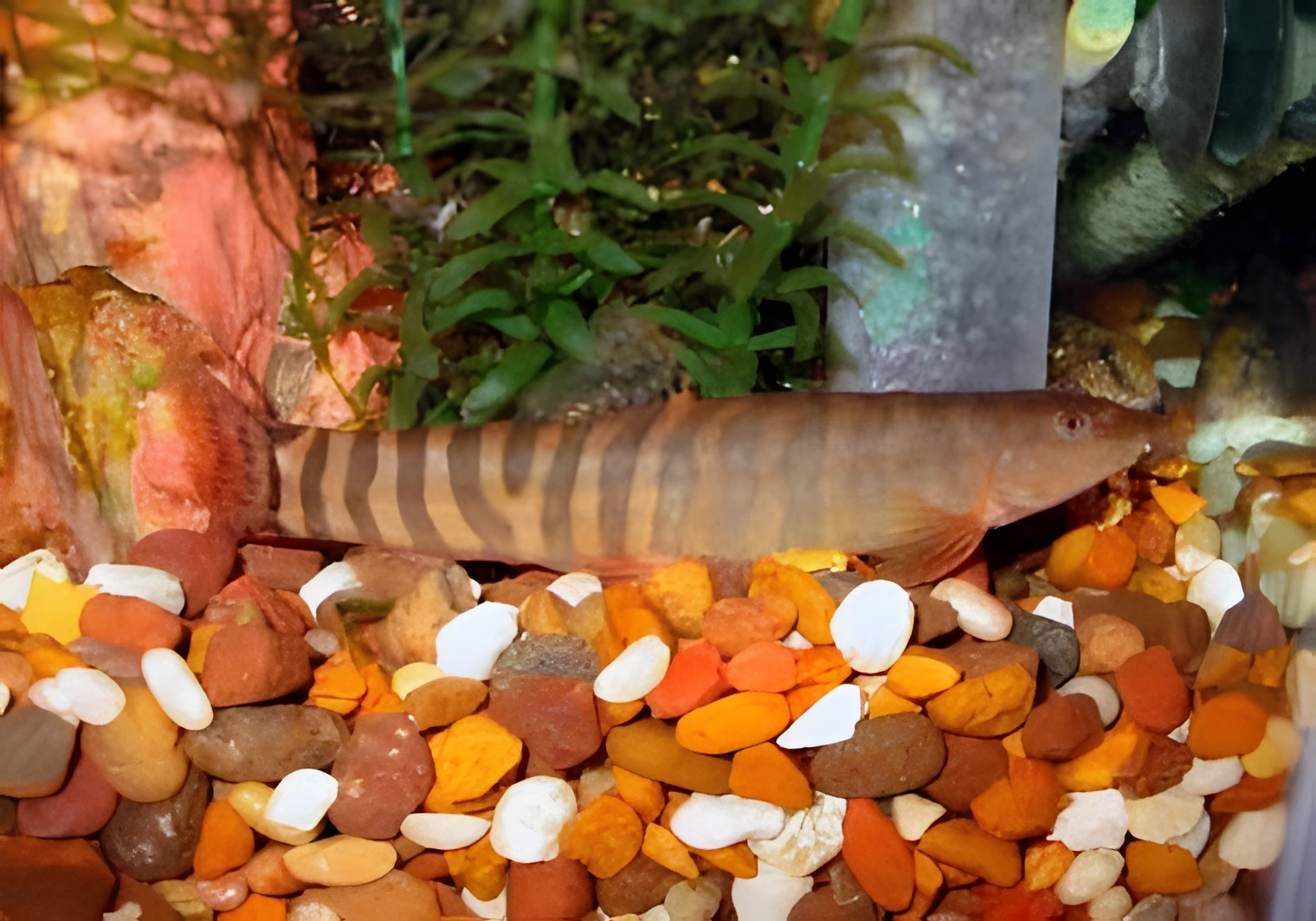
Adults of this fish typically reach a length of 6–7 cm. Their body is characterized by an elongated, cylindrical shape, slightly compressed laterally. Their fins are short and translucent. The mouth is surrounded by sensitive barbels located on the head. The coloration is predominantly grayish-olive, with a noticeable pattern of dark vertical stripes. Sexual dimorphism is weakly expressed, and it is generally difficult to observe clear differences between males and females.
Habitat
The species inhabits high-altitude streams and fast-flowing rivers in the eastern Himalayas, including territories in India, Nepal, and Bhutan. It prefers areas with rocky or gravel bottoms, where the water is rich in oxygen. In nature, these fish are bottom-dwellers, often hiding among rocks and pebbles.
Behavior and Compatibility
These fish exhibit territorial behavior: occupying a section of the bottom, they jealously guard it from other conspecifics. Despite this, Schistura scaturigina needs company, so it is recommended to keep them in groups of 3–4 individuals, but only if the aquarium is spacious enough. Conflicts may arise in a small tank. For this reason, bottom-dwelling fish such as catfish should not be kept as tank mates. However, other species that inhabit the water column or surface are usually tolerated well.
Care and Maintenance
For a group of 3–4 fish, the optimal aquarium volume starts from 60–70 liters. The decor should include coarse sand or a rocky substrate, supplemented with small stones and pebbles, as well as large boulders and driftwood. It is desirable to recreate a moderate internal current, reminiscent of a mountain river, which can be achieved with a separate pump or a powerful filtration system. To maintain the fish's well-being in the long term, a high level of dissolved oxygen, warm water with a pH of about 7.0, and medium hardness are critically important. Since Schistura scaturigina originates from flowing waters, they are very sensitive to the accumulation of organic waste. Therefore, it is crucial to regularly (at least once a week) clean the substrate and replace a portion of the water with fresh water. Individuals raised in captivity generally readily accept common sinking aquarium foods, such as flakes and pellets.
Diet
Fish raised in captivity usually adapt without problems to popular sinking aquarium foods, such as flakes and pellets.
Breeding and Reproduction
Breeding this species in aquarium conditions is considered a challenging task, and reliable information on widespread successful breeding in captivity is insufficient. In nature, the fish are egg-layers, and spawning occurs in flowing waters among rocky substrate.
External sexual differences are weakly expressed, which makes pairing difficult. Sexually mature males may develop characteristic changes in head shape during the spawning period, while females appear more rounded due to eggs. Due to the territorial nature of the species and specific requirements for strong current and high oxygen levels, stimulating spawning requires precise reproduction of mountain stream conditions.
Diseases
Due to their body structure — the presence of very fine scales — these fish show increased sensitivity to water quality and many chemical preparations used for treating aquarium fish. Disease prevention involves maintaining stable environmental parameters, effective filtration, and regular water changes, which prevents the accumulation of organic pollutants.
How to choose
When purchasing, select active individuals that show natural curiosity and have no visible fin damage or body sores. It is important to ensure that the fish do not appear emaciated and that their breathing is even. Given the territorial nature of the species, it is recommended to acquire individuals with sufficient space and hiding places in the aquarium to minimize the risk of aggression between them.
Frequently asked questions
The essentials: size, tank volume, water parameters and care
How big does Schistura scaturigina get?
An adult reaches 6–7 cm in length. Plan the tank around the maximum size: the fish quickly outgrows a cramped setup.
What size aquarium does Schistura scaturigina need?
The minimum recommended volume is 60 L. A smaller tank speeds up nitrate build-up and raises stress levels.
What water parameters does Schistura scaturigina need?
Temperature 18–25 °C, pH 6.5–7.5, hardness 5–15 dGH. Stability matters more than exact values: sudden swings are harder on the fish than a small deviation from the ideal.
How long does Schistura scaturigina live?
Around 5 years when kept properly. Lifespan depends directly on tank volume, water quality and a varied diet.
Is Schistura scaturigina aggressive?
Temperament: peaceful (regular). Keep this in mind when choosing tank mates.
How many Schistura scaturigina should be kept together?
Recommended setup: small group (3–4 individuals). Ignoring this is a common cause of stress and disease.
What does Schistura scaturigina eat?
Diet type: sinking (any). Feed small portions that are finished within a couple of minutes — overfeeding does more harm than underfeeding.
What is the scientific name of Schistura scaturigina?
The scientific name of the species is Schistura scaturigina, family River Loaches (Nemacheilidae). It also appears in the literature as: Cobitis scaturigina, Nemacheilus mugah, Nemacheilus scaturigina.