Temperature20 – 28 °C
Natural range
- Paraguay area
- Southwestern Brazil area
CharacinsConservation status: Least concern LC
Other scientific names: Vesicatrus tegatus
Phenacogaster tegatus, or Six-eyed Tetra (scientific name Phenacogaster tegatus), belongs to the Characidae family. This fish is perhaps not often seen in aquariums, as its subdued coloration does not allow it to stand out significantly among the variety of tetras. Nevertheless, it is quite easy to keep and breed and gets along well with other peaceful species, making it a suitable choice for beginner aquarists.
- Required aquarium volume
- 40 L
- Size in aquarium
- 3.5 – 4 cm
- Temperature
- 20 – 28 °C
- Temperament
- Peaceful (regular)
Parameters
Water pHSlightly acidic (6) – Neutral (7.5)
Water dHVery soft (1) – Hard (12)
Water salinityno salt (freshwater)
Size in aquarium3.5 – 4 cm
Lifespan4 years
TemperamentPeaceful (regular)
Toward small fishnot a predator
Required aquarium volume40 L
Lightingdimmed
Substrateany (no restrictions)
Water flowweak
FeedingAny (universal)
CareGroup (8–10 individuals)
Description
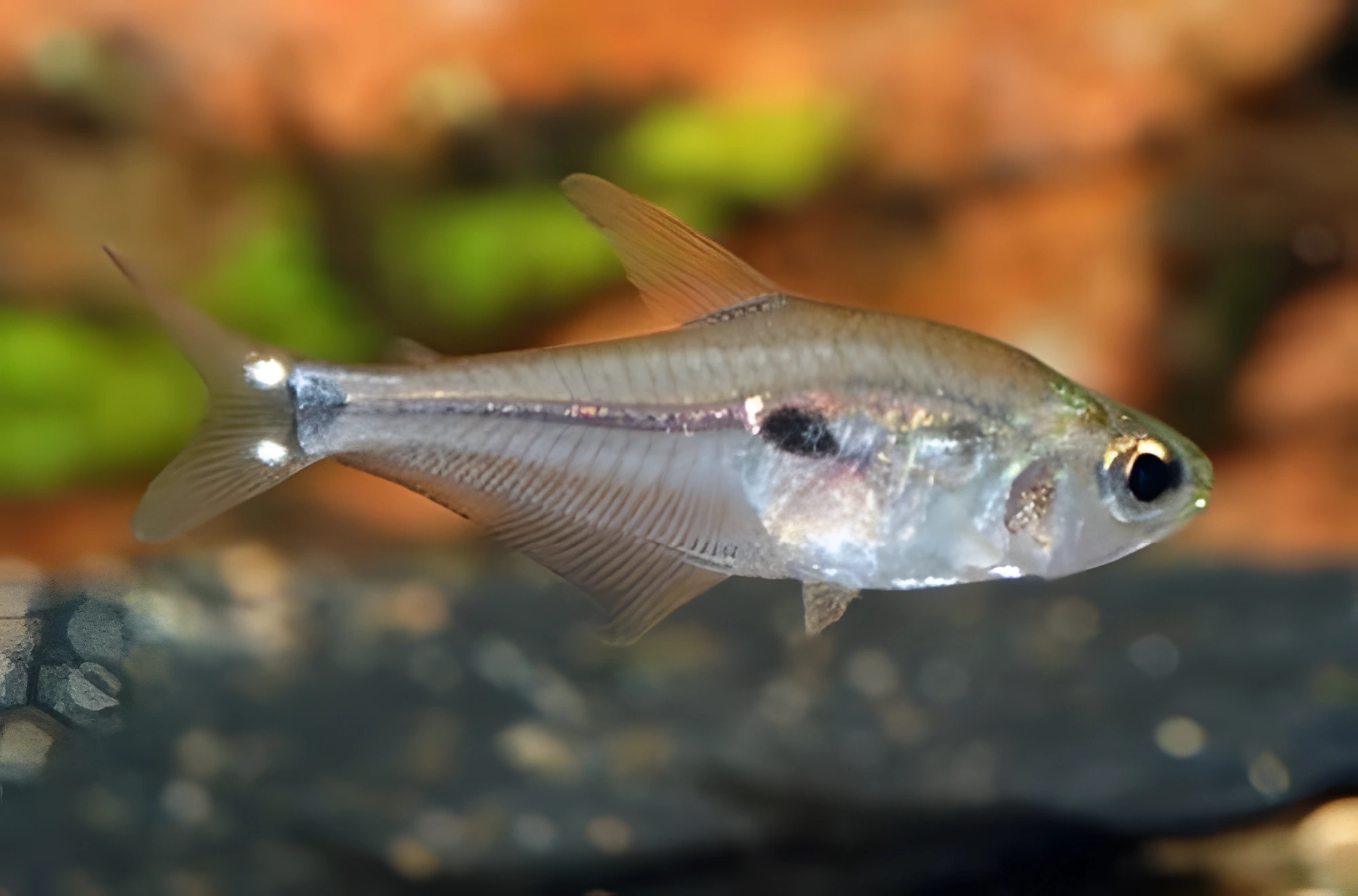
Adults typically reach 3–4 cm in length. Distinguishing males from females is quite difficult, as sexual dimorphism is weakly expressed. Their coloration is predominantly gray, and their body coverings are semi-transparent, sometimes allowing the spine to be seen. A distinctive feature of this species is two black spots: one located in the middle of the body, the other at the base of the caudal fin. These marks resemble eyes in shape and size, which gave the fish its common name “Six-eyed Tetra.” This refers to the fact that there are two such spots on each side, complementing their own pair of eyes.
Habitat
The natural habitat of this fish is in South America, in the Paraná River system and its large tributary, the Paraguay River. It is widespread in Paraguay, as well as in the southwestern regions of Brazil and the northern areas of Argentina. Phenacogaster tegatus prefers to inhabit small, clear streams and tributaries with active currents and abundant aquatic vegetation.
Behavior and Compatibility
This fish is characterized by its peaceful disposition and schooling behavior, so it is recommended to keep a group of at least 8–10 individuals. It gets along well with other non-aggressive species of similar size, such as tetras, danios, rasboras, as well as non-predatory South American cichlids and other peaceful tankmates.
Care and Maintenance
For a small group of 8–10 Phenacogaster tegatus, an aquarium of at least 40 L will be required. Sand substrate is typically used for decoration, along with several pieces of driftwood and groups of aquatic plants, making sure to leave enough open swimming space. Keeping this species usually does not cause significant difficulties. It is important to maintain stable water parameters within acceptable limits of temperature and hydrochemical composition. This is achieved through the use of an effective filtration system and regular maintenance procedures, such as weekly partial water changes, timely removal of organic waste, and prophylactic inspection of equipment.
Diet
Being an omnivorous species, this fish readily accepts a variety of appropriately sized foods in a home aquarium. Its daily diet can include dry foods such as flakes or granules. For complete nutrition and to stimulate vital processes, it is beneficial to add live or frozen invertebrates, such as Artemia, Daphnia, bloodworms, and others.
Breeding and Reproduction
The breeding process of the Six-eyed Tetra is similar to that of most tetra species. During spawning, the fish haphazardly scatter their eggs among aquatic vegetation or directly over the substrate surface. Due to such disorganized scattering, not all eggs are fertilized. Parental instincts are absent in this species: the fish do not care for their offspring and, moreover, may try to eat them at the first opportunity. If successful breeding is the goal, the eggs should be carefully transferred to a separate tank where identical water conditions will be maintained.
Diseases
Cottelata brittani is a hardy and undemanding fish. When suitable keeping conditions are met, health problems usually do not arise. Diseases can appear in cases of injury, contact with already sick fish, or a significant deterioration of habitat parameters (for example, in a dirty aquarium or with poor nutrition). More detailed information on symptoms and treatment methods can be found in the section "Diseases of aquarium fish."
How to choose
When purchasing, choose active individuals that stay in the water column and show no signs of lethargy or apathy. Carefully inspect the fish's body for damage, ulcers, white spots, or film, which may indicate infectious diseases. Healthy fish should have clean fins without signs of erosion and tightly pressed scales. Avoid purchasing individuals from aquariums where dead fish or fish with unnatural behavior are observed. Since the species is schooling, it is recommended to acquire a group of 8–10 individuals at once, as when alone or in small numbers, the fish become timid and susceptible to severe stress, which negatively affects their immunity.
Frequently asked questions
The essentials: size, tank volume, water parameters and care
How big does Six-eyed Tetra get?
An adult reaches 3.5–4 cm in length. Plan the tank around the maximum size: the fish quickly outgrows a cramped setup.
What size aquarium does Six-eyed Tetra need?
The minimum recommended volume is 40 L. A smaller tank speeds up nitrate build-up and raises stress levels.
What water parameters does Six-eyed Tetra need?
Temperature 20–28 °C, pH 6–7.5, hardness 1–12 dGH. Stability matters more than exact values: sudden swings are harder on the fish than a small deviation from the ideal.
How long does Six-eyed Tetra live?
Around 4 years when kept properly. Lifespan depends directly on tank volume, water quality and a varied diet.
Is Six-eyed Tetra aggressive?
Temperament: peaceful (regular). Keep this in mind when choosing tank mates.
How many Six-eyed Tetra should be kept together?
Recommended setup: group (8–10 individuals). Ignoring this is a common cause of stress and disease.
What does Six-eyed Tetra eat?
Diet type: any (universal). Feed small portions that are finished within a couple of minutes — overfeeding does more harm than underfeeding.
What is the scientific name of Six-eyed Tetra?
The scientific name of the species is Phenacogaster tegatus, family Characidae. It also appears in the literature as: Vesicatrus tegatus.