Temperature21 – 26 °C
Natural range
- Southern Borneo area
- Eastern Sumatra area
CyprinidsConservation status: Least concern LC
Other scientific names: Barbus hexazona, Barbus pentazona, Puntius hexazona, Systomus hexazona
The Six-banded Barb, scientifically known as Desmopuntius hexazona, belongs to the family Cyprinidae. This peaceful, energetic, and vibrant fish will perfectly complement the inhabitants of your freshwater aquarium.
- Required aquarium volume
- 80 L
- Size in aquarium
- 5 cm
- Temperature
- 21 – 26 °C
- Temperament
- Peaceful, calm/shy/inactive
Parameters
Water pHAcidic (4) – Neutral (7)
Water dHVery soft (1) – Soft (5)
Water salinityno salt (freshwater)
Size in aquarium5 cm
Lifespan5 years
TemperamentPeaceful, calm/shy/inactive
Toward small fishnot a predator
Required aquarium volume80 L
Lightingdimmed
Substratesoft silted
Water flownone or stagnant (no flow)
FeedingAny (universal)
CareLarge group (10+ individuals)
Description
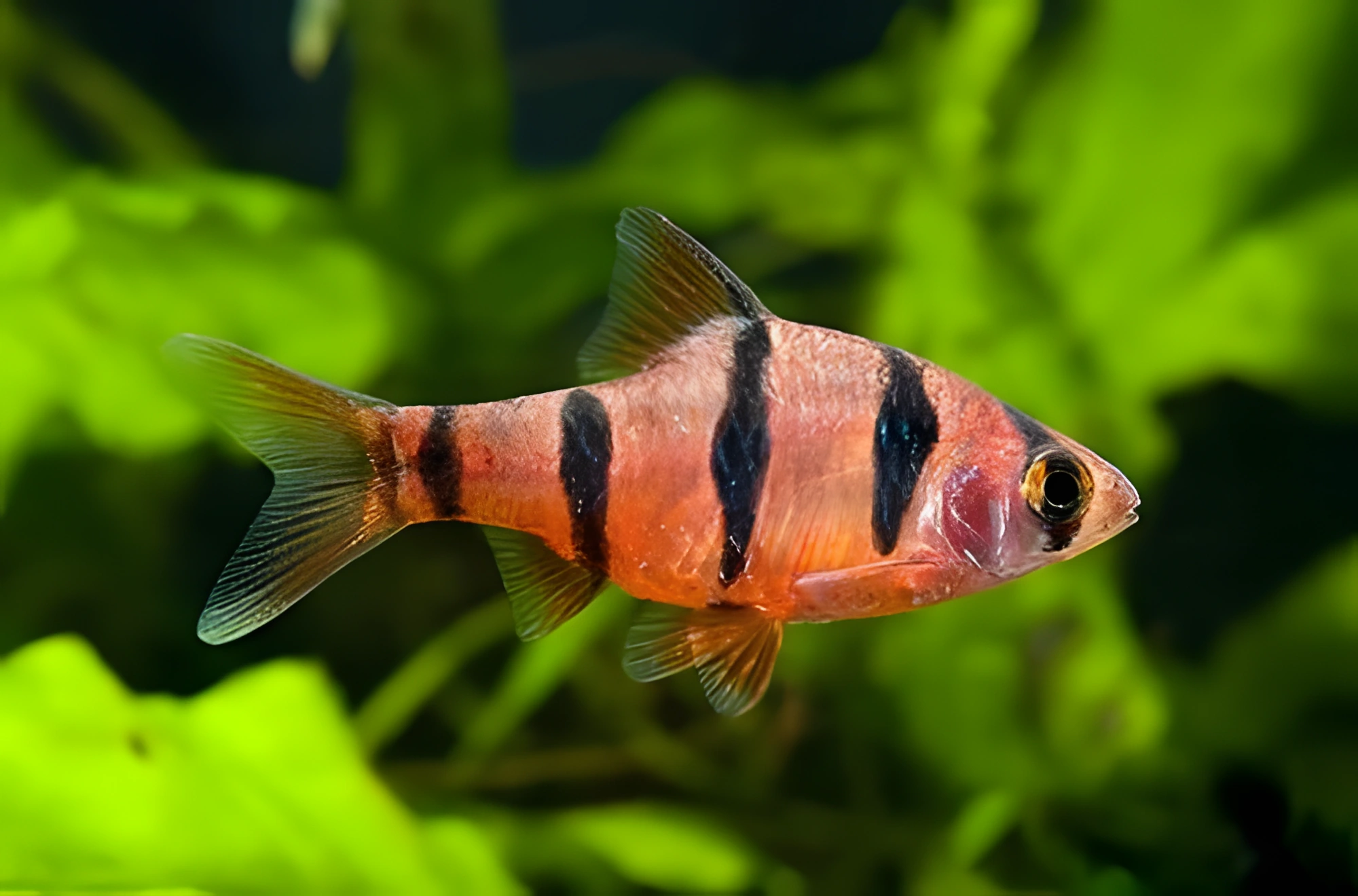
Outwardly, this species is practically indistinguishable from its close relative, the Five-banded Barb. One might assume that the key difference lies in the number of dark stripes, but this is not the case. Both species have the same number of stripes — five distinct ones and a sixth one, located at the base of the tail, which is not always visible. This discrepancy in the number of stripes even led to a slight mishap in their scientific names. The main difference of the Six-banded Barb is the absence of a small black spot on the posterior part of the dorsal fin, which is characteristic of the Five-banded Barb. Adult specimens grow to approximately 5 cm in length. Their coloration is light, with delicate pink, orange, or red iridescence, and the pattern consists of 5–6 vertical dark stripes. Sexual dimorphism is quite weakly expressed; females are usually slightly larger than males, but their coloration is less vibrant.
Habitat
Its natural habitat is Southeast Asia, including the southern part of Borneo, eastern Sumatra, Singapore, and the Malay Peninsula. These fish inhabit peat swamps, where the water is stained dark, even black. This is caused by a high concentration of tannins formed from the decomposition of organic plant material. The water in such places is characterized by an acidic reaction (3.0–4.0 pH) and extremely low carbonate hardness.
Behavior and Compatibility
These active, peaceful fish feel best in large groups, consisting of at least 10 individuals. They get along well with many other aquarium fish of comparable size. However, overly slow or very small fish, as well as those with long flowing fins, should be excluded from the list of potential tank mates. Many barbs are known to nip at the long tails and fins of other fish.
Care and Maintenance
For comfortable keeping of a school of 10 Six-banded Barbs, an aquarium of at least 80 L will be required. Since many generations of these fish have lived in artificial environments, they have adapted well to conditions that may differ from natural bodies of water. Therefore, the importance of aquarium decoration is not critical. However, it is recommended to provide several hiding places for the fish, and to ensure not too bright lighting. For example, floating plants are excellent for creating shade. While the decor remains a matter of the aquarist's personal preference, water parameter requirements must be strictly observed. It is important to prevent the accumulation of organic waste (food remnants, excrement); for this, it is necessary to regularly clean the substrate and perform partial water changes. The hydrochemical composition of the water should be maintained within 4.0–7.0 pH and 1–5 dGH. Keeping these fish in hard alkaline water is strictly not recommended!
Diet
These fish are omnivores. Their daily diet can well include common dry foods. To ensure complete nutrition, it is advisable to periodically add live or frozen foods to their menu, such as Artemia, bloodworms, or Daphnia.
Breeding and Reproduction
Under favorable conditions, these fish successfully breed even in a community tank. However, in such a case, there is a high probability of eggs and newly hatched fry being eaten. For targeted breeding of Six-banded Barbs, they should be moved to a separate tank. The bottom of the spawning tank is best covered with a special substrate that will protect the eggs from being eaten. This can be a layer of large pebbles, decorative marbles, a fine-mesh net, or dense thickets of small-leaved, low-growing plants. After spawning, the parents are returned to the main aquarium.
Diseases
Balanced nutrition and properly selected keeping conditions are the best prevention of diseases in freshwater fish. If the first signs of illness appear, such as changes in coloration or behavior, the first step should be to check the water parameters and quality. If necessary, all values should be brought back to normal, and only then should treatment begin. More detailed information on symptoms and treatment methods can be found in the "Diseases of Aquarium Fish" section.
How to choose
When choosing Six-banded Barbs, preference should be given to active individuals with clean fins and no visible skin damage. Avoid purchasing fish with signs of emaciation, sunken bellies, or unnatural behavior, such as constantly hovering near the water surface or attempting to rub against decorations. It is important to remember that this species is often confused with the Five-banded Barb, so for accurate identification, check for the absence of a black spot at the base of the dorsal fin. Given the schooling nature of the fish, it is recommended to acquire a group of 6–10 individuals simultaneously to reduce stress during transfer to a new aquarium. Before purchasing, ensure that the keeping conditions in the store meet the species' requirements, as fish kept in hard, alkaline water for a long time may have weakened immune systems.
Frequently asked questions
The essentials: size, tank volume, water parameters and care
How big does Six-banded Barb get?
An adult reaches 5 cm in length. Plan the tank around the maximum size: the fish quickly outgrows a cramped setup.
What size aquarium does Six-banded Barb need?
The minimum recommended volume is 80 L. A smaller tank speeds up nitrate build-up and raises stress levels.
What water parameters does Six-banded Barb need?
Temperature 21–26 °C, pH 4–7, hardness 1–5 dGH. Stability matters more than exact values: sudden swings are harder on the fish than a small deviation from the ideal.
How long does Six-banded Barb live?
Around 5 years when kept properly. Lifespan depends directly on tank volume, water quality and a varied diet.
Is Six-banded Barb aggressive?
Temperament: peaceful, calm/shy/inactive. Keep this in mind when choosing tank mates.
How many Six-banded Barb should be kept together?
Recommended setup: large group (10+ individuals). Ignoring this is a common cause of stress and disease.
What does Six-banded Barb eat?
Diet type: any (universal). Feed small portions that are finished within a couple of minutes — overfeeding does more harm than underfeeding.
What is the scientific name of Six-banded Barb?
The scientific name of the species is Desmopuntius hexazona, family Cyprinids (Cyprinidae). It also appears in the literature as: Barbus hexazona, Barbus pentazona, Puntius hexazona.