Temperature22 – 28 °C
Natural range
- Guyana area
CatfishConservation status: Least concern LC
Other scientific names: Tatia reticulata
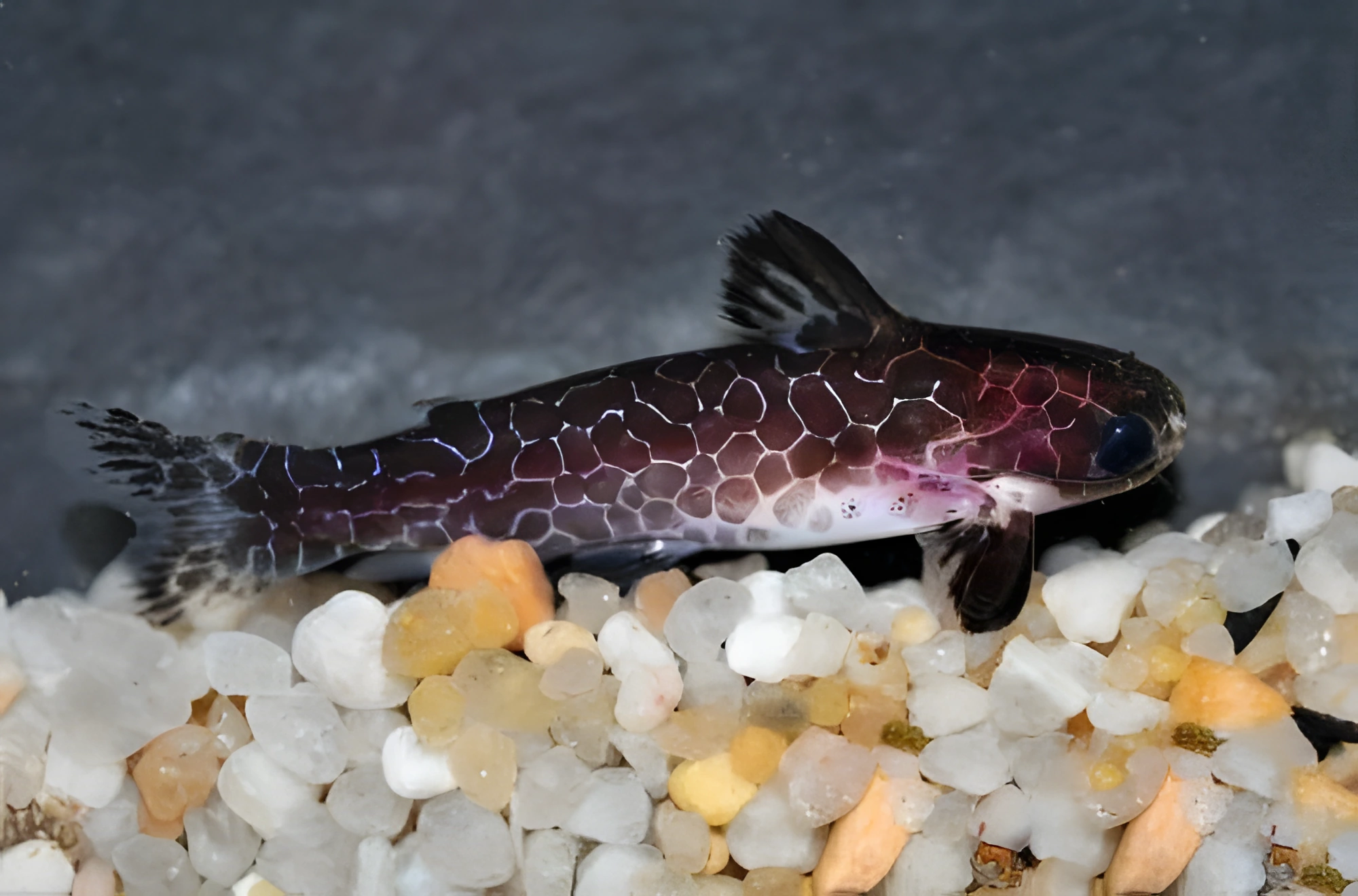
Centromochlus reticulatus, more commonly known as the Reticulated Woodcat or Purple Oil Catfish, belongs to the family Auchenipteridae (Driftwood Catfishes). This species is notable for its ease of care and breeding, as well as its compatibility with many freshwater fish. Thanks to these qualities and its unique coloration, it is an excellent choice for beginner aquarists.
- Required aquarium volume
- 200 L
- Size in aquarium
- 7 – 8 cm
- Temperature
- 22 – 28 °C
- Temperament
- Peaceful (regular)
Parameters
Water pHSlightly acidic (5) – Neutral (7.5)
Water dHVery soft (2) – Hard (12)
Water salinityno salt (freshwater)
Size in aquarium7 – 8 cm
Lifespan5 years
TemperamentPeaceful (regular)
Toward small fishnot a predator
Required aquarium volume200 L
Lightingdimmed
Substraterocky (rock formations, boulders, etc.)
Water flowweak
FeedingAny (universal)
CareGroup (8–10 individuals)
Description
Adults reach a length of about 7–8 cm. The catfish's body is torpedo-shaped, and their short fins have first rays modified into sharp spines, which explains the name "woodcat." The fish's coloration consists of large dark-burgundy spots separated by white veins, and the belly has a silvery hue. Sexual dimorphism is weakly expressed in this species, and males are practically indistinguishable from females by eye. Another name, "Purple Oil Catfish," also reflects its appearance, as the coloration and pattern resemble oil slicks on the water surface.
Habitat
Its natural habitat is in South America, specifically in Guyana. The catfish inhabits the Rupununi River basin, a tributary of the Essequibo. Despite the lack of precise data, its range is presumably much wider. It prefers sections of rivers with slow currents, where there are many natural shelters, such as submerged trees and roots. In nature, this catfish is nocturnal, finding refuge among snags during daylight hours.
Behavior and Compatibility
This is a peaceful and calm species that gets along well with other small, non-aggressive fish. It is quite social, so it is recommended to keep them in groups of at least 8 individuals.
Care and Maintenance
For a group of 7–8 individuals, an aquarium of 200 liters or more is recommended. The aquarium's design can be varied, but it is important to provide enough shelters or shady spots—one for each catfish—using snags, decorative elements, or dense plant thickets. Although activity is nocturnal in nature, after acclimatization, the fish often appear during the day, so specialized "night" lighting is not mandatory. Keeping the Reticulated Woodcat is not difficult if an adequate environment is provided. It is critically important to maintain stable water parameters: temperature and hydrochemical indicators within acceptable limits. This requires an appropriate set of equipment and regular aquarium maintenance procedures.
Diet
This species is omnivorous and readily accepts most common foods in an aquarium environment. Unlike some other catfish, it can feed not only at the bottom but also actively collect food in the water column or near the surface.
Breeding and Reproduction
Breeding these catfish in a home aquarium is quite feasible. Members of the Driftwood Catfish family, to which this species belongs, use a peculiar breeding strategy—internal fertilization. The female can store the male's sperm along with unfertilized eggs inside her for a long time. Fertilization and subsequent spawning occur only when external conditions become maximally favorable. These fish lack parental instincts; the female abandons the clutch immediately after spawning.
Diseases
Most health problems in fish often arise from unsuitable keeping conditions. Maintaining a stable and comfortable habitat is a key factor for successful keeping. If symptoms of illness appear, the first step is to check the water quality. If deviations are found, it is important to take immediate measures to eliminate them. If the symptoms do not disappear or worsen, medicinal treatment may be required. More detailed information on symptoms and treatment methods can be found in the "Diseases of Aquarium Fish" section.
How to choose
When selecting individuals, pay attention to their activity in the evening, as the species is predominantly nocturnal. Healthy fish should have clean skin without whitish film, sores, or damage, and tightly pressed fins without signs of erosion. Avoid specimens with sunken bellies or unnaturally bloated abdomens, which may indicate emaciation or internal diseases. Since this is a schooling species, it is recommended to purchase a group of 8 or more individuals to reduce stress levels during adaptation to new conditions. Given the secretive nature of catfish, it is best to choose fish in the store that show interest in the offered food and do not exhibit signs of lethargy or apathy.
Frequently asked questions
The essentials: size, tank volume, water parameters and care
How big does Reticulated Woodcat get?
An adult reaches 7–8 cm in length. Plan the tank around the maximum size: the fish quickly outgrows a cramped setup.
What size aquarium does Reticulated Woodcat need?
The minimum recommended volume is 200 L. A smaller tank speeds up nitrate build-up and raises stress levels.
What water parameters does Reticulated Woodcat need?
Temperature 22–28 °C, pH 5–7.5, hardness 2–12 dGH. Stability matters more than exact values: sudden swings are harder on the fish than a small deviation from the ideal.
How long does Reticulated Woodcat live?
Around 5 years when kept properly. Lifespan depends directly on tank volume, water quality and a varied diet.
Is Reticulated Woodcat aggressive?
Temperament: peaceful (regular). Keep this in mind when choosing tank mates.
How many Reticulated Woodcat should be kept together?
Recommended setup: group (8–10 individuals). Ignoring this is a common cause of stress and disease.
What does Reticulated Woodcat eat?
Diet type: any (universal). Feed small portions that are finished within a couple of minutes — overfeeding does more harm than underfeeding.
What is the scientific name of Reticulated Woodcat?
The scientific name of the species is Centromochlus reticulatus, family Driftwood Catfishes (Auchenipteridae). It also appears in the literature as: Tatia reticulata.