Temperature22 – 28 °C
Natural range
- Amazon Basin
- Guyana area
- Suriname area
- French Guiana area
Predators CharacinsConservation status: Least concern LC
Other scientific names: Salmo falcatus, Salmo pulverulentus, Xiphorhamphus ferox
The Sickle Barracuda, scientifically known as Acestrorhynchus falcatus, belongs to the family Acestrorhynchidae. This fish earned the name "barracuda" due to its external resemblance to marine barracudas, although there is no relatedness between them. It is not difficult to care for, making it suitable even for beginner aquarists. Nevertheless, it is best to entrust the setup and initial launch of an aquarium for it to experienced specialists.
- Required aquarium volume
- 250 L
- Size in aquarium
- 25 – 27 cm
- Temperature
- 22 – 28 °C
- Temperament
- Semi-peaceful (including aggression during spawning / intraspecific conflicts)
Parameters
Water pHSlightly acidic (6) – Neutral (7.5)
Water dHVery soft (2) – Hard (12)
Water salinityno salt (freshwater)
Size in aquarium25 – 27 cm
Lifespan8 years
TemperamentSemi-peaceful (including aggression during spawning / intraspecific conflicts)
Toward small fishpredator
Required aquarium volume250 L
Lightingdimmed
Substrateany (no restrictions)
Water flowweak or moderate
FeedingFor carnivores (live fish, insects, etc.)
CareBoth solitary and in group (flexible)
Description
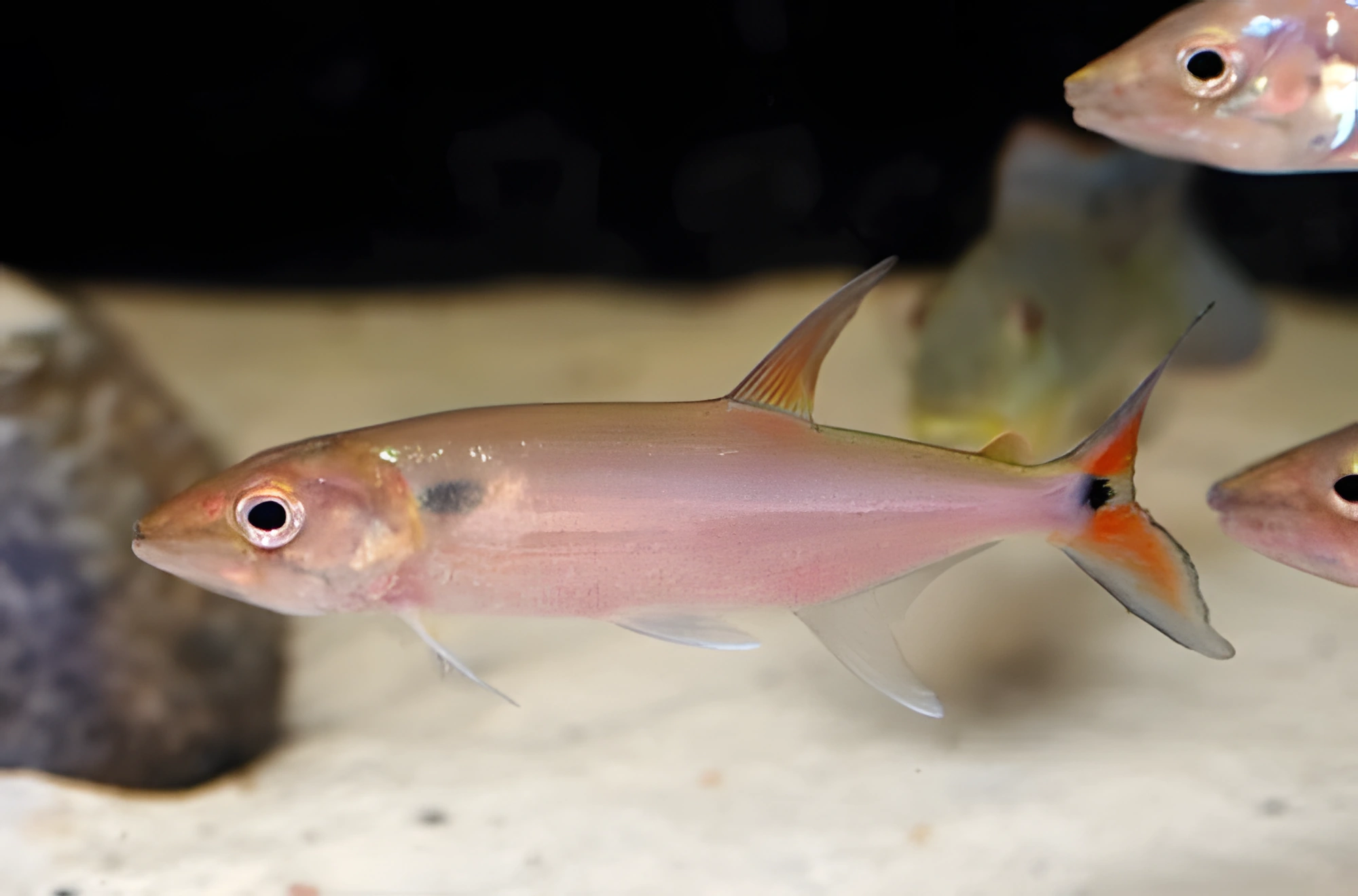
These fish reach quite impressive sizes: adults can grow up to 25–27 cm in length. Sexual dimorphism is weakly expressed; males are almost indistinguishable from females, although the latter may be slightly larger. They are often confused with the Red-tailed Barracuda, a close relative, and sold under the same name. The main difference of Acestrorhynchus falcatus lies in the shape of its tail, which resembles a sickle, as reflected in the species' name. Otherwise, they are very similar. Their body is elongated, and their fins are pointed and shifted closer to the tail. The coloration ranges from pinkish to silvery. The caudal fin is red, with a distinct black spot at the base. The fish's upper jaw has a characteristic hook-like shape, and its mouth is studded with numerous sharp teeth.
Habitat
This species originates from South America and is widely distributed in the northern regions of the Amazon, including territories of Guyana, Suriname, French Guiana, as well as the northern parts of Brazil and Peru. The natural habitat of the Sickle Barracuda consists of river channels and their tributaries, where the water acquires a characteristic brown tint due to the high content of tannins and other humic substances. These substances are actively released from plant debris such as branches, leaves, and fruits, which are abundant in tropical forests.
Behavior and Compatibility
Despite its predatory nature, this species is relatively peaceful. The fish are safe for large, similarly sized fish, as well as for well-protected catfish species. Intraspecific conflicts have not been observed, so they can be kept either individually or in a group. However, cohabitation of fish of different sizes should be avoided, as cannibalism is possible. They are incompatible with aggressive, territorial, and small aquarium inhabitants.
Care and Maintenance
When acquiring such a predatory fish, especially if you are not a professional aquarist, it is advisable to entrust the setup and initial launch of the aquarium to specialists. The minimum aquarium volume for comfortable keeping of one adult specimen starts from 250 liters. A reliable lid is extremely important to prevent accidental jumping out. Since this fish prefers open space, the aquarium decor should be minimalistic. Tall decorative elements are best placed along the walls. The presence of plants is desirable, but it is important to ensure they do not overgrow, leaving ample open swimming space. Water quality is crucial for successful keeping. An effective filtration system combined with regular partial water changes will help prevent the accumulation of organic waste and sharp increases in concentrations of dangerous compounds such as nitrites and nitrates. To create the brownish tint characteristic of their natural habitat, you can use Indian almond leaf extract or place the leaves or bark of this tree directly in the aquarium. During decomposition, they release tannins, giving the water a tea-like hue.
Diet
This species is a true predator. Sickle Barracuda specimens caught in the wild may initially refuse any food other than live fish when in an aquarium. However, such specimens are rarely found outside North and South America. In European trade, fish raised in artificial conditions are usually available. These specimens are adapted to accept fresh or even dried pieces of fish. It is strictly forbidden to feed them products of animal or avian origin.
Breeding and Reproduction
Breeding Acestrorhynchus falcatus in home aquariums, while possible, is extremely rare. Breeding is usually done for commercial purposes in specialized fish farms or by experienced professional aquarists.
Diseases
Like most predators, the Sickle Barracuda is characterized by its hardiness and unpretentiousness. The main cause of most diseases is usually unsuitable keeping conditions. Therefore, if the fish's behavior or coloration has changed, or if redness or ulcers appear on its body, it is first recommended to check the quality and chemical composition of the water, and to ensure there is no excess concentration of dangerous substances. Upon detecting any deviations from the norm, these problems should be addressed first, and only then should diagnosis and treatment begin. In many cases, restoring optimal water parameters leads to the fish's self-recovery. More detailed information on symptoms and treatment methods can be found in the "Aquarium Fish Diseases" section.
How to choose
When purchasing, choose active specimens with clean fins and no skin damage. Due to their high sensitivity to stress and tendency to injure themselves when startled, any signs of wounds or abrasions on the head and body are critical, as they quickly become infected with fungal diseases. It is important to visually check for parasitic infestations, as the species is susceptible to invasions.
- avoid specimens that appear lethargic or show signs of emaciation
- prefer specimens of comparable size if acquiring a group to avoid cannibalism
- ask the seller if the fish is accustomed to non-live foods, as transitioning them can be difficult
Frequently asked questions
The essentials: size, tank volume, water parameters and care
How big does Sickle Barracuda get?
An adult reaches 25–27 cm in length. Plan the tank around the maximum size: the fish quickly outgrows a cramped setup.
What size aquarium does Sickle Barracuda need?
The minimum recommended volume is 250 L. A smaller tank speeds up nitrate build-up and raises stress levels.
What water parameters does Sickle Barracuda need?
Temperature 22–28 °C, pH 6–7.5, hardness 2–12 dGH. Stability matters more than exact values: sudden swings are harder on the fish than a small deviation from the ideal.
How long does Sickle Barracuda live?
Around 8 years when kept properly. Lifespan depends directly on tank volume, water quality and a varied diet.
Is Sickle Barracuda aggressive?
Temperament: semi-peaceful (including aggression during spawning / intraspecific conflicts). This is a predatory species — any fish small enough to fit in its mouth will eventually be eaten.
How many Sickle Barracuda should be kept together?
Recommended setup: both solitary and in group (flexible). Ignoring this is a common cause of stress and disease.
What does Sickle Barracuda eat?
Diet type: for carnivores (live fish, insects, etc.). Feed small portions that are finished within a couple of minutes — overfeeding does more harm than underfeeding.
What is the scientific name of Sickle Barracuda?
The scientific name of the species is Acestrorhynchus falcatus, family Acestrorhynchidae. It also appears in the literature as: Salmo falcatus, Salmo pulverulentus, Xiphorhamphus ferox.