Temperature21 – 26 °C
Natural range
- Caribbean Sea area
- Mexico area
- Colombia area
- Ecuador area
CatfishConservation status: Least concern LC
Other scientific names: Ariopsis simonsi, Arius jordani, Arius seemanni, Galeichthys eigenmanni, Galeichthys gilberti, Galeichthys jordani
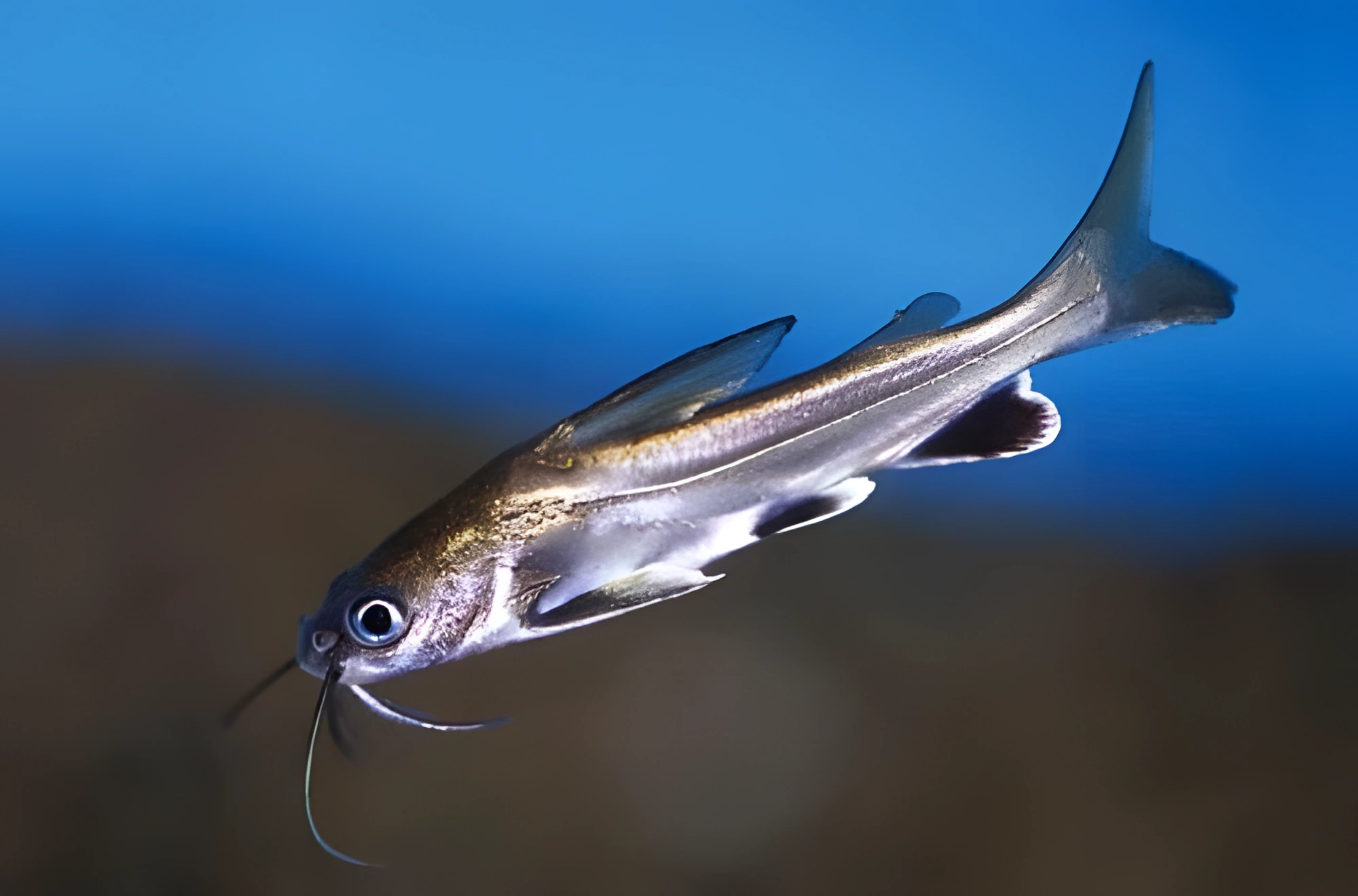
The Colombian shark catfish, also known as the silver shark, bears the scientific name Ariopsis seemanni and belongs to the family Ariidae. This species earned its name due to its unique appearance, resembling a miniature shark, although for aquarium conditions, the fish is quite large. A distinctive feature of this catfish is not only its appearance but also the sounds it emits. Scientists suggest that these sounds serve as a means of communication between individuals in murky water, helping them maintain the school, similar to dolphin echolocation, and this navigation method surpasses vision and the lateral line in effectiveness. Another distinguishing characteristic of this fish is the venomous rays of its dorsal fin. Although the venom is not lethal, it can cause painful sensations comparable to a bee sting.
- Required aquarium volume
- 280 L
- Size in aquarium
- 35 cm
- Temperature
- 21 – 26 °C
- Temperament
- Semi-peaceful (dangerous to smaller ones)
Parameters
Water pHNeutral (6.5) – Slightly alkaline (8)
Water dHMedium hardness (8) – Very hard (30)
Water salinityincreased (10–15 g/L)
Size in aquarium35 cm
Lifespan15 years
TemperamentSemi-peaceful (dangerous to smaller ones)
Toward small fishnot a predator
Required aquarium volume280 L
Lightingany
Substratecoarse sand / gravel / pebbles
Water flowmoderate or strong
FeedingHigh protein (predominantly meat)
CareSmall group (3–4 individuals)
Description
Outwardly, the catfish strongly resembles a real shark, both in its appearance and its manner of movement; only the presence of barbels clearly indicates its belonging to the order Siluriformes. Young individuals are characterized by a silvery-gray coloration with a white belly, while the back and caudal fin have a darker shade. With age, the coloration of adult fish becomes duller, but they still attract attention. Its sharp dorsal fin is located close to the head and contains a venomous spine, serving as protection against predators. The anal fin is quite long, numbering from 26 to 46 rays. The fins are dark-colored with a white edge. The fish reaches large sizes, up to 35 cm, but despite this, it looks graceful.
Habitat
The Silver Shark was first described by the explorer Carl Günther in 1864 as part of an expedition to Central and South America. This catfish is widespread in river deltas, especially those flowing into the Caribbean Sea. It can be found in countries such as Mexico, Guatemala, El Salvador, Nicaragua, Costa Rica, Colombia, Ecuador, and Peru. During spawning, these fish migrate upstream in rivers, where the fry subsequently appear.
Behavior and Compatibility
The Colombian shark catfish prefers to live in a school, so for comfortable existence, it is necessary to keep a group of at least three individuals. When alone, these fish often become timid and anxious. Unlike many other catfishes, they are not prone to territorial behavior. Towards fish of similar size, the catfish exhibits peaceful behavior. However, smaller aquarium inhabitants may be perceived as prey.
Care and Maintenance
Given the schooling lifestyle and impressive size of this fish, an aquarium of at least 280 L will be required for its keeping. It is noteworthy that the catfish reaches its maximum size in just two years. It is very important to provide sufficient free swimming space. The aquarium decor should ideally resemble its natural habitat as much as possible, for example, using mangroves, driftwood, and intertwined roots. For plants, species with a strong root system capable of growing well in brackish water are preferred. To prevent possible injury to the catfish's sensitive barbels, coarse sand or fine smooth gravel is recommended as a substrate. This fish requires a high oxygen content, so it is necessary to ensure an enhanced aeration system and use combined filters capable of diffusing air. Care should also be taken to create water movement in the aquarium. If the catfish constantly stays near the filters, where water is discharged, this may indicate insufficient current. As a rule, productive filters and an effective aeration system successfully solve this problem, creating the necessary water flows. Water should be hard and brackish. It is recommended to change about 30% of the total volume weekly. Marine salt is used to prepare brackish water. Adult individuals require a salt concentration of 10 grams per 1 liter of water, while for juveniles, 2 grams per 1 liter is sufficient. It is important to remember that when maintaining the aquarium, gloves must be worn, as there is a risk of accidental injury from the venomous spine. In people prone to allergic reactions, such injuries can lead to serious complications.
Diet
In its natural habitat, the Silver Shark preys on small fish, insects, and crustaceans. Although it is classified as an omnivorous species, an exclusively plant-based diet will quickly lead to the fish's demise. Meaty foods should form the basis of its diet, and other non-meaty products should be offered as supplements. The catfish uses its barbels, covered with sensitive receptors, to search for food. These receptors respond to electrical fields produced by moving fish, allowing them to detect prey even in the substrate. In aquarium conditions, the catfish will readily consume earthworms, mussels, shrimp, strips of octopus or fish, as well as any types of sinking commercial foods such as pellets, tablets, or flakes.
Breeding and Reproduction
Distinguishing between male and female by external signs is difficult even for experienced specialists, as there are no obvious differences between them. In home aquariums, breeding of this species does not occur, primarily due to the impossibility of recreating natural conditions. In the wild, catfishes mate in brackish water, after which the male incubates the fertilized eggs in his mouth throughout the incubation period. By the time the fry hatch, he moves upstream in the river and releases them into fresh water, where they develop into adults.
Diseases
Most often, disease outbreaks in this species are associated with improper keeping conditions, both regarding the hydrochemical composition of the water and the aquarium setup. Diseases in home aquariums are not uncommon. Detailed information on diseases can be found in the "Aquarium Fish Diseases" section.
How to choose
When purchasing, avoid individuals with damaged fins, cloudy eyes, or a coating on the body, as the fish is sensitive to water quality and stress. It is important to remember that Ariopsis seemanni is a large species requiring specific keeping conditions, so do not acquire juveniles if it is not possible to provide them with an aquarium of 280-470 L and a gradual transition to brackish or marine water. In the store, the fish should appear active and show interest in food. Extreme caution must be exercised during transportation and transfer, as young individuals already have developed venomous spines on their dorsal fin, contact with which causes painful sensations.
Frequently asked questions
The essentials: size, tank volume, water parameters and care
How big does Silver Shark get?
An adult reaches 35 cm in length. Plan the tank around the maximum size: the fish quickly outgrows a cramped setup.
What size aquarium does Silver Shark need?
The minimum recommended volume is 280 L. A smaller tank speeds up nitrate build-up and raises stress levels.
What water parameters does Silver Shark need?
Temperature 21–26 °C, pH 6.5–8, hardness 8–30 dGH. Stability matters more than exact values: sudden swings are harder on the fish than a small deviation from the ideal.
How long does Silver Shark live?
Around 15 years when kept properly. Lifespan depends directly on tank volume, water quality and a varied diet.
Is Silver Shark aggressive?
Temperament: semi-peaceful (dangerous to smaller ones). Keep this in mind when choosing tank mates.
How many Silver Shark should be kept together?
Recommended setup: small group (3–4 individuals). Ignoring this is a common cause of stress and disease.
What does Silver Shark eat?
Diet type: high protein (predominantly meat). Feed small portions that are finished within a couple of minutes — overfeeding does more harm than underfeeding.
What is the scientific name of Silver Shark?
The scientific name of the species is Ariopsis seemanni, family Ariidae. It also appears in the literature as: Ariopsis simonsi, Arius jordani, Arius seemanni.