Temperature20 – 25 °C
Natural range
- Venezuela area
KillifishConservation status: Least concern LC
Other scientific names: Austrofundulus dolichopterus
The Saberfin, scientifically known as Terranatos dolichopterus, belongs to the Rivulidae family. This species is the sole representative of the genus Terranatos, whose name is derived from Latin: "Terra" meaning "earth" and "natos" meaning "birth."
- Required aquarium volume
- 20 L
- Size in aquarium
- 3 – 4 cm
- Temperature
- 20 – 25 °C
- Temperament
- Peaceful (regular)
Parameters
Water pHSlightly acidic (6) – Neutral (6.5)
Water dHSoft (4) – Soft (6)
Water salinityno salt (freshwater)
Size in aquarium3 – 4 cm
Lifespan1 years
TemperamentPeaceful (regular)
Toward small fishnot a predator
Required aquarium volume20 L
Lightingdimmed
Substratesoft sandy (including silted)
Water flowweak or moderate
FeedingMeat / protein (live, frozen, fresh)
CareHarem (1 male and several females)
Description
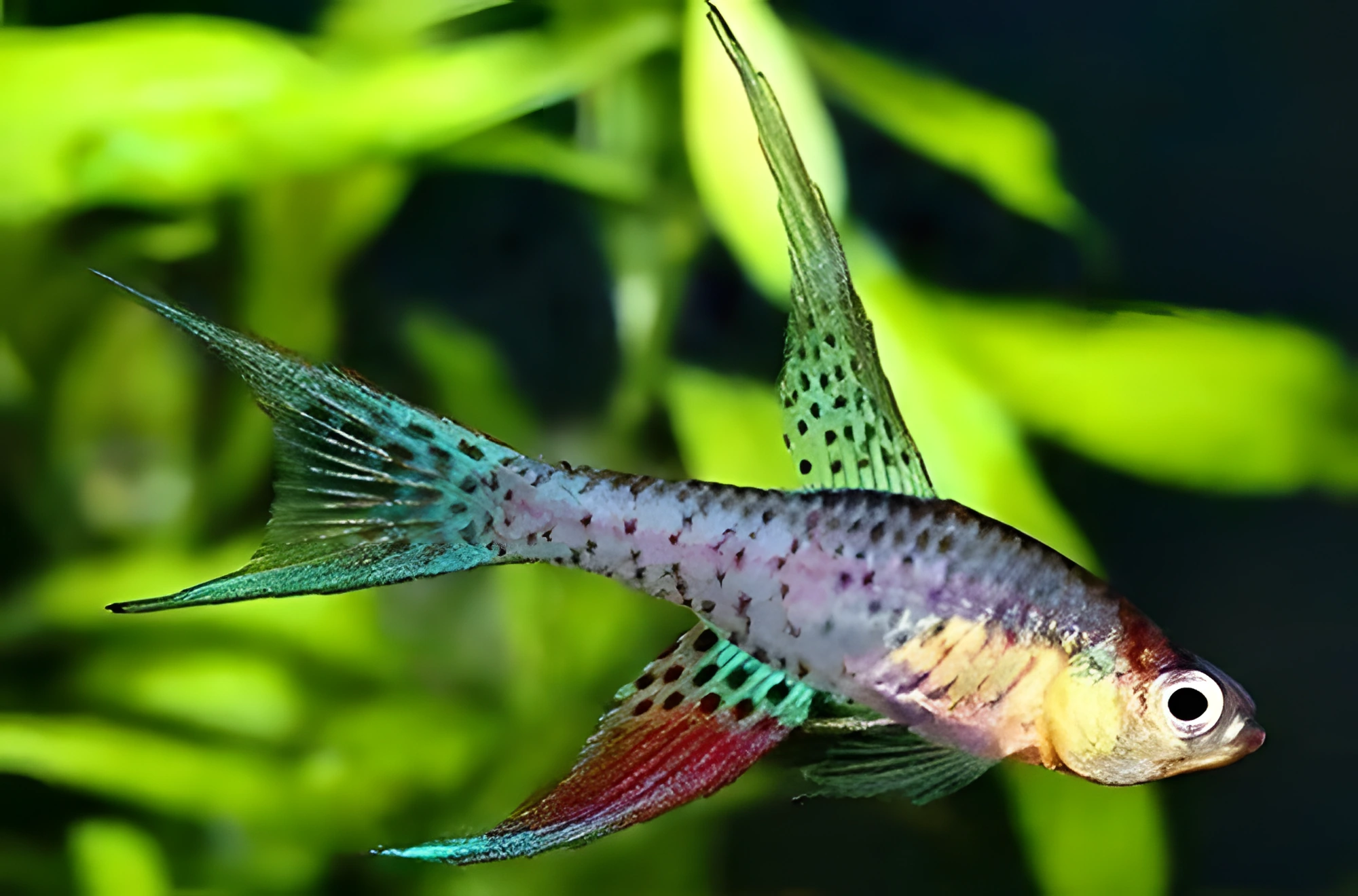
Adults reach a maximum length of 4 cm. This species exhibits pronounced sexual dimorphism. Males have a more graceful body structure and are distinguished by vibrant coloration, including purple, reddish, and orange hues. Their main distinguishing feature is their high, pointed, turquoise dorsal and anal fins, resembling wings, as well as elongated edges of the caudal fin. Females, in contrast, are more modest: their coloration, fin shape, and size are less pronounced.
Habitat
These fish originate from South America. They can be found in Venezuela, in the Orinoco River basin, where they prefer to inhabit temporary floodplain lakes and swamps that form after river overflows.
Behavior and Compatibility
These fish behave amicably towards their conspecifics, especially if kept in a group where there are 2–3 females per male. A shortage of females or an excess of males inevitably leads to intense competition, which can result in injuries. Co-housing with active, territorial, or aggressive species should be avoided. The optimal solution is to set up a species-specific aquarium.
Care and Maintenance
In nature, Saberfins are often found in small, drying water bodies, which makes them undemanding regarding aquarium volume. A 20 L tank may be sufficient for a single pair. For aquarium decor, it is recommended to use dark, soft substrate covered with a layer of fallen leaves and snags. It is also important to provide an abundance of aquatic plants, including floating ones, which effectively create shade. Keeping these fish is considered challenging even for experienced aquarists. Saberfins are often acquired at the larval stage or even as eggs packaged in dry peat briquettes. Residents of their natural habitats may catch wild specimens. In all cases, long-term acclimatization is not possible, so it is critically important to provide Saberfins with conditions as similar as possible to their natural habitat: soft, acidic water with a high tannin content and a temperature range of 20–25°C. For the same reason, these fish do not always adapt to alternative foods, such as dry foods, and require exclusively live foods. It is advisable to clarify the specific keeping and feeding requirements with suppliers.
Diet
In nature, they feed on small invertebrates. In aquarium conditions, they accept only live foods such as daphnia, cyclops, or artemia. Dry commercial foods are usually ignored, so to maintain the fish's health, regular access to high-quality live cultures must be ensured.
Breeding and Reproduction
This is a seasonal species, whose spawning in nature coincides with the rainy season. For breeding in an aquarium, a spawning tank with a soft peat substrate at the bottom is used. The eggs are laid in the peat, after which the substrate is removed, slightly dried, and stored in a sealed container for 4 to 10 months, depending on the temperature. Embryo incubation is completed after the peat is flooded with soft water, after which fry hatch and are fed with infusoria and artemia nauplii.
Diseases
Fish are sensitive to water quality and sudden changes in its chemical parameters, which can lead to stress and reduced immunity. If keeping conditions are not met, they are prone to fungal infections and bacterial diseases. Prevention includes maintaining stable environmental parameters, regular water changes, and strict adherence to the temperature regime.
How to choose
When purchasing, select active specimens with clean fins and no visible skin damage. It is important to ensure that the fish show interest in the live food offered. Due to their short life cycle and specific keeping requirements, it is recommended to acquire young specimens, avoiding fish with signs of emaciation or sluggish behavior.
Frequently asked questions
The essentials: size, tank volume, water parameters and care
How big does Saberfin get?
An adult reaches 3–4 cm in length. Plan the tank around the maximum size: the fish quickly outgrows a cramped setup.
What size aquarium does Saberfin need?
The minimum recommended volume is 20 L. A smaller tank speeds up nitrate build-up and raises stress levels.
What water parameters does Saberfin need?
Temperature 20–25 °C, pH 6–6.5, hardness 4–6 dGH. Stability matters more than exact values: sudden swings are harder on the fish than a small deviation from the ideal.
How long does Saberfin live?
Around 1 years when kept properly. Lifespan depends directly on tank volume, water quality and a varied diet.
Is Saberfin aggressive?
Temperament: peaceful (regular). Keep this in mind when choosing tank mates.
How many Saberfin should be kept together?
Recommended setup: harem (1 male and several females). Ignoring this is a common cause of stress and disease.
What does Saberfin eat?
Diet type: meat / protein (live, frozen, fresh). Feed small portions that are finished within a couple of minutes — overfeeding does more harm than underfeeding.
What is the scientific name of Saberfin?
The scientific name of the species is Terranatos dolichopterus, family Rivulidae. It also appears in the literature as: Austrofundulus dolichopterus.